Automated Revenue Waterfall Reports From Billing System Data
Billing data accuracy determines whether every waterfall number downstream is right or wrong.
The revenue waterfall tells finance whether a dollar promised in a contract has actually turned into a dollar the company can put on its income statement. That chain only works if the billing platform captures exactly what was consumed and when. As pricing shifts toward usage-based and hybrid models, that requirement stops being a nice-to-have and becomes the whole game: get the billing data wrong, and every stage downstream, deferred revenue, recognized revenue, the audit trail, inherits the error.
What the revenue waterfall is actually measuring and why the data source matters
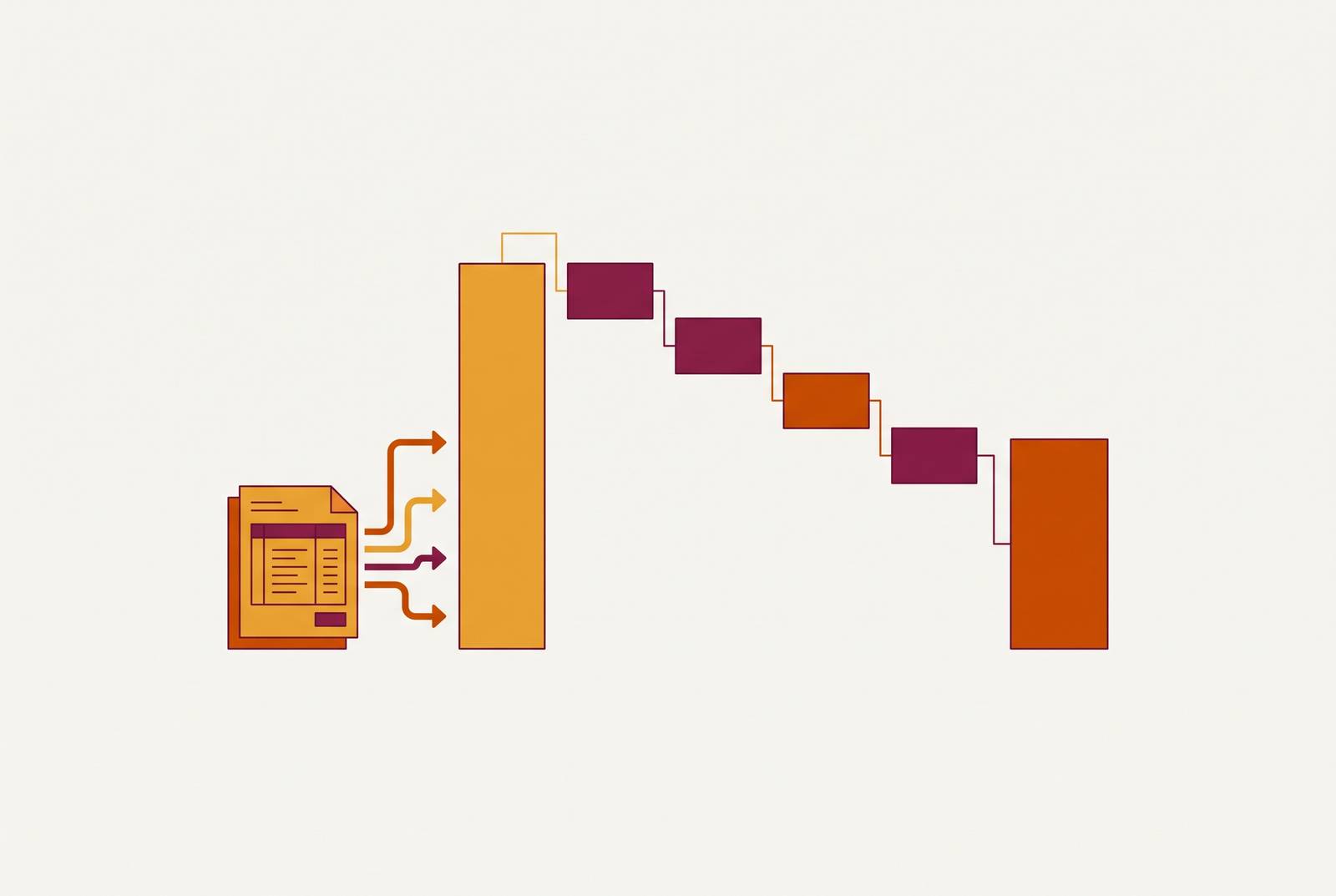
The waterfall runs in four stages, and each one leans on the one before it. Bookings mark the total contract value at signature, the ceiling everything else works down from. Billings are the invoices actually sent out, the moment the company claims cash it's owed. In a usage model, that amount isn't fixed at signing; it's set by what got metered, sometimes weeks after the contract was signed. Deferred revenue is cash collected but not yet earned, sitting on the balance sheet as a liability until the service gets delivered. Recognized revenue is the piece earned in the period, the number that lands on the income statement and the number auditors comb through line by line.
The trouble is where each piece lives. The contract sits in a CRM. The invoice lives in a billing tool. Recognition logic often lives somewhere else entirely: a spreadsheet, a finance team's homegrown model. Research from TABS backs this up directly, finding that most finance teams struggle with the waterfall because its four components sit in systems that were never built to talk to each other.
For a subscription business, that gap is manageable. Amounts are fixed, periods are predictable, and a scheduled export into a spreadsheet bridges the distance well enough. Usage-based billing removes that cushion, full stop. And here's what most finance teams still get wrong: they treat the billing system as just another input to reconcile, when for usage pricing it's the only one that matters. The billing system becomes the sole place that knows what got consumed, at what rate, and at what moment, and if it doesn't capture that precisely, every number downstream is wrong. A miscounted token event doesn't just produce a bad invoice. It produces the wrong deferred revenue balance, the wrong recognized revenue figure, and a waterfall that won't reconcile. A credit wallet drawdown that isn't timestamped can't be assigned to the right recognition period at all.
How manual waterfall processes fail under variable billing conditions
Per EY research, over 40% of finance teams already take more than eight straight days to close the books — and adding variable billing to that process stretches the close further still. Add variable billing to that process and the close stretches further, because now someone has to pull billing data from one system, contract data from another, and usage data from a third, then match up the formats, match events to periods, and hand-allocate credits to the right months. Then a usage dispute shows up after the close is already submitted, and the whole cycle runs again.
Errors land in the same handful of spots every time. Overage charges land in the wrong period because the consumption events that triggered them arrived late. Prepaid credit balances get recognized as revenue before they're actually earned, which isn't just sloppy bookkeeping, it's a compliance exposure under ASC 606 and IFRS 15. Hybrid customers, running a subscription base plus usage overage, end up with two billing streams reconciled separately and then summed together wrong.
None of this survives an audit. Manual waterfall processes throw off point-in-time snapshots that can't be rebuilt later, so when an auditor asks for the specific event that drove a recognition entry, a spreadsheet has nothing to show for it. The cost shows up in headcount: finance absorbs the gap between systems by hiring people to reconcile it by hand instead of fixing the pipeline. Per Intuit Enterprise research, every accountant a company doesn't have to hire against that gap saves $66,689 in base salary. This isn't a carelessness problem. Finance teams are running usage-era pricing on infrastructure built for a much simpler contract world, and no amount of overtime during close week fixes a mismatch that deep.
What real-time event ingestion means for waterfall accuracy
Waterfall data starts three steps upstream, in a metering pipeline most finance teams never see directly. Ingestion collects raw telemetry, things like API calls, tokens consumed, GPU-minutes, agent actions, often at high and unpredictable volume. Metering normalizes and rolls that stream up into billable metrics per customer, per period. Rating applies pricing rules to those aggregated metrics to produce charges tied to a recognition period. A delay or gap at any of these three steps shows up later as a waterfall error, and by the time someone in finance notices, the event that caused it is long gone.
A consumption event that lands an hour late gets filed into the wrong billing window. An AI agent running a multi-step workflow can throw off thousands of events per minute, one scenario in the research puts it at thousands of events per minute, and a pipeline not built for that volume falls behind, producing stale state that causes both billing enforcement failures and recognition errors. Stale metering data means the deferred revenue balance at period-end reflects what got consumed an hour ago, not what actually happened by the close of the period.
The better architecture splits the work in two. A fast path handles rough aggregations for real-time customer dashboards, and a slow path handles the exact aggregations that go into the final invoice and the waterfall. Multiple aggregation windows, minute, hour, day, support pricing models built around peak usage or daily active uniques. Catching duplicates matters just as much here as speed: duplicate events have to get caught before they hit billing, because a token counted twice is revenue booked twice. For global products, usage data often gets collected close to the user and reconciled centrally afterward, and regional latency in that collection step can misallocate consumption to the wrong period if nobody catches it before the invoice generates. Waterfall accuracy gets decided at the ingestion layer, not at the reporting layer sitting above it. A nicer dashboard bolted onto a slow or lossy metering pipeline just produces clean-looking numbers that are still wrong underneath.
How billing systems that unify metering and rating become the waterfall's authoritative source
Running metering and billing as two separate vendor tools means someone has to build an integration layer to pass aggregated usage data into the billing engine, and that layer is itself a reconciliation risk. If the metering tool's aggregation window doesn't line up with the billing tool's invoice period, consumption events fall into the wrong period before the invoice even gets cut. The waterfall then inherits whatever timing errors that integration introduced, and finance spends close week tracing discrepancies back through two systems that neither team fully owns. Calling that a reasonable tradeoff for using best-of-breed tools misreads the risk. It's the setup to avoid.
A unified system removes that seam entirely. Metering and rating share the same event log, so a consumption event gets ingested once, metered once, rated once, and written to the invoice record with a timestamp the recognition engine reads directly. No handoff, no translation layer. Prepaid credit wallet drawdowns get tracked in the same system as postpaid overage charges, both appearing on the same invoice and feeding the same waterfall. Pricing changes, a new tier, a rate adjustment, a promotional credit, apply directly to the event stream without opening a new reconciliation gap.
Products that bill across several dimensions at once, tokens, GPU-minutes, audio minutes, hardware tiers, generate waterfalls with multiple revenue streams running per customer at the same time. A billing system that models all of those dimensions natively produces one invoice record per customer that the recognition engine can process without cross-referencing separate sources. That also gives finance a real audit trail: a time-stamped, event-level record running from raw consumption straight through to recognized revenue, so every line in the waterfall traces back to the ingestion event that generated it. For enterprise customers whose contracts require usage data to stay within a defined infrastructure boundary, the billing system has to run where that data is generated. A cloud-only vendor can't satisfy that requirement, and it breaks the audit chain for exactly the customers who care most about having one.
The recognition logic the billing system must enforce to keep the waterfall compliant
ASC 606 and IFRS 15 both hinge on the same idea: revenue gets recognized when a performance obligation is satisfied, not when an invoice goes out. For usage-based products, that means recognition has to track actual service delivery, not billing dates. Prepaid credits sold upfront create a deferred revenue liability that only gets relieved as credits are consumed, so the billing system has to track drawdown at the event level for recognition to be correct at all. Minimum commit contracts split the difference: the committed amount recognizes across the period on schedule, while overage recognizes as the usage actually happens.
Usage billing adds real compliance weight on top of that baseline. When the total invoice amount isn't knowable at contract inception, ASC 606 requires an estimate of variable consideration, and the billing system's metering data is what that estimate, and any later true-up, has to be built on. Multi-element arrangements, a subscription base plus usage overage plus professional services all on one invoice, require splitting the transaction price across separate performance obligations, which means the billing system has to produce itemized records detailed enough to support that split.
Automated recognition schedules need three things from the billing system underneath them: event timestamps tied to the correct fiscal period, credit drawdowns allocated to the period where the service was actually consumed rather than the period the credit was purchased, and idempotent event records, so a system restart or a network retry doesn't quietly duplicate a recognition entry. Flexprice, for instance, is a metered billing platform built to handle exactly this kind of consumption tracking across tokens, credits, and API calls in a single engine. Zenskar's revenue waterfall engine runs on cohort-based models with ASC 606 compliance, tracking both subscription and usage-based revenue in real time so shifts in customer consumption show up in the waterfall immediately rather than at close. Its Yembo case study reports a 90% cut in finance team bandwidth spent on billing, accounting, and AR tasks. BillingPlatform takes a related approach, generating detailed waterfall and rollforward reports, including trial balances, through a module that connects to the general ledger and supports both ASC 606 and IFRS 15, which shortens the close. The argument holds regardless of vendor: a billing system that can't attach recognition rules to individual usage events forces that logic into a spreadsheet or some downstream tool, and that's exactly where audit trails fall apart.
What automated waterfall tooling requires from the billing system it reads from
Waterfall automation tools typically pull from three places: the CRM for contract and booking data, the billing system for invoice, usage, credit, and recognition data, and the general ledger for period mapping and trial balance. The CRM and the GL are, generally speaking, reliable. The billing system is where variable consumption data enters the financial record for the first time, which makes it the weak link in that chain for any usage-heavy product, and no amount of polish downstream changes that.
Reporting tools need event-level data with real timestamps, not just period totals rolled up after the fact. They need credit balance snapshots at both the start and end of a period, not just a record of credit purchases. They need revenue broken out by pricing dimension, tokens against GPU-minutes against storage, so the waterfall can be sliced by revenue type instead of treated as one lump sum. And they need a reliable API or webhook stream feeding them continuously, not a monthly export that only updates the picture once a month.
Salesforce Revenue Cloud and Adaptive Insights can automatically track and categorize ARR changes, cutting down the manual work in waterfall reporting, but the output is only as good as what the upstream billing system feeds in. Tools like Clari and Anaplan get credited with smoothing the alignment between RevOps and finance in ARR waterfall workflows, and the same limit applies there too: the reporting layer can't fix bad data arriving from below it. HubiFi's research makes the point plainly: when billing, accounting, and CRM systems don't talk to each other, data silos make a complete financial picture nearly impossible to assemble. Buying another reporting tool doesn't fix that. Only a billing system that produces clean, event-level data the reporting layer can use without reshaping it first actually closes the gap. Worth flagging too: a billing platform with a clumsy event ingestion API or a poor SDK just pushes the problem onto engineering, who end up building the abstraction layer the company was trying to buy in the first place, and that hand-built layer becomes one more point where the chain can break.
How finance teams use waterfall data operationally once the billing system makes it reliable
Once the billing system produces clean, event-level data, the waterfall stops being a backward-looking report and starts working as an early warning system. A deferred revenue balance that updates in near-real time lets leadership catch a revenue slowdown weeks before it would ever surface in the income statement. That timing gap matters more than it sounds. By the time a slowdown shows up in a quarterly close, the decisions that could have addressed it were already due weeks earlier.
Cohort-level waterfall analysis, revenue recognized per customer cohort per period, shows which pricing models and which customer segments are actually expanding versus shrinking, instead of burying that signal inside one aggregate revenue number. Per L.E.K. Consulting's analysis, finance teams are increasingly building out indicators like revenue by cohort and net metrics precisely because the aggregate waterfall figure hides too much of what's happening underneath it. None of this works, though, unless the billing system feeding it captures consumption accurately in the first place. Better dashboards don't fix bad inputs. Only the infrastructure upstream can.