Audit Trail Requirements for Usage-Based Revenue in SOC 2 Environments
Auditors rebuild invoices from raw logs to catch metering failures that policies cannot hide.

SOC 2 compliance runs on five Trust Services Criteria, but only one of them decides whether a company charges its customers the right amount, at the right time, for the right thing. Security gets the budget and the pre-audit fire drill, year after year. Processing Integrity, the criterion governing accurate, complete, timely, and authorized data processing, gets treated as an afterthought, and that's backwards. For any company running usage-based billing, Processing Integrity is the criterion most likely to produce an actual finding, precisely because it's the one nobody built for on purpose.
SOC 2 auditors examining a metered billing system focus on four properties tied to the Processing Integrity criterion: accuracy, completeness, timeliness, and authorization. For every usage event, they want an immutable record showing who or what initiated it, what was consumed, a millisecond-precision timestamp captured at emission rather than ingestion, and the quantity that landed on an invoice line. The hardest test they run is re-performance: taking raw event logs and rebuilding an invoice from scratch, without human reconciliation. If the billing system cannot reproduce its own totals from its own records, the control has failed, and no policy document claiming billing accuracy saves it. Processing Integrity matters more than Security for usage-based companies because Security failures typically don't produce a wrong invoice, whereas a metering pipeline that drops events, aggregates and discards raw records, or applies pricing rules without versioned timestamps will produce one, and the audit trail is the only thing that proves otherwise.
What do SOC 2 auditors specifically look for when examining audit trails in a usage-based or metered billing system?
An audit trail, in its plainest form, needs four fields for every event: who initiated it, what happened, when it happened, and what the outcome was. For a metered billing system, "who" is the customer account or the internal process that fired the event. "What" is the consumption itself, an API call, a batch of tokens, a GPU-minute. "When" is a timestamp precise to the millisecond. "Outcome" is the quantity that eventually lands on an invoice line.
Auditors checking a Type II report want that trail intact across the full observation window, which for Type II evaluations spans six to twelve months. Logs need to exist for every day in that window, not a handful of days pulled for a sample. Retention alone isn't enough, either: a log that can be edited after the fact fails Processing Integrity even if it's complete, because tamper-proof storage is a separate requirement from simply keeping the data around.
The hardest test an auditor runs is re-performance. They take raw event logs and try to rebuild an invoice from scratch. If the billing system can't reproduce its own total from its own records, the control has failed, full stop, and no policy document claiming "billing is accurate" saves it. As AI-driven billing spreads, auditors are asking a related question: can the company explain how an automated metering or pricing decision got made, not just what number came out the other end? A system that aggregates events every night and throws away the raw records can't answer that, because the evidence needed for re-performance no longer exists at the event level. That's the design flaw worth watching for, and it shows up more than it should.
The architecture of a usage event from emission to auditable record

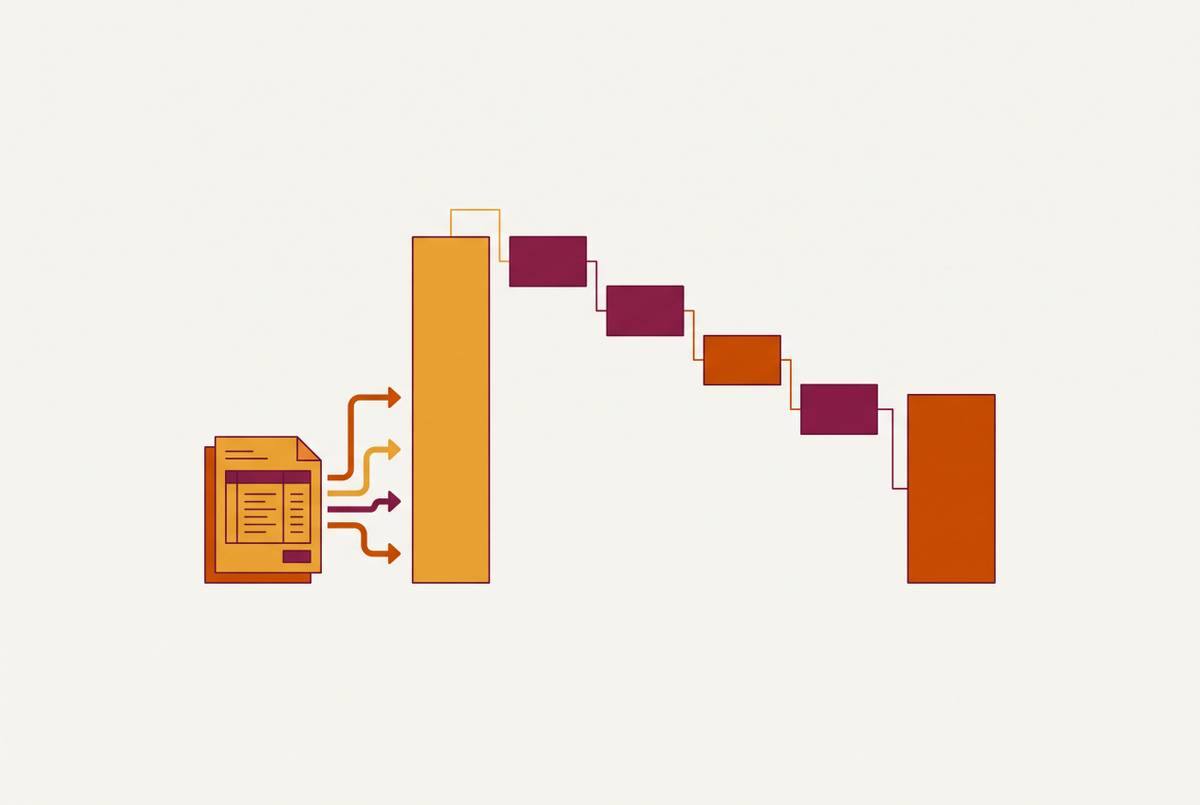
Every metered billing system, whether anyone designed it this way on purpose or not, runs through three stages: ingestion, metering, and rating.
Ingestion captures the raw telemetry: API calls, tokens consumed, storage written, steps an agent completed. It has to be durable. An event that drops in transit during a network blip becomes a hole in an invoice, and that hole is exactly what an auditor is trained to notice. Metering takes the normalized stream and turns it into billable units, say, converting raw token counts into GB-minutes. The trail has to preserve both sides of that transformation, input and output, not just the final number. Rating then applies the pricing logic: tiers, discounts, credits, overage. Every change to a rate card needs its own timestamp, so an auditor can confirm which pricing rule applied to which event at which moment.
Deduplication sits inside this pipeline as a control, not a nice-to-have. If a service retries during an outage and fires the same event twice, and the billing system counts both, the invoice is wrong and the audit trail now shows consumption that never happened. Idempotent ingestion, where the same event received multiple times produces exactly one record, is what makes deduplication provable rather than assumed.
The event store itself needs to be immutable: written once, never overwritten. Corrections show up as new compensating records, so the full correction history stays visible instead of vanishing into an edit. This matters more once AI workloads enter the picture. An agent running a multi-step workflow can generate thousands of events a minute, and a pipeline built for slower, human-paced usage falls behind fast. If the enforcement layer is reading state that's a few minutes stale, a customer can blow past a spending cap before the system catches up and posts the overage an hour later. That gap between when consumption happened and when it got recorded is precisely the timing failure Processing Integrity exists to catch.
Real-time dashboards can lean on approximate, fast-path aggregation, and that's fine for a customer glancing at usage mid-day. Final invoices cannot use that same path. They need exact, slow-path aggregation, with a clear marker on which number came from which path so nobody mistakes an estimate for a billed figure. Global deployments add one more wrinkle: usage collected at edge nodes in different regions has to reconcile into one authoritative record before anything gets billed, and that reconciliation step needs its own log so an auditor can confirm nothing got lost or double-counted on the way in.
Why retrofitting a subscription billing tool for PI compliance fails
Subscription billing tools were built to track plan state and renewal dates. They were not built to ingest, deduplicate, and permanently store millions of discrete consumption events, and that gap doesn't close just because a company bolts a metering tool on the side. Trying to retrofit one for Processing Integrity is the wrong move, full stop, and the failure is architectural, not procedural. No amount of process documentation fixes a system that was never designed to hold both the raw event and the invoice in the same place.
The common pattern looks like this: a separate metering system counts usage, then pipes aggregated totals into the subscription platform for invoicing. Raw events live in one place. The invoice lives in another. No single system holds both, so no single system can pass the re-performance test, because the auditor needs to trace a line from raw event straight through to invoice total, and that line runs through two databases with two different owners.
Running several billing codepaths, one per product line, one per pricing model, multiplies the problem. Each codepath carries its own event schema, its own aggregation quirks, its own gaps. Reconciling them becomes a manual exercise finance runs at the start of every month, and that's itself a red flag under Processing Integrity: manual correction after the fact is the opposite of a tamper-proof, automated control. Nightly batch aggregation compounds it further, since by the time an auditor asks to reproduce a charge, the raw event that generated it has already been discarded.
The consequences aren't hypothetical. In the summer of 2025, Cursor generated a $7,225 invoice for a single developer, traced back to uncapped usage in the plan. That's a metering architecture decision made long before the bill went out, and no after-the-fact documentation could have fixed it once the usage had already happened. Hybrid pricing is only making this more urgent: a large majority of AI-agent companies now pair subscriptions with usage-based charges, which means nearly every company in that space needs subscription state management and event-level metering running on the same engine, at the same time, not stitched together after the fact.
The specific controls a purpose-built metered billing system must implement to satisfy Processing Integrity
Accuracy needs deduplication logic built on idempotency keys, rate cards with effective-date versioning, and reconciliation loops that compare metered totals against underlying event counts and flag mismatches automatically, not manually.
Completeness needs a durable event store that guarantees delivery even when retries happen, dead-letter queues for anything that fails processing (with the disposition logged, not silently dropped), and population-completeness checks an auditor can actually inspect. Timeliness needs a millisecond timestamp captured at the moment an event is emitted, not the moment it's ingested, with the gap between those two logged. Real-time enforcement has to read current state, not a cached snapshot from a few minutes back. Authorization needs every pricing change, rate card update, or credit adjustment gated behind access control and logged with who made the change, when, and what value it replaced.
Mid-cycle events deserve their own attention. An upgrade, downgrade, or cancellation partway through a billing period needs a log entry showing the proration math, the effective timestamp, and the resulting charge, not just a single line on the final invoice with no visible working. Prepaid credit wallets raise the bar further: every grant, every deduction, every expiry needs its own ledger entry, and the wallet balance at any moment in the observation period needs to be reconstructible from that ledger alone.
Limit enforcement is audit evidence in its own right. When a customer nears or hits a cap, the system's response, a warning, a throttle, a hard stop, needs to be logged along with the threshold, the measured consumption, and the timestamp. That's how an auditor confirms the authorization control actually fired rather than existing only on paper.
Retention has to span the full observation period, six to twelve months for Type II, in storage that's tamper-evident. Cryptographic log signing or append-only storage architecture satisfies that requirement. A regular writable database table does not, no matter how good the backup schedule is.
How metering infrastructure scale intersects with audit completeness
Completeness doesn't get easier to argue at scale. It gets harder. A system processing tens of millions of events a month still has to account for every one of them in the audit trail, and a representative sample doesn't satisfy Processing Integrity, no matter how statistically sound it looks. Sampling is an accountant's shortcut, not an auditor's standard, and treating the two as interchangeable is where a lot of billing teams get caught flat.
Handling that volume without losing events calls for event-driven architecture with durability guarantees closer to what Kafka-class systems provide: every event gets persisted to a log before it's acknowledged, so nothing disappears between emission and storage even at peak load. Columnar storage in the style of a data warehouse lets auditors and finance teams query the entire event history without rebuilding anything from scratch, since the same store powering real-time aggregation also serves as the audit record.
A single AI agent can generate roughly 3,000 events a minute. A platform serving many such agents at once needs a throughput floor well above that, without dropping events or introducing lag that breaks the timeliness requirement. Partitioning storage by customer and by time window matters just as much as raw throughput: if an auditor samples one customer's events for one month, the system should retrieve that population directly, not run a full-table scan across years of data. Poor storage layout can make re-performance impractical even when every byte technically still exists somewhere.
Running continuous reconciliation loops, comparing ingested event counts against billed quantities on a rolling basis, catches completeness gaps while there's still time to fix them. Waiting for the auditor to surface the gap is the expensive way to find out, and by then the fix is a finding, not a patch.
Spend visibility and real-time alerting as Processing Integrity evidence, not just product features
Usage dashboards get built and sold as product features, something customers like seeing. That framing undersells what they actually do. Under Processing Integrity, a dashboard is evidence: proof that the billing system surfaces accurate, timely data to the party with the most at stake when metering goes wrong, the customer being billed. Treat it as a nice-to-have and the control behind it never gets built properly.
When a customer can watch consumption climb in real time, a billing dispute surfaces the same day, not thirty days later on an invoice. That dispute log becomes part of the audit trail, showing the accuracy controls were actually operating rather than sitting dormant. Real-time budget alerts depend on the same millisecond-accurate metering that Processing Integrity already demands. An alert firing off stale, minutes-old aggregated data is little more than a delayed report mislabeled as a real-time control. It's a delayed notification dressed up as one.
The absence of that visibility is itself a failure mode. When customers can't see consumption building up in real time, bill shock follows, the kind that produced a $7,225 charge for one Cursor developer. The relevant audit question in a case like that has nothing to do with customer communication. It's what allowed the customer to be surprised, and specifically why the billing system had no control in place that would have caught the spike before it reached an invoice.
GitHub Copilot's move, effective June 1, 2026, to an AI Credits model, where agent mode and other features draw from one monthly credit pool, points at the same operational requirement from a different angle. A credit wallet that can run dry quickly, without the customer seeing it happen, is a gap in the metering control, not a communication problem to be fixed with better copy. Alert thresholds themselves, warn at 80%, hard-stop at 100%, whatever the numbers are, need to be stored and versioned so an auditor can confirm exactly what threshold was active when an alert did or didn't fire. And for outcome-based pricing models, like Intercom Fin billing $0.99 per resolved interaction, the audit trail has to connect that outcome metric back to the underlying consumption events that produced it. Outcome billing with no such linkage can't be re-performed, and an auditor has no way to check the math.
Evaluating billing infrastructure for SOC 2 readiness before the auditor arrives
The right question to ask a billing vendor has nothing to do with what a SOC 2 report covers. It's whether the platform can actually produce the evidence an auditor will demand for Processing Integrity, and that's a considerably higher bar to clear.
A few questions do most of the work here. Does the platform store raw events in an immutable, tamper-evident log, or only the aggregated totals that come out the other end? Does it support idempotent ingestion with deduplication keys that can be shown to an auditor on request? Can it reconstruct any historical invoice straight from raw event records, without a human stepping in to reconcile the numbers by hand? Does it log every rate card change, every credit adjustment, every limit-enforcement action, with the identity of who made the change and when? Does it retain the full event history for the entire audit window, six to twelve months for Type II, in storage that's tamper-evident rather than just backed up? And does the real-time usage data shown to customers come from the same authoritative event store used for billing, or from a separate, looser system that only approximates it?
For some enterprise buyers, on-premises deployment is a hard requirement, not a preference. If a billing platform can't run inside the customer's own infrastructure or a sovereign cloud, the audit trail sits outside that customer's control boundary entirely, which raises Processing Integrity and confidentiality concerns at once. Developer API quality matters more than it gets credit for, too: a clumsy ingestion API pushes engineering teams to build their own abstraction layer on top of it, and that layer becomes one more place where events can get dropped, transformed, or delayed before they ever reach durable storage. Each of those points is a potential finding waiting for an auditor to notice it.
Billing infrastructure built from the ground up for usage-based charging, designed to ingest events at scale, deduplicate them, store them immutably, and apply versioned pricing rules as a matter of architecture, satisfies Processing Integrity structurally. It doesn't need compensating controls stitched on after the fact to paper over gaps the system was never built to avoid in the first place. That distinction, structural versus stitched-on, is the whole difference between passing an audit and explaining a finding.