Reconciling Customer Credit Balances at Quarter End
Four structural points break credit reconciliations in hybrid pricing models every quarter.

Credit-based pricing is now common enough that most finance teams closing the books this quarter will hit a reconciliation problem their existing process wasn't built for. The number of companies running credit-based models has grown sharply (79 in the PricingSaaS 500 Index, up from 35 at the end of 2024, a 126% year-over-year jump according to Kyle Poyar's Growth Unhinged), and the mechanics of reconciling those credit balances break in the same four places, quarter after quarter. This is a workflow guide for the finance or billing-ops person who has been handed a stack of discrepancies and needs a structured way to close them without losing a week to firefighting.
What a credit balance reconciliation is reconciling
The phrase "credit balance" gets used loosely, but it actually refers to three separate things that behave differently and live in different systems.
A prepaid credit wallet is a block of usage a customer bought upfront and burns down over time; until it's consumed, the unconsumed portion is a liability on the seller's books. An issued credit note is a distinct object, an after-the-fact adjustment correcting an overbilling, a disputed charge, or a proration, and it reduces an open receivable rather than a wallet. Deferred revenue is different again, governed by ASC 606, and it lives on the balance sheet rather than inside the billing platform's ledger of usage events.
Reconciliation means confirming that the contract, the billing platform, the payment processor or bank record, and the general ledger all agree on each of these three objects. In a pure subscription business, these three objects rarely collided, since there was usually just one invoice and one payment per cycle. In a hybrid pricing world, they routinely stack on the same account. A customer might hold a $10,000 prepaid wallet, carry a $500 credit note outstanding from last quarter's overbilling, and sit on $2,000 of deferred revenue from an annual prepayment, all at the same time. Finance has to reconcile each of the three independently, then confirm the combined position ties out in the GL.
The reconciliation clock starts the moment the billing period closes and ends when the GL is locked. Everything covered below happens in that window.
The four points where credit reconciliations break most often
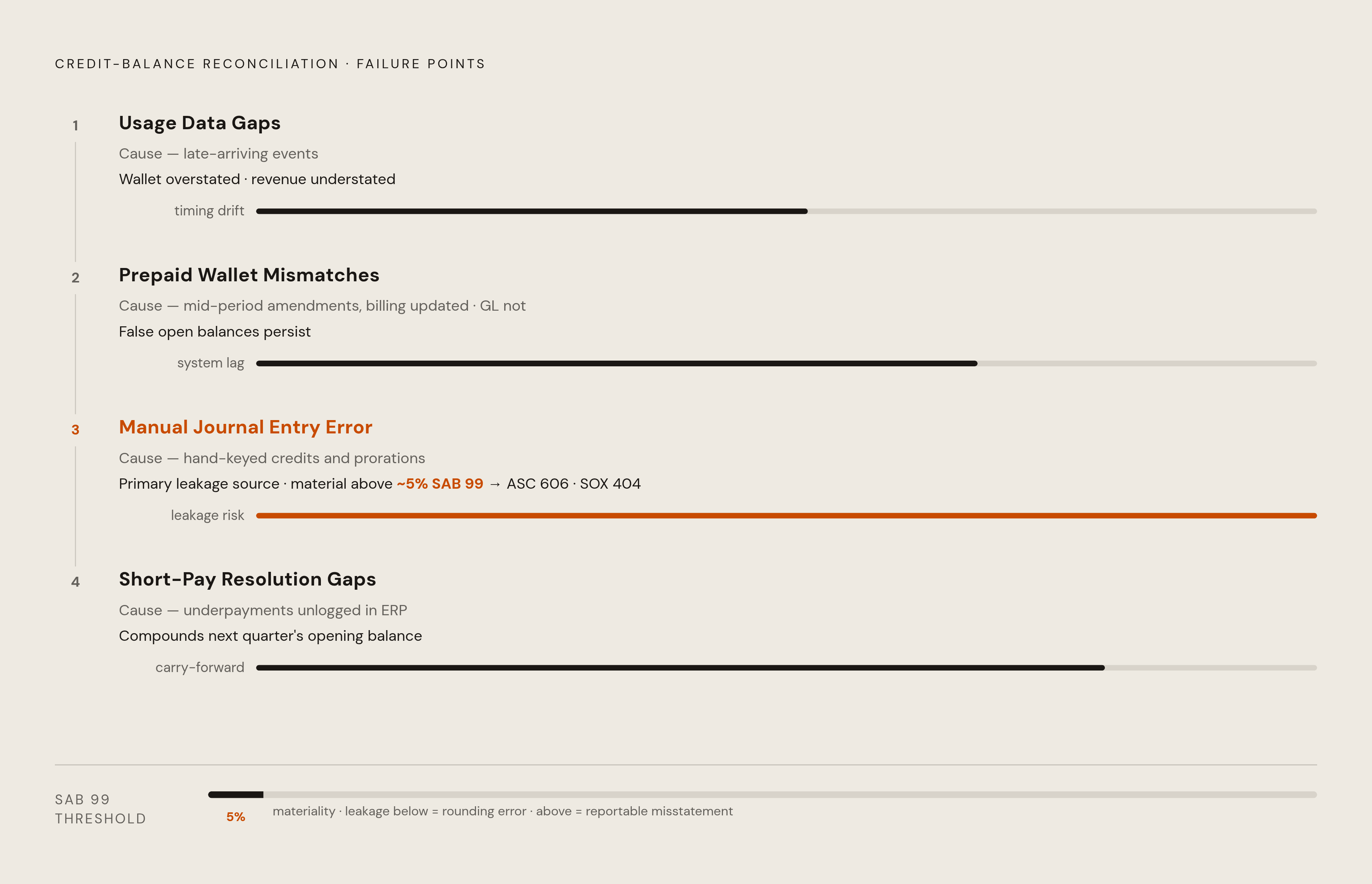
The breaks are structural consequences of pushing usage-based billing through infrastructure that was built to handle flat subscription invoices, and they show up in the same four spots. They're structural consequences of pushing usage-based billing through infrastructure that was built to handle flat subscription invoices, and they appear in the same four spots.
The first is usage data gaps. Events that occurred before the quarter closed but arrived at the billing system late don't make it into the closing balance. This is especially common in AI workloads, where token consumption happens at millisecond speed but billing pipelines typically run on a delayed batch cadence: anything generated between the last batch and the cutoff simply isn't there yet. As a result, the wallet shows more remaining balance than the customer actually has left, overstating the customer's asset and understating the seller's revenue.
The second is prepaid wallet mismatches, where the billing system and the GL disagree on what's left in a given wallet. The usual trigger is a mid-period contract amendment: the billing system gets updated with the new credit entitlement, but nobody makes the corresponding journal entry in the GL. That leaves a false open balance sitting in the ERP, either an outstanding liability that's already been consumed or the reverse.
The third is manual journal entry error. Credit notes, prorations, and wallet top-ups often get entered by hand in the GL because the billing platform has no automated path to push them. Manual entry is the primary source of the revenue leakage the industry keeps flagging, small undercharges that accumulate invisibly across every account over the course of a quarter. Once that leakage crosses the SEC's materiality threshold, roughly 5% under the SAB 99 rule of thumb, though the actual threshold depends on qualitative and quantitative factors specific to each company, it changes from a rounding error into a material misstatement that can implicate ASC 606 compliance and SOX 404 controls.
The fourth is short-pay resolution gaps. A customer pays less than the invoice says because they expected a credit to apply, and if that reason never gets logged in the ERP, the system keeps showing a receivable that, from the customer's perspective, doesn't exist. Left unresolved, it doesn't disappear. It carries forward and compounds next quarter's opening balance.
None of these four are avoidable through better spreadsheet discipline alone. They're what happens when usage-based billing runs on subscription-era plumbing.
Step 1: Lock and validate the usage data before anything else
The instinct is to open the GL first. Resist it. The first real action is to freeze the usage dataset and confirm it's actually complete, because every downstream step depends on a number that, if wrong here, stays wrong everywhere else.
"Complete" has a specific operational meaning. Every billable event needs a unique event_id so duplicates from retries get collapsed into a single count. Every event needs a source timestamp, not an arrival timestamp: the billing cutoff has to apply to when the event happened, not when the system happened to receive it. And every event needs to map to a customer_id or subscription_id that actually corresponds to a live account.
Run a late-event audit specifically: pull everything with an arrival timestamp after quarter close but a source timestamp before it. Those events belong in this quarter's closing balance, not next quarter's. Then compare event totals per account against what the billing system has aggregated. Any gap here is exactly where a wallet mismatch will appear two steps from now.
If the pipeline is batch-based, don't paper over the lag, document it. A nightly batch on the last day of the quarter is going to miss some number of hours of consumption. Either accept that cutoff explicitly or run a manual catch-up job, but decide on purpose rather than by accident.
The output of this step is a signed-off usage report, by account and by metric (tokens, API calls, compute minutes, whatever the contract meters), covering the full quarter with no late events left dangling.
Step 2: Reconcile each prepaid credit wallet balance against the signed-off usage
With usage locked, pull the opening wallet balance for each account from last quarter's closing reconciliation or the contract itself. Add whatever top-ups landed during the quarter from contract amendments, bonus credits, or promotions. Subtract the signed-off consumption from Step 1. What's left should match the billing system's current wallet balance exactly. Any gap is a discrepancy to chase down before it ever touches the GL.
The usual suspects behind a gap: a top-up recorded in the billing system but never journaled in the GL, or the reverse; a credit issued to settle a prior dispute that got applied to the wallet without a matching GL entry; or, for wallets denominated in a currency other than the functional currency, a conversion difference.
For each discrepancy found, log the dollar amount, the account, the period the originating event occurred in, and classify it as a timing difference or a permanent error. That classification decides what fixes it, a journal entry or a correction inside the billing system itself.
Prepaid wallets are liabilities until they're actually burned. Confirming the GL reflects the correct deferred-revenue balance for unconsumed credits isn't optional housekeeping, it's an ASC 606 requirement. The output here is a wallet reconciliation statement per account: opening balance, additions, consumption, closing balance per the billing system, closing balance per the GL, and a variance that should, ideally, read zero.
Step 3: Match credit notes and adjustments to their originating invoices
Pull every credit note issued during the quarter. This is a separate list from the wallet balances in Step 2, covering adjustments made after invoices were already generated.
For each one, check three things. Does it reference a specific invoice line item, rather than floating as an adjustment with no originating document? Has the corresponding GL entry actually posted, a credit to accounts receivable and a debit to revenue or the right contra account? And if the credit note exists because of a usage error, has the underlying usage record been corrected in the billing system so the same error doesn't repeat next quarter?
Then work the short-pays. For every invoice where the payment received fell short of the billed amount, check if that shortfall equals an outstanding credit note. If it does, close the receivable, mark the note as applied, post the matching entry. If it doesn't, escalate to collections or billing-ops. An unresolved short-pay left sitting in the GL doesn't stay contained, it becomes next quarter's opening balance error.
One more check belongs here: flag any account with a mid-period contract amendment and confirm the invoice actually reflects the new terms. The most common failure of this kind is an overage line still priced against an old commit threshold after the commit was raised. The output of this step is a credit note register: each note, its originating invoice, its GL posting status, and its resolution, whether applied to a short-pay, applied to a wallet, or still outstanding.
Step 4: Tie the combined position to the general ledger and post correcting entries
Now bring the three outputs from Steps 1 through 3 together into a single account-level statement. That means the closing wallet balance (a liability) checked against the GL's deferred revenue balance, outstanding credit notes checked against the GL's accounts receivable balance, and revenue recognized during the quarter checked against usage actually consumed and billed, which confirms there's no material leakage hiding in the gap.
Every variance found needs a correcting entry, and the type of entry depends on the cause. Timing differences, an event that arrived late or a payment that settled after close, get accrued in the closing period and reversed at the start of the next one. Permanent errors, like the wrong pricing tier applied or a credit issued in the billing system but never journaled, get a correcting entry posted in the closing period along with a documented root cause.
Manual journal entries are the primary source of recurring error, so wherever the billing platform can push entries to the GL automatically, it should be configured to do exactly that. Manual entry should be the exception handling.
There's an ASC 606 checkpoint at this stage too: deferred revenue balances should reflect only unconsumed prepaid credits. Any credit that's already been consumed but is still sitting on the deferred revenue schedule is a misstatement, full stop. And for companies subject to SOX 404, correcting entries above the internally set materiality threshold should go through a second reviewer sign-off as part of the journal entry control design, not get bolted on afterward when the auditors ask. The output of this step is a signed GL reconciliation with every variance explained, every correcting entry posted, and zero-variance sign-off by account and by ledger line.
Step 5: Document the closing balance as next quarter's opening position
Quarter-end reconciliation turns into a week of firefighting for one recurring reason: the prior quarter's closing position was never formally written down, so the next period opens carrying a discrepancy nobody actually owns.
For each account, the closing statement needs to record the wallet balance at close (the liability the next quarter opens with), any credit notes outstanding but not yet applied (live offsets against next quarter's receivables), any known timing differences expected to reverse in the first week of the new period, and the contract version in effect at close. If an amendment is pending, note it here, so the billing system gets updated before the next billing cycle actually runs.
That document becomes the literal starting input for next quarter's Step 1, the opening balance the usage reconciliation rolls forward from.
For high-volume accounts, daily reconciliation is worth the overhead. It catches the same four failure modes early, before they've had a full quarter to compound, and it cuts down the sheer volume of work waiting at close. The formal quarterly close described above still has to happen, but a lighter daily or weekly check against those same failure points keeps the quarter-end version from turning into an emergency. The output of this step is a standardized closing-balance package per account, stored somewhere both finance and billing-ops can reach, with a named owner attached to every open item.
Billing infrastructure design and its effect on workflow difficulty
Every manual step described above exists because something in the billing stack can't do it automatically. It's fundamentally a systems problem. It's a systems problem that happens to show up wearing accounting's clothes.
Most billing platforms were designed around subscriptions, where the only variable is which plan a customer is on, and they have no native way to count usage. Once a company adds AI features or credit wallets, metering and billing end up running in two separate systems, and reconciling the two becomes a job for a human because it was never a job the software was built to do on its own.
A common approach has been to pair a metering tool with a billing tool and integrate the two. That solves part of the problem, but the integration layer itself is often where event-count discrepancies can emerge and go undetectednate, since two systems counting the same usage independently rarely agree to the decimal.
The capabilities that actually cut down reconciliation labor are specific. Real-time event ingestion with deduplication built in removes the need for the late-event audit in Step 1. Wallet balances maintained inside the same engine that generates the billing record, rather than mirrored across two systems after the fact, remove most of the mismatch risk in Step 2. Neither capability is universal across the market yet, and until it is, the five-step workflow above is what stands between finance and a GL that doesn't tie out.