Credit Grant and Expiration Policies in Enterprise SaaS Contracts
Prepaid credits expire silently, turning buyer commitments into vendor windfall revenue.

Credit grant and expiration terms in enterprise SaaS contracts now carry consequences big enough to decide whether prepaid capacity turns into usable value or disappears before anyone notices. The hybrid pricing model, a seat subscription anchoring access with metered credits pricing actual AI consumption, has become the dominant structural form across enterprise software. Most contracts signed today contain both a fixed layer and a variable layer, and those two layers interact through credit mechanics that used to be an afterthought in the renewal conversation. A single credit clause now governs consumption across products, users, and increasingly agents acting on a buyer's behalf, which gives that clause far more reach than a seat count ever had. Deals signed during a period of adoption enthusiasm are hitting renewal against real usage data, and each clause inside the contract has to hold up on its own terms, independent of the headline pricing number. What follows sets out the interlocking mechanics inside a credit policy and how procurement, finance, and product teams should approach negotiating each one.
The five structural mechanics every credit policy must specify
A credit grant consists of five distinct policy decisions, and any one left unspecified hands the vendor a default that may or may not serve the buyer who signed the deal. The framework below comes from the credits lifecycle specification published in the Monetplane project, and it gives buyers a vocabulary for naming what is actually being decided inside a credit clause.
The first mechanic is grant source and bucket identity. Every credit grant should belong to an auditable bucket that carries its source, the amount granted, the amount remaining, a validity window, and policy metadata. Without this structure, a buyer has no way to verify what they were given in the first place or what is left of it. The second is expiration treatment. Purchased credits can be configured to persist independently of subscription allowances, but only if the contract specifies that behavior rather than leaving it to the vendor's default billing logic.
The fourth mechanic is consumption ordering: when a buyer holds multiple bucket types at once (subscription credits, purchased credits, bonus credits) the order in which they draw down needs to be documented and testable, and a reservation should never be able to consume credits that have already expired or are otherwise unavailable. The fifth is true-down rights. Each of these five mechanics is a decision point with a vendor-favorable default and a negotiable alternative, and the sections that follow take up the two or three that carry the most financial risk for the buyer.
Grant Buckets and Consumption Ordering
Bucket identity and consumption ordering interact in a way that determines, often invisibly, which credits a buyer actually loses. A buyer's credit balance typically breaks down into at least three types: subscription credits that reset on a fixed cadence, purchased credits that are prepaid and typically carry a longer validity window, and bonus or admin credits issued promotionally, which tend to expire soonest. When a contract holds all three types at once and does not specify the order in which they are consumed, the vendor's system default decides which credits drain first, and that default does not automatically favor the party that paid for them.
The Monetplane specification treats this as an engineering requirement rather than a contract footnote: consumption ordering must be documented and tested, and reservations must not be able to consume credits that have expired or are otherwise unavailable. The commercial consequence of skipping this requirement is specific. Buyers should specify ordering that exhausts the soonest-expiring bucket first, and they should require the vendor to document, in plain language, which bucket takes priority under each consumption scenario.
What expiration triggers look like in practice
Expiration policy varies widely from one vendor to the next, and that variation is where a prepaid commitment either delivers its full value or evaporates on a schedule the buyer did not choose. Adobe's Firefly credits reset monthly and do not roll over. Microsoft's Security Copilot, bundled with Microsoft 365 E5 and E7, carries a monthly capacity allowance of Security Compute Units tied to the number of paid user licenses, and unused units do not carry forward into the next month either. Both examples show a monthly hard reset applied at real enterprise scale, with no grace period built into the standard terms.
Rollover provisions change this outcome by letting unused credits from one subscription period carry into the next, giving a buyer with uneven month-to-month consumption a real buffer against a use-it-or-lose-it deadline. The Monetplane specification confirms that purchased credits can be configured to expire independently of subscription allowances. The two credit types warrant separate expiration treatment in a policy built with the buyer's interest in mind, each on its own clock. A related risk compounds on top of expiration: credit allotments inside existing plans can shrink at flat pricing even when nothing in the contract technically changes, so buyers should benchmark the actual quantity of credits granted at every renewal, not just the sticker price of the plan.
Why the vendor's incentive structure makes use-it-or-lose-it the default
Credit expiration functions as a deliberate commercial lever, not a quirk of how billing systems happen to be built. Credits that expire on a monthly cycle create pressure on the buyer to consume at a cadence the vendor prefers, which increases how locked in a customer becomes to the platform and discourages the practice of banking unused credits against future need. Under ASC 606, revenue from credits that go unused and expire is recognized gradually by the vendor, as the customer exercises its rights, a practice known as breakage revenue. That accounting treatment means the expiration date written into a contract doubles as a revenue recognition date for the vendor, which gives vendors a structural reason to favor hard monthly resets over rollover provisions regardless of what serves the buyer's usage pattern.
A widespread pattern documented in procurement research shows IT leaders absorbing unexpected consumption charges for capacity they had already pre-purchased but failed to consume before expiration. This sets the terms for how buyers should approach the negotiation: expiration dates are not neutral calendar choices, they are the mechanism through which an uneven usage pattern, the normal condition for any new AI deployment, converts a buyer's prepaid commitment into windfall revenue for the vendor. Recognizing that incentive turns expiration language from a clause to skim past into a clause worth negotiating line by line.
The minimum commitment and true-up mechanics that determine what happens at the edges
A credit policy without clear minimum commitment and true-down terms puts the financial risk entirely on one side of the table. The buyer absorbs the cost of over-committing, and the vendor captures the benefit of under-consumption whenever unused credits expire. The asymmetry is structural: a buyer who exceeds their committed volume can almost always true up and purchase additional credits mid-term, but a buyer whose consumption comes in under forecast rarely has a contractual right to true down and reduce that commitment. True-down rights are the mechanism that corrects this imbalance mid-contract. Without them, a buyer who rolled out an AI feature more slowly than planned ends up paying for capacity it cannot use and has no path to recover.
Resistance from a buyer to accepting a minimum commit level is frequently a signal that the buyer cannot yet forecast its own consumption with confidence, not that the buyer is unwilling to pay for what it uses. Any time a vendor changes the unit it bills against, the commitment level negotiated under the old unit needs to be revisited.
Forced plan migrations and grandfathering failures at renewal
A credit policy that functions well at signing can be invalidated entirely at renewal if the vendor restructures its pricing tiers, because migrating from one plan to another typically resets the credit terms a buyer negotiated, not merely the headline price on the invoice. Adobe's restructuring of its Firefly API offers a concrete illustration. Adobe separated Firefly API from Creative Cloud into a standalone platform with its own pricing, its own credit system, and its own enterprise sales process. Buyers who had negotiated credit terms under the old bundled arrangement had to start over and renegotiate those terms once the restructuring took effect.
The risk compounds for a buyer that already made unfavorable commit decisions earlier in the contract term. Forced migrations are not purely a risk for the buyer, however. That leverage exists only while the migration is still in progress, so it needs to be exercised before the old SKU is fully retired. Grandfathering provisions offer financial protection only when they carry an explicit expiry date or a migration incentive attached to them. A grandfathering clause with no such mechanism functions as a goodwill gesture rather than an enforceable term, and buyers should treat it accordingly.
Auditable credit infrastructure from the buyer's vantage point
None of the negotiated terms above mean anything if the buyer cannot verify them against the underlying system of record. Expiration, rollover, and consumption ordering clauses are only as good as the infrastructure that enforces them. Contract language and billing architecture have to be evaluated as a single question. The Monetplane specification sets a useful floor for what that verification should look like: expiration should change a balance only through traceable ledger events, never through a silent mutation of the number a customer sees, and a console should display available, reserved, and expiring balances alongside full grant provenance, described in plain terms.
Grant provenance, in practical terms, means a buyer can look at any credit balance and see which bucket it came from, when it was granted, what the original amount was, and what its validity window is, without having to file a support ticket to get an answer. Consumption ordering needs the same standard of proof: a buyer should be able to inspect the actual ledger events and confirm that the agreed ordering, soonest-expiring credits consumed first, is the ordering actually being applied. Products that cannot show a customer its own credit consumption as it happens generate bill shock at invoice time, and that shock produces support costs and renewal friction that a properly instrumented credit ledger would have prevented. Companies that build their own credit wallet internally face the identical set of requirements that a purpose-built billing platform needs to satisfy: idempotent writes, traceable expiration events, and deterministic consumption ordering. Those requirements are not trivial to implement correctly, and maintaining them well is harder still. A buyer evaluating a vendor's platform and finding none of this verifiable should treat that gap as a due diligence failure, not a minor product limitation to work around later.
A negotiation framework for procurement and finance teams reviewing credit clauses
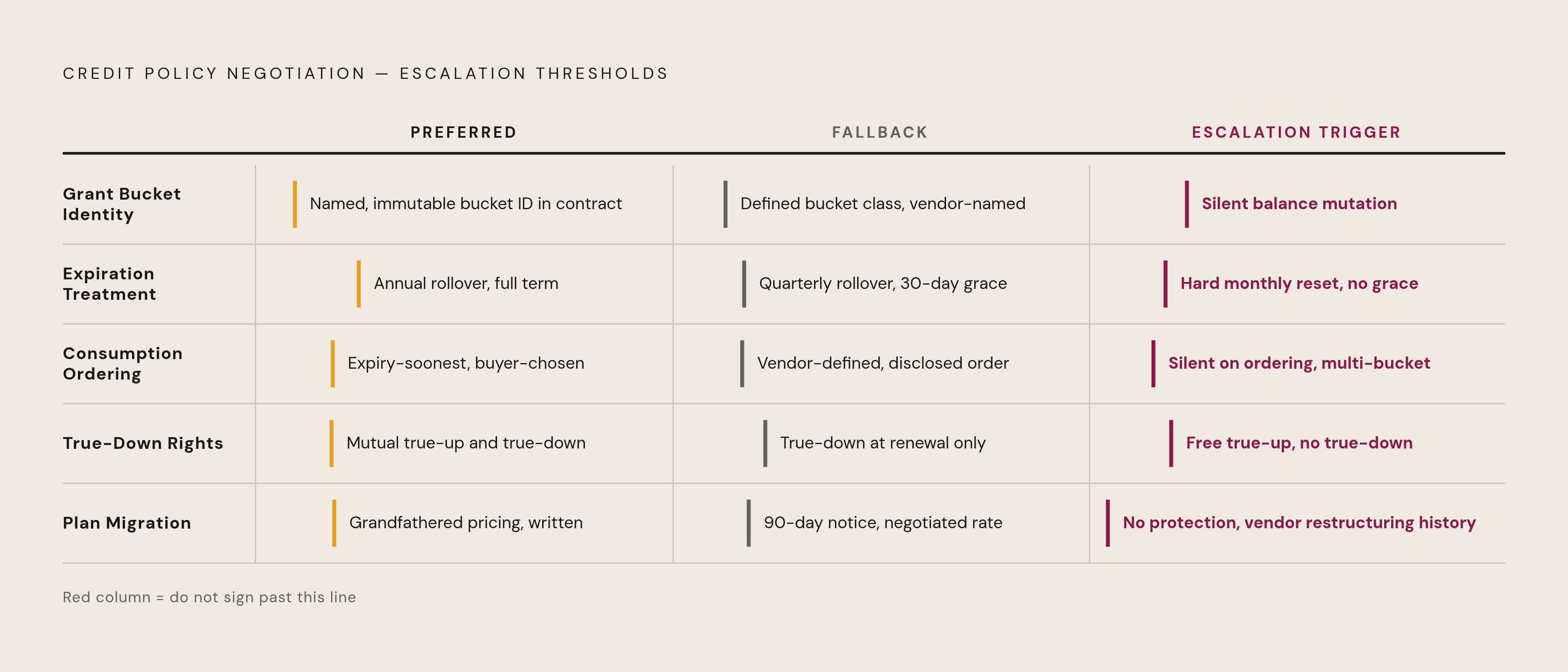
Each of the five credit mechanics can be approached as a tiered drafting decision: a preferred position, an acceptable fallback, and an escalation trigger that signals a term is not safe to sign as written. Structuring the negotiation this way converts a vendor's pricing model into a contract that still protects the buyer at renewal, two or three years out.
For grant bucket identity, the preferred position is full ledger transparency, source, amount, validity window, and remaining balance, accessible without having to open a support request. An acceptable fallback is a monthly statement that breaks out bucket-level detail. The escalation trigger is any contract that permits silent balance mutation or fails to define what counts as a credit grant record.
For expiration treatment, the preferred position is rollover of unused subscription-period credits up to a defined cap, with purchased credits carrying a validity window at least as long as the contract term itself. A workable fallback is a grace period following the end of each period. The escalation trigger is a hard monthly reset applied to any credit type with no grace period attached.
For consumption ordering, the preferred position is a contractually specified order, soonest-expiring credits consumed first, backed by a verifiable ledger trail. A fallback is vendor-documented ordering published in product documentation paired with an audit right. The escalation trigger is a contract that stays silent on ordering despite multiple bucket types coexisting in the same account.
For true-down rights, the preferred position is a mid-term right to reduce commitment with reasonable advance notice. A fallback is a one-time right to reduce the commitment at renewal, supported by documented usage evidence. The escalation trigger is a contract that grants true-up rights freely but includes no true-down provision.
For plan migration and grandfathering, the preferred position is a contractual commitment to preserve existing credit terms for the remainder of the contract term if the vendor restructures its plans. A fallback is migration credits equal to the unused balance as of the migration date. The escalation trigger is a contract with no change-of-plan protection at all, particularly from a vendor with a documented history of restructuring its tiers.
Palo Alto Networks' published grace period policy offers a useful reference point for the level of specificity buyers should expect from any vendor running a credit-based contract. Not every vendor will accept every preferred position above, and procurement teams should expect to concede on some fallbacks in exchange for holding firm on others. Knowing the tiers in advance lets a negotiating team decide, deliberately, where to push and where to let a secondary term go, while still securing the clauses that make a prepaid commitment deliver its value.