Metering Accuracy Standards and Acceptable Error Tolerances
Distinguishing metering accuracy from billing accuracy to prevent revenue leakage.
Metering accuracy and billing accuracy are not the same problem, and treating them as one is why so many usage-based billing systems fail quietly for months before anyone notices. Billing accuracy asks whether an invoice matches a contract. Metering accuracy asks whether the underlying pipeline captured every billable event exactly once, for the right customer, in the right period, before any price was ever applied. This piece works through what "accurate enough" actually means in production metering systems, where the failures live, and why AI workloads have made the whole problem harder to solve.
Metering accuracy versus billing accuracy: a different engineering problem
A flat-rate subscription invoice needs two things: a contract and a monthly trigger. There's no counting involved, no instrumentation, no data pipeline standing between the product and the bill. Metered billing changes the underlying requirement. A metered invoice depends on an instrumented product, a reliable event stream, and a system capable of turning raw usage data into accurate charges at scale, and that dependency chain is a fundamentally different infrastructure challenge than the one flat-rate billing ever asked teams to solve.
Billing accuracy is a math and contract-logic problem: given a usage number, did the system apply the right rate, the right tier, the right discount? Metering accuracy is upstream of all of that. It asks whether the pipeline recorded the event at all, recorded it once, recorded it under the correct customer, and recorded it inside the correct billing period. These are two distinct failure surfaces, and they require different remedies: a billing logic bug gets fixed by correcting a pricing rule, while a metering bug gets fixed by rearchitecting how events are captured, transmitted, and deduplicated before they ever reach the rating engine.
The stakes have grown because the billable units themselves have multiplied. The billable units have multiplied with AI products: API calls, tokens processed, AI agent actions completed, data processed or stored, and compute hours, each with its own measurement surface and failure modes. A pipeline that drops even a small fraction of events under load becomes a source of systematic revenue leakage and unresolved customer disputes, making metering accuracy financially material from the first day a usage-based product ships.
The implicit thresholds for error tolerance
No published industry standard sets a universal error tolerance for metered billing. Instead, practitioners have converged on implicit thresholds, and those thresholds carry real financial and operational consequences the moment a pipeline crosses them. The relationship between error rate and dollar impact is linear and unforgiving: a small percentage error on a large usage stream turns into a significant sum over a year, and that sum only grows as the underlying usage volume grows.
Revenue leakage data shows a clear split in where the leakage originates. Usage-based and metered businesses tend to lose revenue primarily through metering gaps and unbilled overages, while hybrid businesses that combine seats with usage lose revenue primarily through reconciliation failures between the two pricing models. Industry reporting on revenue leakage more broadly finds that RevOps leaders attribute a meaningful share of lost revenue to systemic breakdowns, with billing errors, pricing drift, and missed usage charges among the leading causes.
The tolerance a team should accept depends entirely on what is being counted. High-volume, sub-cent events like tokens and API calls behave like a slow leak: even a tiny drop rate compounds into a large absolute loss once volume is high enough, so tolerance for systematic drops in this category is effectively zero. Low-frequency, high-value events, such as completed compute jobs or finished AI agent tasks, behave differently. A single missed event here is a line item a customer can point to and dispute, so tolerance for any miss in this category is also effectively zero, just for a different reason. Aggregate metrics like storage consumed or data processed occupy a middle ground, where small measurement variance can be tolerable, but only within rounding conventions that are applied consistently and disclosed to the customer up front.
The practical consequence for engineering teams is that a single pipeline-wide accuracy target is close to meaningless. A pipeline can meet an aggregate accuracy goal and still be systematically wrong for one high-value event type buried inside the average. Setting an explicit tolerance budget for each billable unit type, rather than one blended number for the whole system, is the only way to catch that kind of failure before a customer does.
Failure modes across the pipeline
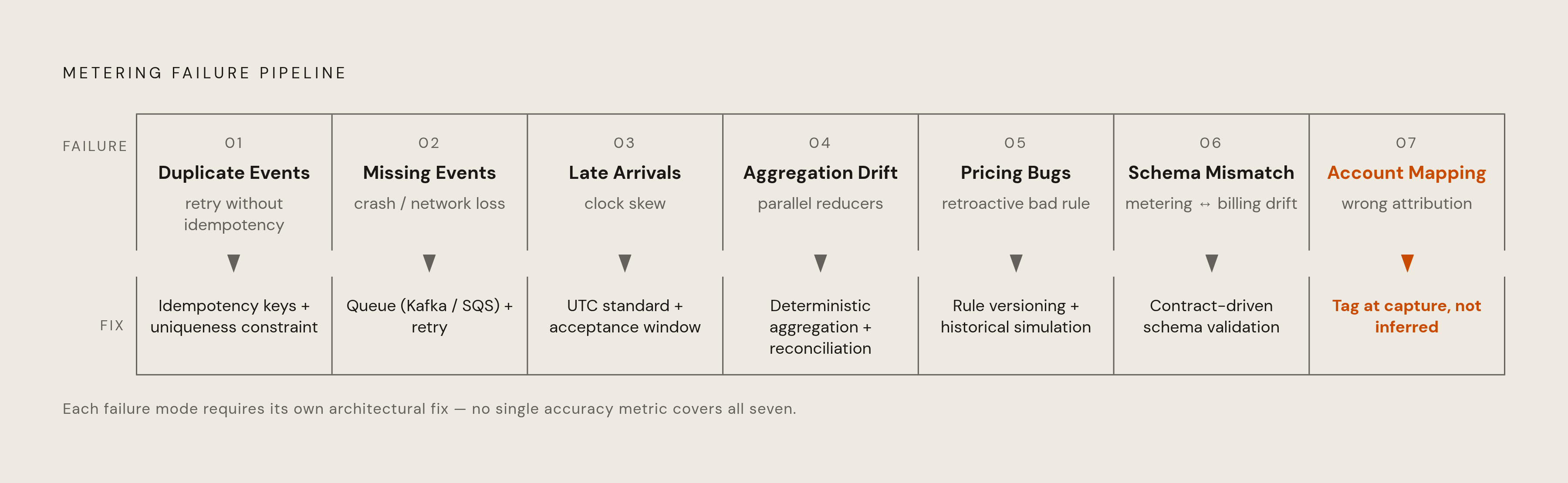
Metering inaccuracy comes from specific, well-understood structural failure modes at particular points in the event-to-invoice pipeline, not from random noise scattered across a system. It comes from a specific, well-understood set of structural failure modes, and each one lives at a particular point in the event-to-invoice pipeline with its own architectural fix.
Duplicate events come from retry logic that lacks idempotency protection. A network timeout triggers a retry, the original request actually succeeded, and now the same action has been recorded twice, producing overbilling. The remedy is idempotency keys enforced through uniqueness constraints at the storage layer.
Missing events come from producer crashes or network loss between the point of instrumentation and the message queue. Nothing in the system necessarily flags that an event never arrived, so the result is underbilling and quiet revenue leakage. The remedy is a queue-based architecture, built on something like Kafka or SQS, that buffers events during traffic spikes and applies retry logic for transient failures.
Late arrivals come from clock skew or delayed processing somewhere upstream, and they land in the wrong billing period once they finally arrive. The remedy is UTC standardization across every service in the chain, explicit testing around period boundaries, and a defined acceptance window for events that arrive after their period has technically closed. Some platforms enforce a structural cutoff on how old an event timestamp can be, and anything older than that cutoff gets rejected outright: a late event from a crashed producer is lost for good unless the pipeline has a separate backfill path built for exactly this case.
Aggregation drift comes from parallel reducers that fall out of alignment across partitions, producing incorrect totals even when every individual event has been captured correctly. The remedy is deterministic aggregation design paired with regular reconciliation checks that compare partition-level sums against the whole.
Pricing rule bugs come from a bad rule deployment applied retroactively or inconsistently across customers. The usage data itself is correct, but it's billed at the wrong rate. The remedy is pricing rule versioning combined with simulation against historical usage data before any new rule goes live.
Reconciliation failures come from a schema mismatch between the metering layer and the billing layer, where correct event counts exist but don't map cleanly onto invoiceable line items. The remedy is contract-driven schema validation that forces both layers to agree on structure before data moves between them.
Account mapping errors come from incorrect customer attribution at the moment an event is captured, producing an aggregate count that's accurate in total but charged to the wrong customer. The remedy is per-customer event tagging applied at instrumentation time, not reconstructed later from inference.
Each of these failure modes requires a different signal to catch. Dead-letter queue accumulation reveals missing events. A rising deduplication rate reveals retry storms. Growing consumer lag reveals a pipeline slowing down in real time. No single accuracy metric can substitute for watching all of them, because each one is diagnostic of a different point in the pipeline failing in a different way.
Idempotency as the foundational correctness property
Idempotency is the property that repeating an operation produces the same result as running it once. Applied to billing, it means the same event arriving twice must still produce exactly one charge, and it has to be enforced at the storage layer rather than left to application-level checks that can be bypassed or missed under load.
The mechanism is specific and concrete. Every event carries an idempotency key. The database enforces uniqueness constraints on both fields, so when a duplicate arrives, the insert triggers a constraint violation and gets rejected outright, rather than silently creating a second charge. This is exactly-once accounting built on top of infrastructure that, by default, only guarantees at-least-once delivery. The enforcement happens in the database, where a future code change cannot quietly remove it.
The deduplication window attached to this mechanism matters just as much as the constraint itself. Some platforms cap how old an event timestamp can be before it's rejected from deduplication consideration entirely, and any event that falls outside that window gets dropped rather than reprocessed. That means a late-arriving event from a producer that crashed and retried hours later can vanish permanently unless the pipeline has a dedicated backfill path built specifically to handle it. A system can have flawless idempotency enforcement and still lose revenue if nobody designed for what happens at the edge of that window.
The organizational lesson here is a hard one. Idempotency cannot be bolted onto an existing pipeline without a schema migration and a full reprocessing run across historical data. It has to be designed in from the very first version of the system. Teams that build metering infrastructure in-house without this discipline from the outset tend to discover the gap only after their first significant overbilling incident forces them to go back and find out why customers were charged twice for the same action.
How AI workloads make deterministic metering structurally harder
Traditional SaaS metering assumes that the same action produces the same measurement every time it happens. AI workloads break that assumption at the root. The same prompt submitted twice to the same model can produce a different number of output tokens, particularly with streaming responses, function calling chains, or agent workflows that branch depending on intermediate results, and that variability makes deterministic testing of the metering pipeline effectively impossible. Metering logic for AI products has to tolerate variance from the start rather than treating it as an exception case.
Agent workflows compound the problem because they aren't atomic transactions. A multi-step agent completing a task can generate a series of intermediate actions along the way, and each of those intermediate actions may itself be billable. Whether a partially completed chain, one that fails halfway through, should generate a partial charge is a product decision, and that decision has to be encoded directly into the metering logic rather than handled as an afterthought during invoicing. Streaming responses add a further complication at the boundary level: a streamed response can't be fully counted until the stream closes, which introduces a lag between when consumption actually happens and when the billable event can be finalized, creating edge cases right at period boundaries.
A harder attribution problem sits underneath: metering has to track which customer drove which specific unit of usage, not just measure the total. AI products built on top of third-party LLM APIs typically pass model costs through to end customers, often with a margin added on top, and that means metering has to track which customer's usage drove which specific unit of underlying token consumption at the level of the individual LLM call, not just at the level of the application's own API. An aggregate token count at the product level tells a company almost nothing useful about which customer is actually driving cost. Framed as a visibility problem, a company that cannot see compute cost sitting next to revenue per customer in real time is pricing blind, and nondeterministic token counts make that visibility problem worse, because the true cost of serving any given customer is itself a moving target rather than a fixed number.
The standard this forces is a higher one than anywhere else in SaaS metering. AI metering systems have to measure what was actually consumed rather than what was expected, attribute that consumption to the correct customer at the level of the individual call, handle event sizes that vary from one run to the next, and still enforce idempotency across the entire chain. Every architectural requirement covered in the previous section still applies. AI workloads simply remove the option of assuming stability in the thing being measured.
Observability as the operational discipline that keeps accuracy from drifting
A correctly designed metering pipeline does not stay correct on its own. Load patterns shift, upstream services change their retry behavior, new event types get added without full review, and a system that was accurate at launch will drift without someone actively watching it. Accuracy in metering is an operational discipline that has to be maintained continuously.
Metering pipelines now fall squarely inside SRE territory. Error budgets have to account for the pipeline's availability and correctness, not just its uptime, and on-call rotations now treat lost events, duplicate billing, and stale invoices as incidents on the same level as service downtime. That shift reflects a recognition that a billing pipeline silently dropping events is just as much an outage as a service that stops responding, even though nothing about the product itself appears to be down.
Several signals do most of the diagnostic work. Throughput and latency establish the baseline health of the ingestion layer. A rising deduplication rate signals a client retry storm, which is itself evidence that something upstream is already failing. Error rates and dead-letter queue growth signal events being dropped outright rather than merely delayed. Growing consumer lag signals that events are piling up faster than they're being processed; billing accuracy degrades in real time rather than after the fact. Each of these maps directly back to one of the failure modes covered earlier: dead-letter accumulation to missing events, deduplication rate to retry storms, consumer lag to pipeline slowdown generally.
Usage pipelines need continuous monitoring paired with structured periodic audits, the answer that has emerged across the industry, rather than a single validation performed at launch and left alone afterward. Clock skew in particular demands active, ongoing management rather than a one-time architectural fix. Usage events near billing period boundaries need explicit testing, UTC standardization has to be enforced across every service in the instrumentation chain without exception, and period-close reconciliation needs to be a scheduled operational step performed every cycle, not an ad hoc check run only when something looks wrong.
A metering pipeline without continuous observability is a pipeline whose accuracy is, by definition, unknown. Unknown accuracy behaves exactly like known inaccuracy the moment a customer disputes an invoice, because in both cases there's no evidence available to settle the question either way.
How hybrid pricing models compound accuracy requirements
The pricing structure that has become dominant for AI products, a base subscription that includes a usage allowance plus per-unit overage beyond that allowance, does not simply add metering complexity onto an existing billing problem. It multiplies the requirements already in place, because every single invoice now depends on accurate metering, accurate attribution of usage to the correct billing period, accurate detection of where a customer crosses a tier boundary, and accurate overage calculation, all at once, for the invoice to come out right.
Industry analysis of SaaS billing patterns identifies this hybrid structure, subscription tiers with a set allotment of included tokens and overage priced per token beyond that allotment, as the dominant model for AI products in the current period, and notes that it is considerably more complex to implement and to explain to customers than either a pure subscription or a pure usage model on its own. The complexity isn't cosmetic. A customer who exceeds their included allowance midway through a billing period needs their overage calculated against exactly the right remaining balance, calculated from exactly the right usage events, attributed to exactly the right period, and that calculation depends on every architectural safeguard covered earlier in this piece functioning correctly at the same time.
Most standard billing tools handle subscription logic well, and most handle usage metering well, but very few handle both accurately within the same invoice. A hybrid model asks a system to reconcile two fundamentally different billing logics, one contract-driven and periodic, the other event-driven and continuous, and produce a single, coherent invoice from both. Every failure mode covered in this piece, duplicate events, missing events, late arrivals, aggregation drift, pricing rule bugs, reconciliation mismatches, account mapping errors, has the potential to corrupt a hybrid invoice in a way that's harder to trace than in a pipeline running a single pricing model alone. The reconciliation step between the subscription ledger and the usage ledger is where hybrid businesses tend to lose revenue, and getting that reconciliation right is what separates a billing system built for the current generation of AI products from one still built for the pricing models that came before it.