Tamper-Evident Audit Logs for Metered Usage Data in Enterprise SaaS
Hash-chaining and WORM storage prove usage counts weren't altered after the fact.

Usage-based billing turns every API call, GPU-minute, or token into an invoice line item, changing what an audit must check. Subscription billing gives an auditor a handful of clean, human-reviewable events per customer per month. Metered billing gives them a firehose, and every drop in it can move a dollar figure.
Why Metered Billing Creates a Different Kind of Audit Problem Than Subscription Billing
Subscription billing produces a small, predictable set of events, such as a renewal, an upgrade, a cancellation, or a proration. A person can look at those events and understand what happened. Metered billing doesn't work that way. When billing is per token, GPU-minute, or API call, billable signals per customer jump from a handful yearly to potentially millions daily, each one a direct input to what's owed rather than a record of a plan change.
That density is the actual problem, not a side effect of it. The audit surface is the raw event stream, not the invoice itself. Auditors, finance teams, and regulators now check whether the numbers feeding the math were ever altered afterward, since the invoice math itself is not in question.
The stakes shift too. If someone edits a renewal date in a subscription system, that's an error worth catching, but it's a single, visible field on a single record. A silently altered usage count ripples into a specific invoice dollar amount, often with no obvious trace. Detection is harder precisely because the record in question is one of thousands generated that hour, not one of a handful generated that year.
This isn't a niche concern anymore. Most AI-native SaaS companies now run usage-based pricing, and that revenue is expected to keep growing. Metered billing is now the default architecture for AI-native software, not an exception bolted onto subscriptions.
The Cursor incident from June 2025 shows what happens when the event layer isn't handled carefully. A single developer received a massive invoice, the direct result of uncapped usage inside an annually-billed plan. Nobody needed to tamper with anything for that invoice to become a crisis. The architecture itself produced a number nobody expected, and the customer had no way to independently confirm the number was right. That's the risk metered billing carries even before you introduce the possibility of an altered record. Add tampering, or even just the inability to prove tampering didn't happen, and invoice shock becomes an evidence gap.
What "tamper-evident" means, and why the weaker definitions fail auditors
"Tamper-evident" is a precise term, and it's precise on purpose. It means a record can be changed, but if it is, that change can be detected. It means that if a record is changed, that change can be detected. Using "tamper-proof" instead promises something cryptography can't deliver, a mismatch auditors are trained to notice.
The formal name for the property auditors want is non-repudiation. For a metered usage log, non-repudiation requires proving both that an event happened and that its count wasn't altered afterward. Both halves matter, because that count is what turns into a dollar amount on somebody's invoice.
Most teams think they've already solved this by "logging everything," and most of them haven't. A mutable database table, even one only appended to under normal conditions, won't satisfy a SOC 2 auditor wanting proof nobody quietly deleted a row. Logging is not the same claim as tamper-evidence, and auditors know the difference even when engineering teams don't.
Three failure modes recur. The first is a database table with append-only behavior enforced only at the application layer. It looks tamper-evident until an administrator with direct access runs an UPDATE or DELETE, leaving nothing to show it happened. The second is a log where each event is individually well-formed and even individually signed, but the events aren't linked to each other, so altering one record in isolation leaves no trace visible from its neighbors. The third failure mode is subtler and arguably more common among teams that have done real work: a properly hash-chained log whose checkpoints never leave the building. If the operator never publishes a checkpoint outside their own control, they could in principle rewrite the entire chain with internally consistent hashes no external party could catch. A chain that's only ever verified against itself isn't proof of anything to an outside auditor.
Hash-chaining and append-only architecture applied to a usage event stream
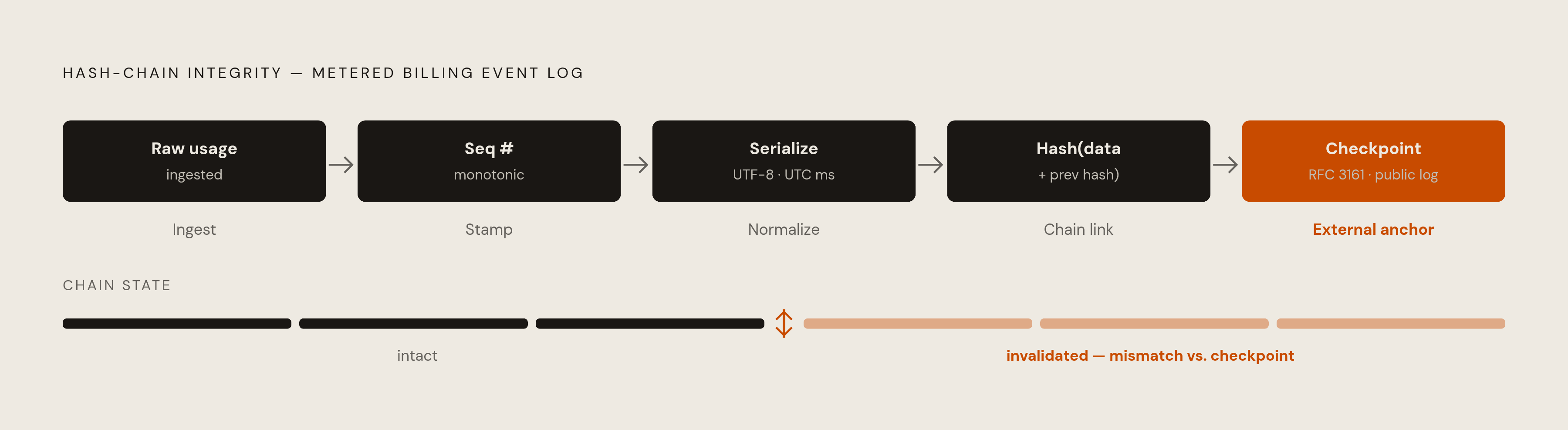
The core mechanism is straightforward once you see it. Each usage event's hash combines its own data with the hash of the preceding event. This linkage means altering any record breaks every subsequent hash, making tampering detectable rather than merely inconvenient.
A working pipeline for this, in a metered billing context, generally runs the same way. Raw usage gets captured in real time at ingestion. Each event is stamped with a monotonic sequence number, and gaps in that sequence during verification are worth investigating independently of any hash mismatch. Before hashing, event data must be serialized identically every time: keys sorted in fixed order, timestamps normalized to UTC with millisecond precision, numbers formatted consistently, encoding pinned to UTF-8. This sounds like a small detail, and it's actually the detail most likely to break a system in production. Once the hash is computed, it's stored with the event, and verification later just means recomputing the hash from the stored data and checking it matches. From there, a rating engine converts raw units into dollars, a billing system turns those dollars into invoices, and a revenue sub-ledger posts the resulting debits and credits. The immutable event log is the evidence layer everything else depends on.
Hash-chaining alone doesn't finish the job, though. Application-layer append-only semantics are necessary but not sufficient, since a privileged database user can still reach past the application to touch storage directly. WORM storage (AWS S3 Object Lock in Compliance mode, or locked-policy Azure Immutable Blob Storage) blocks modification at the storage layer with no administrative override. Pairing hash-chaining with WORM storage achieves most of real non-repudiation at a fraction of blockchain's infrastructure cost.
The remaining gap is external verification. A hash chain that only ever gets checked against itself can, in theory, be rewritten wholesale by whoever controls it, as long as the new chain is internally consistent. Closing that gap means periodically publishing a checkpoint (a summary hash of the chain) to something outside the operator's control: an RFC 3161 timestamping authority, a public transparency log, or a hash committed to a public code repository. Once that checkpoint exists outside the operator's control, rewriting history becomes visible, because the checkpoint and the rewritten chain will no longer agree.
For multi-tenant SaaS, the practical answer is one independent chain per tenant. Cross-tenant verification proves nothing useful and just adds unneeded complexity. A few operational details are essential: synchronized clocks, since timestamp ordering is the chain's foundation; idempotency checks so retried requests don't create phantom usage; and a defined cut-off rule for late-arriving events so they don't break chain integrity.
Research is already pushing past the basic hash-chain design. Nitro, published at ACM CCS 2025, is an eBPF-based tamper-evident audit logging system that avoids the kernel recompilation earlier systems required, catches tampering at fine grain, and shows real performance gains under stress testing and real-world workloads.
The performance objection to tamper-evident logging is real but not a reason to skip it
The objection deserves to be taken seriously before anyone dismisses it. The Nitro paper reports that older tamper-evident logging systems suffered high overhead, lost data badly under heavy load, and only caught tampering at a coarse grain. That's a legitimate track record of failure, not a strawman.
At the scale a metering system actually runs at, this isn't a theoretical concern. A single AI product can produce millions of events daily, and a naive hash-chain implementation, where each write waits on the previous hash, becomes a sequential bottleneck that worsens with volume.
The fix is to build tamper-evidence differently. It's to build it differently. Checkpoint-based verification is one answer: segments verify independently against their checkpoints instead of validating the whole chain from record one, turning an O(n) problem into something parallelizable across ranges. Nitro's variant Nitro-R adds in-kernel log reduction, cutting runtime overhead further without losing tamper-detection granularity. Nitro's eBPF approach matters because it sidesteps the kernel recompilation requirement that made earlier high-performance systems too painful to deploy.
So the honest framing isn't tamper-evidence against performance. It's a question of which architecture delivers tamper-evidence at the volume metering actually produces. The performance objection is an argument for picking the right implementation, not an excuse to leave the log mutable.
What SOC 2, HIPAA, and a revenue recognition standard require from a metered usage log
The three frameworks don't converge on one checklist, and treating them as if they do leaves teams under-built for at least one. SOC 2 Type II requires audit trails logging access to sensitive data with non-repudiation; it sets no specific retention window, but most organizations settle on roughly a year. HIPAA is stricter: any system touching protected health information needs audit controls, and certain §164.316(b)(2)(i) documentation must be retained six years.
Metering data lives in the product or billing system, not the ERP, and most ERPs can't natively apply the variable-consideration constraint logic usage-based contracts require. The usage log is not supporting documentation for the revenue calculation, it is the only source of truth it has.
Snowflake's compute billing shows this concretely: revenue books the moment credits burn, not when an invoice is issued, so the log event and revenue event are effectively simultaneous. If that log isn't auditable at ingestion, the revenue recognized against it isn't defensible either, no matter how clean the invoice looks afterward.
A written revenue recognition policy alone doesn't survive an audit. A policy enforced by the system, where a tamper-evident log feeds revenue recognition directly rather than through a human transcription step, does. The market has priced this in: WorkOS's enterprise readiness checklist notes audit logs now come up in the first sales call, not after signing.
Tamper-evident usage logs as the evidence layer for enterprise trust, dispute resolution, and AI agent accountability
Auditors aren't the only ones asking for this. Enterprise customers billed on usage want independent verification, and a tamper-evident log lets them check their own usage without trusting the vendor's word. Such a log also carries more weight as legal evidence since its integrity can be checked mathematically rather than asserted.
This is what settles billing disputes in practice. When a customer disputes an invoice, the tamper-evident log is what both sides can point to; a mutable log gives neither party reason to trust it, since either could have altered it. The Cursor invoice-shock case is the clean real-world example of exactly this kind of dispute. A vendor with a tamper-evident log for that incident could show events were recorded as they happened, never modified afterward, and tied cleanly to every disputed invoice line.
AI agents add a genuinely new wrinkle to all of this. An audit trail increasingly must answer what an agent did, when, and under whose authorization, since agents touch multiple systems in a single action and reconstructing that chain requires the log to carry sufficient context. WorkOS's May 2026 checklist calls this a gap specific to this moment: MCP-authenticating agents need audit trails scoped to the individual tool level and tied into identity governance, distinct from human-action logs; the MCP project's 2026 roadmap lists standardized audit trails as one of four open enterprise readiness gaps.
The Snowflake breach is the cautionary version of what happens when this drifts. It became central to the identity governance conversation because directory state, application state, and log retention had quietly fallen out of sync. That kind of drift is easy to miss until an incident forces someone to reconstruct a timeline and finds the pieces don't line up. In modern enterprises, NHIs (service accounts, API keys, SaaS integrations) outnumber human identities by 25x or more, and weak lifecycle control lets missed synchronization and missing evidence accumulate quickly.
The minimum viable schema and architecture for a metered billing audit log
Stripped down to what's actually required, a usage event record needs a defined set of fields, not an open-ended one. Identity comes first: who or what performed the action, including role and human-or-agent status, tracked beyond a single session. A UTC timestamp with millisecond precision follows, since ordering underlies both the hash chain and the billing calculation. Action type belongs in the schema as a controlled vocabulary rather than a free-text field, because free text turns a clean audit trail into noise at scale. A resource identifier points to the specific thing acted on: the metered unit, the customer account, or the product line. A quantity or count field carries the number that maps directly onto the invoice line item, which makes it the single most important field for tamper-evidence to protect. Finally, each record carries its own cryptographic hash and the hash of the record before it, plus a monotonic sequence number, since a gap in that sequence during verification is a signal worth chasing down on its own.
Serialization is, in practice, the hardest part: object keys must sort consistently, timestamps normalize to UTC, numbers format identically regardless of language, and encoding stays pinned to UTF-8, since the chain depends on identical event data producing identical hashes regardless of which SDK generates or verifies it.
Storage choice comes down to a real tradeoff, not a default. Append-only Postgres with row-level security is the cheapest path and gives meaningful protection, though not the strongest guarantee available. WORM object storage (AWS S3 Object Lock or Azure Immutable Blob Storage) blocks modification at the storage layer with no override, making it the stronger choice at the cost of query flexibility. Which one a team picks should depend on what an auditor is actually going to ask for, not on which one is easier to stand up this quarter.
Sources
- Rethinking Tamper-Evident Logging: A High-Performance, Co-Designed Auditing System | Proceedings of the 2025 ACM SIGSAC Conference on Computer and Communications Security
- The 10 enterprise features every B2B SaaS needs (and how to ship them fast) — WorkOS
- Why do enterprise SaaS products need SCIM and audit logs as part of IAM?
- Rethinking Tamper-Evident Logging: A High-Performance, Co-Designed Auditing System