Operationalizing Annual Commit Contracts With Monthly True-Ups
How vendors can bill monthly against annual commitments without manual reconciliation errors.

Annual commit contracts with monthly true-ups solve a mismatch that has become unavoidable in software pricing: buyers want a fixed number they can put in a budget, and vendors need a way to recover costs that no longer behave like fixed costs. Large enterprise buyers favor annual terms because they match fiscal-year planning, simplify how accrual accounting treats the expense, and fit capital-approval processes that might only meet twice a year. A twelve-month renewal cycle with a once-a-year negotiation is, for most procurement teams, the only cadence that fits how the rest of the business runs.
At the same time, pure annual commitments have stopped being sufficient on their own. Pay-as-you-grow contracts that bill automatically as usage rises have grown to capture close to 12% of net-new SaaS spend, up from a small share in 2021; Zylo and other SaaS management platforms have tracked this shift. That shift tracks a change in what vendors are actually selling. AI caused the real change in software pricing's cost structure: every AI interaction carries a real compute cost, and a vendor that wraps unlimited AI usage inside a flat subscription fee is betting that average usage stays low enough to protect margin. That bet doesn't hold at scale, and packaging unlimited AI into a flat fee has become a quiet way to erode gross margin one heavy user at a time.
The annual commit with a monthly true-up is the structure that reconciles these two pressures. The commit gives the vendor a predictable revenue floor and gives the buyer a number to put in a budget line. The monthly true-up settles the account against actual consumption, so neither side has to wait a full year to find out the number was wrong. In market terms, this is the "capacity" archetype: commit to a volume upfront, pay overage past it, distinct from pure consumption billing or outcome-based billing. It is a reasonable answer to a real problem. What it costs to run well is the subject of everything that follows.
The operational burden that the sales deck never mentions
The appeal of this structure is easy to describe in a pricing meeting and hard to deliver in production. A monthly true-up is a settlement event, not a billing frequency. Every cycle, a system has to measure what the customer actually consumed, compare that figure against the committed baseline, calculate the overage, produce an invoice that will hold up if the customer disputes it, and do all of that without a person manually checking the math.
Most vendors are not currently clearing that bar. The 2026 SaaS Management Index found that a large majority of IT leaders saw unexpected charges tied to consumption or AI features in the past year, and a similarly large share hit costs that only became visible after the contract was already signed. Those numbers describe a settlement layer that is failing buyers at scale, not just an isolated billing glitch. A surprise overage on a monthly true-up isn't a quirk of the contract. It becomes a support ticket, a dispute, and a churn risk, all three arriving inside a single invoice.
The pattern that produces this failure is consistent across vendors: three separate billing codepaths, one for the committed base, one for usage overages, one for AI credit consumption, reconciled by hand during the first week of every month. That setup guarantees a rising error rate, a finance team that loses days it doesn't have, and a disputed invoice becoming a customer conversation that costs more trust than the overage amount was ever worth. None of this is a pricing-strategy failure. It is an infrastructure gap: can the system count usage correctly, attribute it to the right contract, compute the delta against the commit floor, and produce an invoice that survives scrutiny before the customer has to ask what happened.
What the metering layer must do
A monthly true-up is only as good as the usage data feeding it, which makes metering the foundation the entire contract rests on. Metering has to capture usage at the event level: API calls, tokens processed, GPU-minutes, audio minutes, storage writes, each one recorded with enough detail that a disputed line item can be traced back to a specific event and a specific timestamp.
The engineering demands on that pipeline scale with volume. A simple counter might hold up when event volume is low. As volume grows, the system needs a streaming pipeline built on idempotent writes and at-least-once delivery, because losing or duplicating events is not a cosmetic bug at this layer, it's a billing error. Double-counting the same usage event overbills the customer, and dropping an event means the vendor eats the cost silently. Neither outcome is acceptable, because monthly settlement depends on the number being right. At higher volumes still, the system needs dead-letter queues for failed events, tracing to follow a record through the pipeline, and audit logs on every event, because without those, a disputed invoice can't be defended with evidence.
The aggregation rules that turn raw events into billable units deserve the same rigor. Those rules need version control and an audit trail, because a rule change mid-month, however small, can quietly change what counts as a billable unit and corrupt the true-up calculation for that entire period. And the developer-facing side of metering matters as much as the backend: an ingestion API that's clumsy to integrate, or an SDK that doesn't cover the cases engineering actually needs, pushes engineering teams to build their own abstraction layer on top of it. At that point the vendor has recreated, inside its own stack, the exact fragmentation the metering system was supposed to solve.
How credit-based wallets fit inside an annual commit structure
Credits have become the standard way to make raw consumption legible to a buyer. Tokens, API calls, and GPU-minutes are not units a procurement team can budget against with confidence, so vendors translate them into a single currency, the credit, that can be pre-purchased, tracked, and planned around. That translation is useful. It also adds a layer of bookkeeping that has to sit cleanly next to conventional invoicing, and that's where a lot of the real complexity in this model actually lives.
The mechanics are straightforward in concept: the committed amount funds a credit wallet, usage draws the wallet down, and overage gets billed once the wallet empties before the period ends. Salesforce's handling of Agentforce shows what it looks like to retrofit this onto an existing contract base. Agentforce launched at a per-conversation rate, and in May 2025 Salesforce added Flex Credits priced per discrete action, but it kept the original per-conversation pricing available alongside it. Enterprises can convert unused user licenses into Flex Credits through a Flex Agreement. A vendor can add a second pricing primitive onto an annual-commit foundation without replacing the first one, which tests whether the billing system underneath can hold two models at once without drifting out of sync.
OpenAI's packaging shows a different version of the same idea. Business plans pair a per-seat subscription with an optional shared credit pool that extends usage caps; Enterprise plans use a contract-level shared credit pool with no per-seat cap. In both cases, the seat gives the buyer a fixed floor to plan around, and the credit pool gives them room to grow without opening the door to unlimited exposure. Operationally, this requires the billing engine to track the wallet balance continuously, apply consumption against it correctly before overage pricing ever kicks in, and produce one invoice showing both the credit drawdown and any overage as a single, legible document. Many billing platforms fall short there because prepaid wallets and postpaid invoicing are frequently built as two separate systems. That split forces the manual reconciliation finance teams dread during the first week of every month.
Giving customers real-time visibility into their consumption before the invoice arrives
An invoice can be arithmetically correct and still be a failure if the customer had no way to see it coming. Customers need to watch their consumption trend in something close to real time, so they can act before an overage happens.
The pattern in the 2026 SaaS Management Index, where a large majority of IT leaders ran into unexpected charges tied to consumption or AI features, is a spend-visibility failure: buyers simply cannot see what they're consuming until the invoice tells them, by which point there's nothing left to do but argue about it. A real-time usage dashboard paired with in-flight budget alerts changes that dynamic directly. A customer who can watch a credit wallet draining in real time can adjust usage or request an expansion before the overage is ever invoiced, which converts the monthly true-up from a recurring shock into a predictable, almost routine, event.
Billing predictability has also become a negotiating point in its own right. Vendors who can show a prospective customer that overage charges will never arrive as a surprise are carrying a real advantage into renewal conversations. The technical bar here is specific: an API that exposes current-period usage, wallet balance, and a projected end-of-period total in real time, not a report generated in a batch job after the month closes. Budget alerts set at defined thresholds, escalating as consumption approaches the committed volume, move the customer relationship from dispute to conversation, and conversations are where expansion revenue tends to come from. Vendors who can't show customers their consumption while it's happening should expect the support costs, disputes, and churn that come with bill shock, and those costs reliably outrun whatever it would have cost to build the visibility layer.
The ASC 606 recognition problem that monthly true-ups create for finance teams
The accuracy failure extends past the invoice itself. It extends into how revenue gets recognized, and most billing systems built to track usage events were never built to produce what ASC 606 requires. Overage revenue under a monthly true-up is variable consideration under the standard, and tracking usage accurately is a different task than producing an auditable estimate of that variable consideration.
Under ASC 606 Step 3, usage-based revenue is almost always variable consideration, because the total contract value isn't knowable at signing, it depends on how much the customer actually consumes. Vendors have to estimate that figure, constrain the estimate to an amount they're reasonably confident in, and revisit it every reporting period. Datadog's disclosed FY2025 10-K policy draws the relevant line clearly: committed contractual amounts are recognized ratably over the subscription term, while usage in excess of that ratable amount is recognized as the product is used. Any vendor running annual commits with monthly true-ups has to operationalize that same distinction inside its own revenue recognition process.
The constraint on variable consideration isn't a formality. Auditors review how accurate a vendor's past variable-consideration estimates have been each reporting period, and if those estimates have been materially off, the constraint has to tighten, which has turned into a focal point for auditors covering SaaS companies with usage-based pricing. Credit breakage adds a further layer: unused credits are recognized in proportion to how the customer has historically exercised redemption rights, where that pattern can be estimated, and otherwise only once further redemption becomes remote, under ASC 606-10-55-46 through 55-48. Meeting that rule means the billing system has to track not just what was consumed but the remaining balance and the expected shape of its future use. A system that produces a clean invoice but can't trace that invoice back to the underlying usage events leaves the finance team rebuilding the math by hand every quarter, repeating the earlier reconciliation failure one layer deeper, inside revenue recognition.
The reconciliation workflow that must execute automatically every month
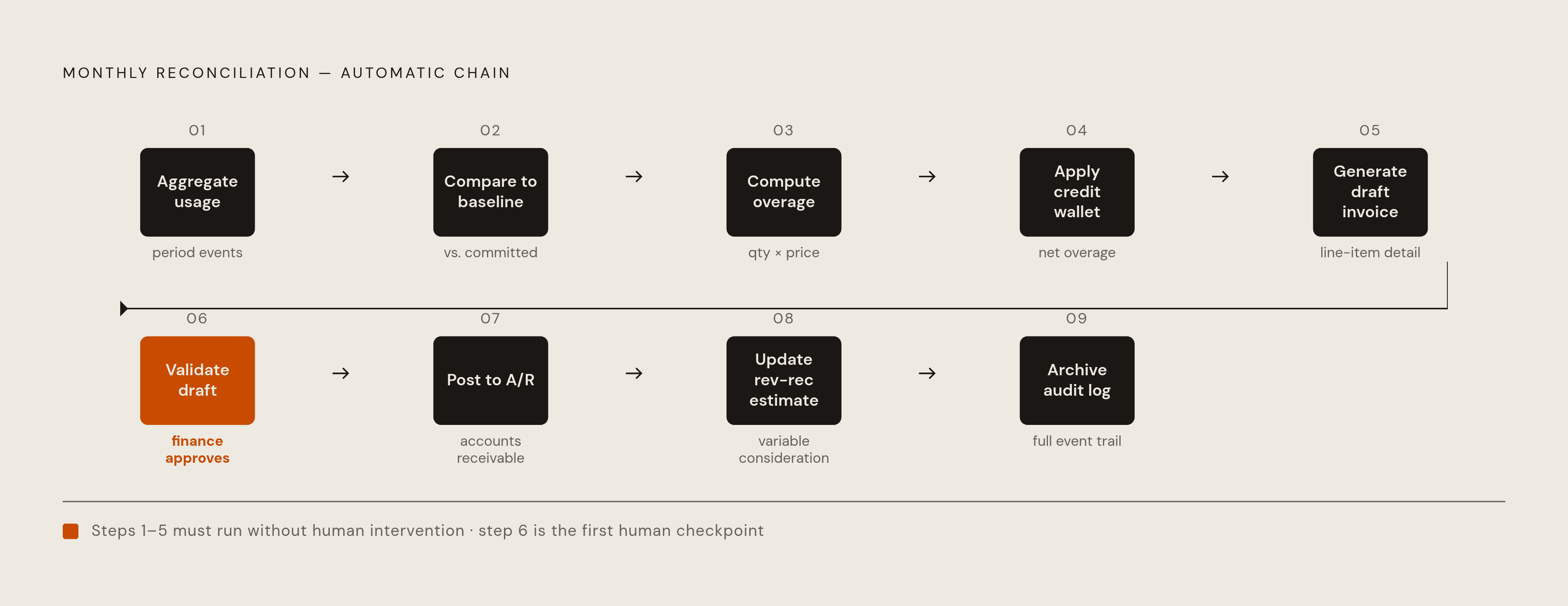
Whether an annual-commit-plus-true-up operation is actually working comes down to one test: does the month-end reconciliation run without a person stepping in to fix it. Laying out the workflow step by step shows exactly where that person is usually still standing.
The sequence runs in order: aggregate usage events for the period, compare the aggregate against the committed baseline, compute the overage quantity and its price, apply any remaining credit wallet balance before calculating net overage, generate a draft invoice with line-item detail, validate that draft against the contract terms, post it to accounts receivable, update the variable-consideration estimate for revenue recognition, and archive the full event log as the audit trail. Each step is a place the whole chain can break. Get the aggregation wrong and the overage is wrong. Work from a stale wallet balance and the net overage is wrong. Skipping the line-item detail leads the customer to dispute the invoice. Fail to archive the event log and there's no audit trail to defend any of it later.
Companies running metering and billing as two separate systems have to integrate them at every one of these steps, and every integration point is a place where data can drift, formats can stop matching, or timing can introduce an inconsistency that appears at month-end, when there's no time left to fix it cleanly. The practical bar for calling a workflow "automatic" is that finance reviews and approves a draft invoice. The system should hand finance something to check, not a blank form to fill in. Pricing changes have to move through this whole chain without requiring engineering to rewrite the aggregation or invoice logic by hand, whether it's a mid-year credit rate adjustment, a new model tier, or a negotiated discount. If teams can't change pricing without opening an engineering ticket, they end up freezing their pricing wherever it stood the last time the system was rebuilt.
Build versus buy for the metering and billing infrastructure underneath the true-up
Any engineering team that can ship the product can build metering and billing infrastructure too. Whether the operational demands of a monthly true-up justify that investment depends on whether infrastructure built for this purpose already exists.
Building it makes sense in one clear case: when metering and invoicing are the product itself, as with a payments company or a billing vendor, the infrastructure is core intellectual property, and building it is simply the job. For every other company, the honest accounting of what building costs includes far more than the initial engineering sprint. Every pricing model change, every new metric a product team wants to bill on, every update to how ASC 606 gets applied, and every scaling event, moving from a modest monthly event volume to a much larger one, becomes its own engineering project competing for time against the product roadmap. That ongoing cost is what the sales deck leaves out, and it's the real number any vendor should be weighing before deciding to build this layer from scratch.