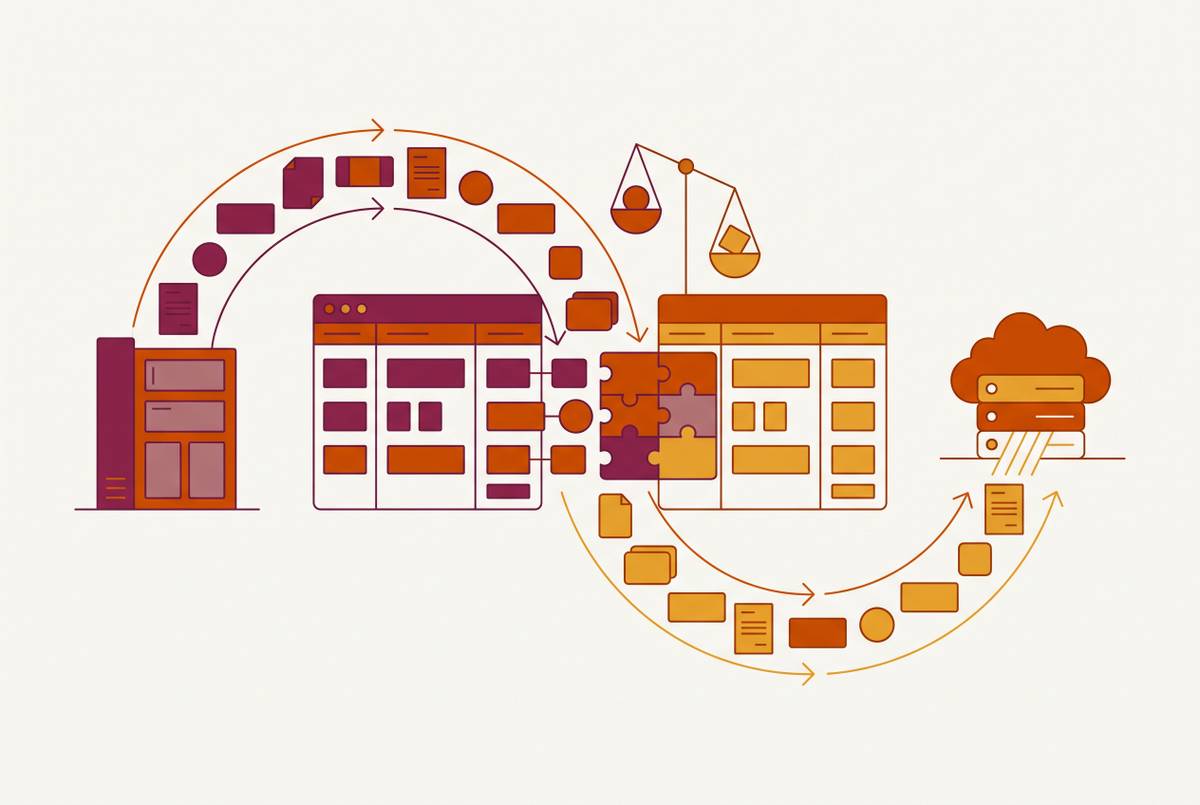
Automated Invoice Matching Between CRM Contracts and Billing System Output
Modeling gaps between CRM contracts and billing systems break matching before it starts.
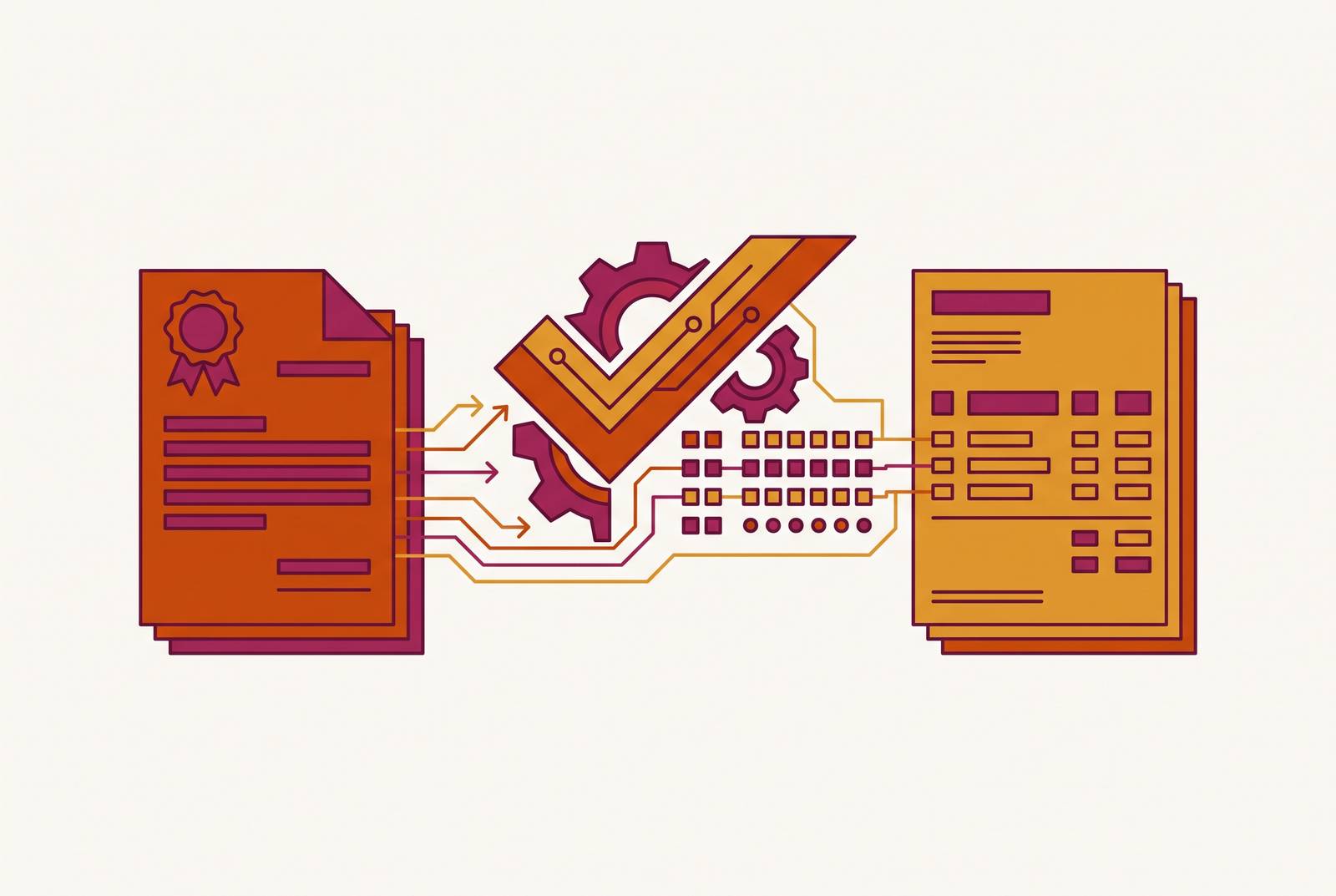
Automated invoice matching fails at exactly the point where a contract stops being simple. Multi-dimensional pricing, prepaid credit blocks, usage commitments with overage clauses: these are the terms that break reconciliation software before it even starts checking numbers, because the billing system generating the invoice has no structural way to represent what the CRM recorded. This is a modeling failure, not a matching failure, and the distinction matters more than most finance teams give it credit for. A model that was never built to represent the contract in the first place remains unfixed by any amount of matching intelligence.
CRM contracts and billing system output rarely describing the same deal
A CRM contract is written in the language of a negotiation. Committed spend, tiered rates, credit packages, overage thresholds, outcome-based fees: this is commercial vocabulary, built to capture what two parties agreed to when the deal closed.
Billing system output speaks a different dialect. Line items, unit prices, quantities, tax codes. Transactional vocabulary, built to describe what happened, not what was promised. Both documents describe the same deal, in theory. But they don't share a data model, and invoice matching automation quietly assumes they do.
That assumption is baked into how the software works. Invoice matching tools reconcile invoices against purchase orders, goods receipts, and contract terms using rule engines, OCR, and increasingly machine learning. All of that tooling presupposes the contract is a legible, structured input the system can query. When the contract encodes commercial logic the billing system can't represent, there's nothing legible to query. The matching engine ends up comparing an invoice to a reference it can't actually read, and it will never flag that as the real problem.
What automated invoice matching assumes
Two-way matching checks an invoice against a purchase order: right supplier, right price, right quantity. Three-way matching adds a goods receipt to confirm that what got ordered actually showed up. Three-way matching is the operational default in accounts payable control today, and modern AP platforms automate the retrieval of POs, apply tolerance bands for small variances, and surface exceptions with a suggested next step.
None of that is in question. It works well for what it was built to handle: procurement of physical goods or fixed-price services, where there's one purchase order, one receipt, one invoice, and a deterministic comparison between them. A crate of parts costs what the PO says it costs. The receipt confirms the crate arrived. The invoice should match both. That's a closed, countable system.
Commercial software contracts are not that system, and pretending otherwise is where most of this breaks down. There's no goods receipt for an API call. There's no purchase order line item for "$0.99 per resolved support ticket." Three-way matching has no native concept of consumption that varies month to month across multiple dimensions at once, and that gap is where the trouble starts.
Where the CRM contract layer breaks the matching assumption
The CRM is where the actual deal lives. Sales reps log negotiated rates, usage minimums, credit packages, ramp schedules, one-off discounts, the entire commercial texture of an agreement that a legal team and an account executive spent weeks shaping. A well-connected CRM-to-billing pipeline is supposed to let those terms flow straight through to the invoice without anyone re-keying them. That pipeline only holds together if the billing system on the receiving end can represent the same terms the CRM captured. Often, it can't.
Take multi-dimensional pricing. A contract billed across tokens consumed, API calls made, and compute minutes used has no single unit price to point to. Each of those three dimensions needs its own aggregation logic, tracked independently and at the same time. A billing system built around "one usage metric, one rate" has nowhere to put the other two.
Prepaid credit drawdowns cause a related but distinct problem. A customer buys a $60,000 credit block. The invoice, if it's correct, should show credits consumed against that block. Without credit wallet infrastructure on the backend, the billing system can't generate that invoice in the first place, so there's nothing for a matching layer to check it against. The comparison never gets off the ground.
Usage commitments with overage pricing add a timing problem: a contract guarantees a minimum spend, with an elevated rate once usage crosses a defined threshold. Billing this correctly means tracking cumulative consumption against the commitment continuously, not at the end of the month after the fact. Outcome-based terms go further still, requiring the system to meter results (a resolved ticket, a completed task) rather than raw inputs like requests or tokens, and most usage billing platforms were never built to attach an arbitrary outcome metric to a line item.
Then there's the mid-cycle amendment. A contract changes terms halfway through a billing period, and the invoice needs to reflect two rate regimes inside one period. That's a proration problem, and plenty of billing systems simply don't handle it with any precision.
None of these count as edge cases anymore. Each one is a place where the billing system lacks the structural vocabulary to say what the contract actually says, so the invoice it produces doesn't correspond to the agreement, no matter how carefully the CRM recorded it.
How usage-based and credit-based pricing worsen the representation problem
This would be a manageable, occasional headache if usage-based pricing were still a niche approach. It's close to the default now for software companies selling anything with a consumption component, and the trend runs further in that direction, not away from it. Usage-based and prepaid models have increasingly displaced straight subscriptions as the preferred commercial structure among enterprise software buyers. The contracts sitting in enterprise CRMs increasingly assume some form of consumption metering, which happens to be the exact thing a large share of billing infrastructure was never built to process.
Credit wallets are a sharp, specific version of this failure. Prepaid credits need credit types, expiration policies, auto-refill logic. Basic customer balance fields, the kind bolted onto older billing systems as an afterthought, don't model any of that. This is not a theoretical concern. A billing system that can't track credit balance in real time can't produce a correct invoice for a credit-consuming contract. Matching automation breaks from the first invoice cycle, not after some slow accumulation of edge cases.
Outcome-based billing sits at the frontier of this problem, and it keeps growing. Salesforce's Agentforce prices around $2 per conversation, and similar per-outcome models have emerged across the industry. These are real commercial terms, recorded faithfully in a CRM as commitments both sides signed on to. Billing them correctly takes outcome metering infrastructure that most systems don't have, and no matching layer can paper over metering that was never built.
The metering gap: when the billing system cannot count what the contract specified
Matching automation checks an invoice against a reference document. That reference is only as trustworthy as the metering that produced it, though, and this is where a lot of otherwise sophisticated matching setups quietly fall apart.
A billing system that processes usage in nightly or hourly batch jobs, rather than as events happen, runs into a specific and predictable set of problems. It can't enforce a spend cap in the middle of a billing period, because it doesn't know the running total until the batch runs. It struggles with correct period cutoffs when usage events arrive with clock skew, a normal occurrence in distributed systems. It can misattribute charges when resource tags go missing upstream. And it risks double-billing when the same event gets ingested twice after a retry, which happens constantly in real distributed infrastructure.
The fix is architectural: real-time stream processing, meaning events get pulled from a message broker, run through stateful transformations, and written into a billing state store as they occur. That's the actual infrastructure requirement behind an invoice that can be meaningfully matched against a complex contract. Multi-dimensional metering makes the requirement stricter still, since tokens, API requests, and compute minutes each need separate, independently aggregated usage records tracked at the same time. A billing system built around a single usage dimension produces invoices that are wrong relative to the contract, consistently and predictably, not occasionally.
Organizational consequences of matching automation meeting an unmodeled contract
The tell is a high exception rate that doesn't improve no matter how much more automation gets thrown at it. Exceptions occur repeatedly, invoice after invoice, because the contract's terms and the billing system's computational capabilities remain misaligned. That recurring gap is the direct cause of the exception rate, and no amount of retraining a matching model closes it.
Teams that hit this wall tend to respond by building parallel billing codepaths: one for subscriptions, one for usage, one for credits, each with its own logic, its own quirks, its own edge cases. Then someone has to reconcile all three by hand at month-end. The first week of every month turns into an ad hoc reconciliation project, with finance manually comparing what the billing system actually invoiced against what the CRM contract says was owed, and computing the delta line by line.
Industry analysis has found that manually processed invoices take a significant amount of time each to handle. At 5,000 invoices a year, that approaches a full-time employee's worth of labor on the mechanical processing alone. That figure almost certainly understates the real cost, since reconciling a usage-based or credit-based contract by hand means actually understanding the contract's logic, not just reading a static document and checking a total.
A smarter matching layer on top of a structurally broken billing system that does not work
Modern AI-powered matching tools are genuinely capable. They use machine learning to catch anomalies, recognize patterns across thousands of line items, and surface mismatches along with a plausible reason. That progress solves the anomaly-detection and pattern-matching problem those tools were built for, and it's a real advance over rule-based reconciliation from a decade ago.
Matching AI can tell you an invoice doesn't match a reference document. It cannot tell you whether the invoice was computed correctly from the underlying usage data, not when the billing system generating that invoice never had a model capable of representing the contract to begin with. Detecting a mismatch and diagnosing a modeling failure are different tasks, and no amount of pattern recognition turns one into the other.
A matching system that flags every usage-based invoice as an exception, month after month, is narrating a structural gap it has no ability to close. Salesforce's 2025 guide to automated invoicing points out that smart systems flag unusual spikes for review, citing an example of a monthly invoice jumping from $5,000 to $15,000. That flag makes sense for a fixed-fee service contract. In a usage-based AI product, though, a $15,000 invoice might be exactly right, if a customer simply ran a large inference workload that month. The matching system has no way to tell a legitimate usage spike from an error, because it never had access to the metering data that would tell it the difference.
Billing infrastructure requirements for viable matching automation
Treat this as a prerequisite checklist. A matching product can do all sorts of clever things, but those capabilities only matter once the billing system underneath already meets certain conditions.
Structural representation of contract terms comes first. The billing system needs to model multi-dimensional pricing, tokens, API calls, compute minutes, outcome units, as genuinely distinct dimensions, each aggregated on its own, not collapsed into a single unit price for convenience.
Real-time event ingestion comes second. Usage has to be ingested and rated as it happens, not accumulated in a batch job and settled after the fact. That capacity is the architectural foundation for any invoice meant to reflect actual, current consumption rather than a delayed or estimated stand-in for it.
Credit wallet infrastructure comes third, and it needs to be a first-class object in the billing system, not a single balance field grafted on as an afterthought. Credit type, current balance, expiration policy, and full drawdown history all need tracking with the same rigor as any other financial record. Skipping this turns every credit-based contract into a manual reconciliation exercise by default.
Evaluating whether a billing system can support automated CRM-to-billing matching for complex contracts
The real test is whether the billing system feeding that matching layer can natively represent the actual commercial terms sitting in the CRM: multiple simultaneous usage dimensions, prepaid credit balances with real expiration logic, usage commitments tracked cumulatively and in real time, and rate changes that take effect mid-period without breaking proration.
If the answer to any of those is no, matching automation will generate a steady stream of exceptions that no rules engine or machine learning model can resolve. The exceptions were never really about the invoice. They trace back to the model underneath it, a model that never represented the contract correctly to begin with, and this flawed model produces exceptions that matching software, however capable, was never built to fix.