Billing System Cutover Reconciliation During a Platform Migration
Small errors in plan mapping become customer disputes and chargebacks overnight.
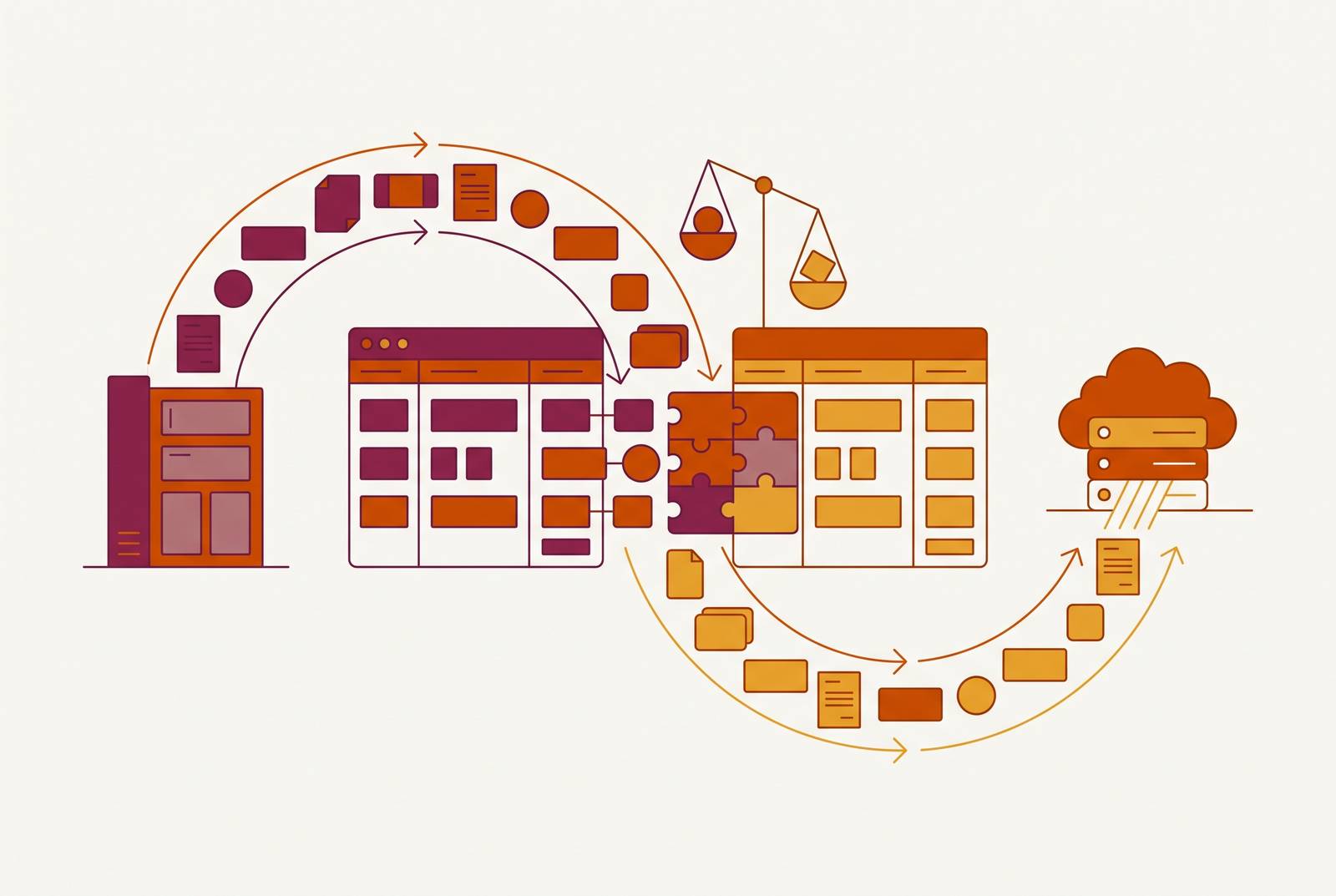
Billing system cutover reconciliation is the phase of a platform migration where small mistakes turn into real money and real disputes, fast. A rounding error in a plan mapping doesn't stay theoretical once it hits a customer's invoice: it becomes a support ticket, then a chargeback, then a conversation with legal. Reconciliation is not a cleanup task you do after the migration, and that thesis should sit before anything else. It is the migration, and everything else is scaffolding around it.
Pricing has moved fast, and that speed is what puts pressure on this. Legacy billing platforms were built for flat subscriptions, one plan, one price, one renewal date, and that was a reasonable design in the era they came from. It is not the era companies operate in now. By 2026, 74% of suppliers had adopted usage-based pricing models. The share of SaaS companies using any form of usage-based pricing rose from roughly 30% in 2019 to about 85% by 2024. And 59% of software companies expect usage-based revenue to keep growing as a share of the total, up 18 points from 2023. Systems designed for flat subscriptions are being asked to run pricing logic they were never built to hold. That is why so many companies are migrating in the first place, and why the migration itself carries so much risk.
Billing is not like other systems. A CRM swap can tolerate a rough week. Billing cannot, for a handful of reasons that compound rather than sit independently. Financial accuracy is non-negotiable, because customers see the output directly, and an error is not an internal bug but a wrong charge on someone's card. Subscription states carry real complexity: proration, credits, prepaid balances, usage recorded mid-cycle, none of which resolve cleanly to a single number. Regulatory obligations sit on top of all of it, since invoice sequencing, audit trails, and revenue recognition rules don't bend for a migration schedule. And the zero-downtime expectation that applies to billing is stricter than what most other systems get, because a lapse in billing is a lapse in revenue capture, not just a lapse in convenience.
The risk taxonomy of a billing cutover: what fails, and where
Migrations rarely fail on the parts that got scoped. Migrations fail on the parts nobody thought to scope: corrections applied by hand months ago, contract terms negotiated outside the system, the customer whose pricing exists mostly in a support agent's memory and a spreadsheet tab.
Pricing-model mapping is where this appears first. An override that a sales rep applied two years ago, maybe a lasting discount tied to a renewal negotiation, was never built as a plan object in the legacy system. It was a spreadsheet row, or a manual adjustment applied every cycle by someone in finance. When the migration tooling looks for a plan to map, there's nothing structurally there to map. It gets missed, or worse, it gets guessed at.
Event replay creates a second failure class, and it's subtler. Two systems can both claim to "aggregate usage" and mean different things by it. One counts every event; the other counts unique values within a window. Replay the same event stream through both, and the totals diverge because the two systems were never computing the same function to begin with.
Then there's the parallel run itself, which introduces its own failure mode independent of pricing logic. Events reach one pipeline and not the other, maybe a webhook retry policy differs, maybe a queue drops a batch, and the resulting diff looks exactly like a pricing bug. It's an ingestion gap wearing a pricing bug's clothes, and conflating the two sends engineering teams chasing the wrong root cause for days. It's an ingestion gap wearing a pricing bug's clothes, and conflating the two sends engineering teams chasing the wrong root cause for days.
Pricing construct mapping: the pre-reconciliation work that determines whether the parallel run means anything
Before any parallel run has value, someone has to map constructs, not plan names. A plan called "Pro" in the legacy system is rarely one thing. It's a bundle made up of a base rate, a set of included units, an overage schedule, maybe a discount tier, maybe a grandfathered term. Each of those pieces needs its own home in the new system, and treating "Pro" as a single object to migrate is how half of it gets lost in translation.
Take a prepaid balance. In the old system, it's probably one number sitting on the account. In the new system, it needs to become a credit ledger, with individual grants, expiry dates, and a priority order for which credit gets consumed first. The failure mode is predictable: expiry and rollover were never stored anywhere, they were enforced manually rather than by any system record. There's nothing to migrate because there was never a record to begin with, just institutional memory.
An annual commitment with a true-up provision has the same shape. The clean version in the new system is a commitment amount plus a defined per-cycle overage calculation. The version that actually exists in most legacy environments is a spreadsheet someone updates at renewal time. Spreadsheets don't import. If the true-up logic was never codified, the migration has nothing to point to, and someone has to reconstruct the business logic from finance's records before the technical work can even start.
Retired plans carry a quieter risk. A customer sitting on a plan that was discontinued three years ago still needs their exact pricing preserved, not a modern approximation of it. The correct approach is a pinned plan version with a full audit trail. The failure mode is someone deciding the old plan is "close enough" to a current one and rebuilding it that way. It isn't close enough. The bill moves, the customer notices, and now there's a dispute over a plan that was working fine until the migration touched it.
Designing the parallel billing window: duration, structure, and what each cycle is testing
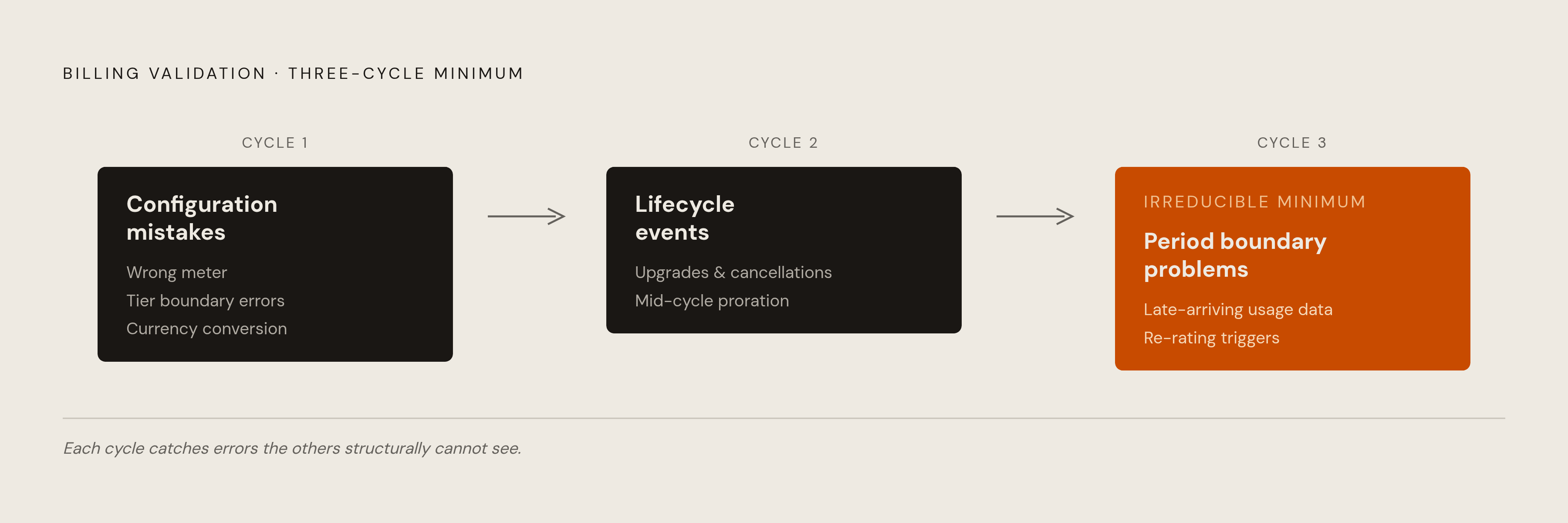
A single billing cycle run in parallel proves almost nothing. Three cycles is the practical minimum, and each one is built to catch a different category of error that the others structurally cannot see.
The first cycle catches configuration mistakes, including the wrong meter attached to a product, a tier boundary set one unit off, and a currency conversion applied incorrectly. These are static errors, present from the moment the new system goes live, and a single cycle of comparison surfaces them.
Lifecycle events appear in the second cycle. Upgrades, cancellations, plan changes, none of these occur reliably in cycle one for every customer, and some of them only ever trigger once someone takes a mid-cycle action. A customer who never touches their subscription in cycle one might upgrade mid-cycle two, and that's the first moment the proration logic in the new system actually gets exercised.
The third cycle exists for period boundary problems, specifically the case where usage data arrives late and lands after a billing period has already closed. That triggers a re-rating, a recalculation of a bill that was already considered final, and re-rating logic is an edge case that doesn't appear until a period boundary has actually been crossed at least once under real conditions.
Running this properly requires a clear split in how data is handled. Historical data, closed invoices, completed payments, terminated subscriptions, gets migrated once and held separately from active data. Active data, current-period usage, live prepaid balances, invoices still in draft, has to stay synchronized across both systems for the entire length of the parallel run. And side-by-side monitoring needs to be operating before a single live customer moves over, not bolted on after the fact once someone notices the numbers don't match.
The ingestion-gap trap from the risk taxonomy resurfaces here in its most damaging form. A diff between two systems during the parallel window can come from a genuine pricing discrepancy, or it can come from an event that reached one pipeline and not the other. Treating every diff as a pricing bug means engineering time gets spent debugging logic that was never wrong, while an actual plumbing problem sits unaddressed.
The parallel window's real output is a dataset. It's a dataset, a record of every place the two systems agreed and every place they didn't. What matters next is how that dataset gets read.
Variance gates: how to set thresholds that catch real errors instead of letting them cancel out
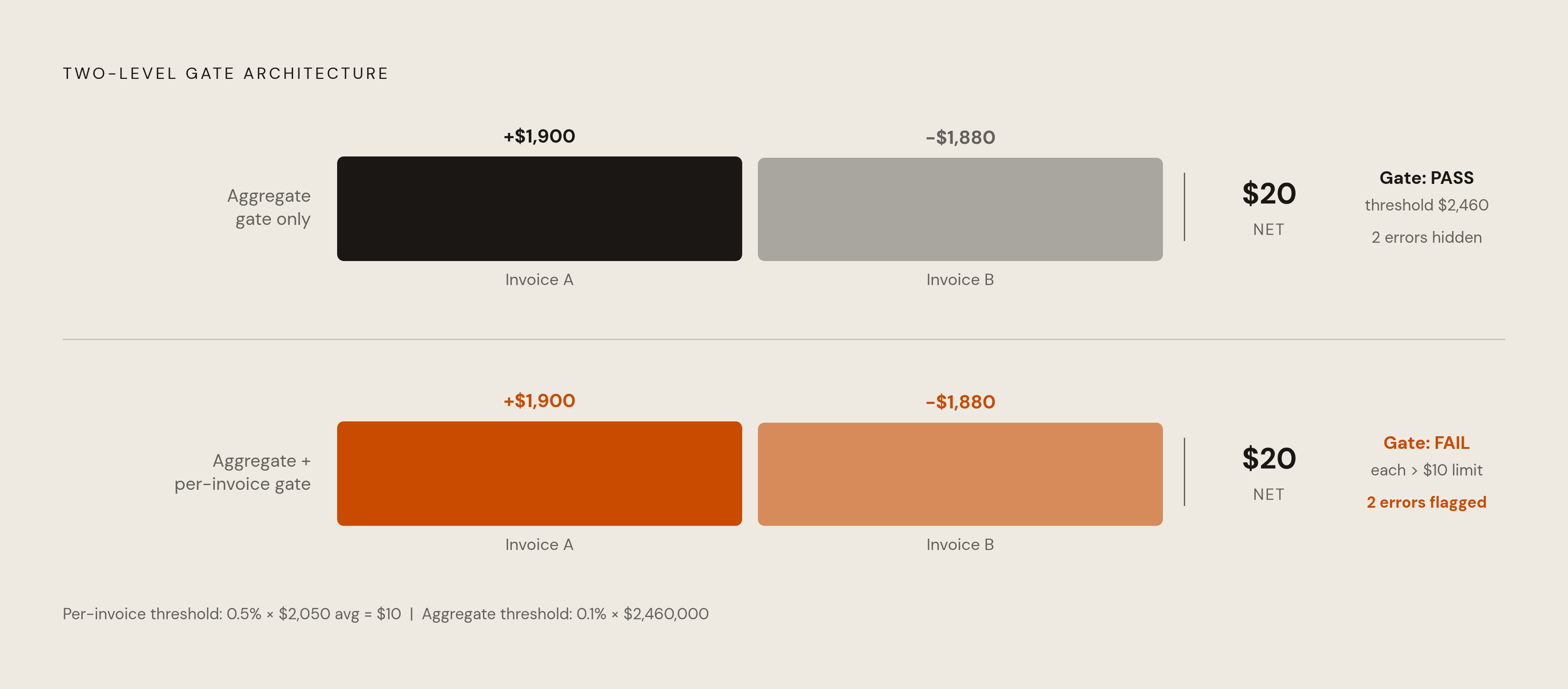
The single most important thing to understand about variance measurement is that an aggregate threshold can hide the exact errors it exists to catch. Consider an invoice overstated by $1,900 sitting next to another understated by $1,880. Net variance: $20. Against a billing volume in the millions, that clears an aggregate gate easily. And yet two customers received wrong invoices, one overcharged by nearly two thousand dollars, and the aggregate number said everything was fine.
This is why a defensible gate architecture needs two levels running at once, not one. An aggregate gate measures total variance across every invoice in the window, expressed as a percentage of total billing volume, and it's useful for spotting systemic drift. A per-invoice gate is separate and non-negotiable: every individual comparison gets checked against its own threshold, regardless of what the aggregate says. One catches the forest. The other catches the tree that's on fire.
Concrete numbers make this legible. A pause threshold set at 0.1% drift against a total billing volume translates to $2,460, a hard stop at which the parallel run halts entirely until someone identifies the source. That's a hard stop, not a warning label. Separately, a per-invoice gate set at 0.5% of an average invoice value of $2,050 works out to roughly $10 of allowable variance on any single bill. Below that, noise. Above it, an error that needs a name and an owner before reconciliation continues.
The cutover window: sequencing the go-live decision and protecting the first billing cycle
Eight hours is the realistic downtime ceiling for a billing system cutover, and treating that number as generous is a mistake. Every hour past it compounds risk on revenue that's supposed to be flowing continuously.
The sequence inside that window has a logic to it. From H+24 to H+28, exception remediation happens: every reconciliation gap identified during the parallel run gets a written disposition, an explanation and a resolution, before the cutover window closes. Nothing carries forward as "figure it out later." From H+28 to H+32, integration tests run against the target system directly. From H+32 to H+36, smoke tests run against real accounts, not synthetic test data, to confirm the system behaves correctly under actual account conditions. At H+36, the go/no-go decision gets made, and it requires sign-off from the CIO, COO, CFO, compliance, and the executive sponsor. Five signatures, not one person's judgment call.
Success should be measured in stages, not declared once. Tech cutover, first full billing cycle, and reconciliation are three separate milestones, and treating the tech cutover alone as proof of success is a documented failure pattern. The system can come up cleanly and still generate a wrong invoice three weeks later when the first real billing cycle closes.
Rollback conditions need to be written down before the cutover starts, not improvised once something breaks. That means naming specific triggers in advance: abnormal decline rates, duplicate invoices, webhook delivery failures, mismatches in downstream reporting. It means defining the rollback window itself, with 24 hours cited as a success criterion for completing a rollback if one becomes necessary. And it means keeping the legacy system in read access, not archived and inaccessible, until the first dispute raised against the new system has actually been resolved. Archiving too early removes the one reference point that explains what the correct answer used to be.
Reconciliation with real-time metering and usage events
Subscription-only migrations deal with discrete, auditable inputs: plan assignments, dates, rates. You can list them, count them, check them one at a time. Metered billing changes the nature of the input. The data is a continuous stream of events, and any gap in that stream doesn't sit quietly, it turns directly into underbilling or a disputed invoice, because there's no static record to fall back on and check against.
Documented incidents in metered billing systems point to a consistent set of failure classes. Duplicate ingestion after a retry produced double billing for twelve hours in one case, the system doing what it was told, just twice. Clock skew between ingestion nodes has split aggregation windows apart, causing usage to be undercounted because events landed in the wrong bucket relative to each other. A service outage that interrupts the event stream can erase an entire customer's charges for a full month, since there's no batch job to rerun when the input itself never arrived. And a schema migration on the producer side, upstream of billing entirely, has caused dropped records simply because the shape of the data changed and nothing downstream was told.
None of these are pricing bugs in the way a misconfigured tier is a pricing bug. They're infrastructure failures that surface through the billing system because billing is where their consequences become visible and expensive. Reconciling a metered billing migration means watching the stream itself, not just the totals it produces, because by the time the totals look wrong, the gap in the stream has already happened.