Access Controls for Billing Data Across Engineering, Finance, and Customer Success
Split billing data into separate access planes so each team sees only what they need.

An engineer granted billing-reader access to debug a metering issue can, in the same login, see private offer terms and commercial discounts negotiated between sales and a customer's legal team. Neither person asked for more than they needed. The system simply had no way to give them less. That is the core failure this piece addresses: billing data behaves as three different things at once, an engineering artifact, a financial record, and a customer-facing signal, and those three functions need different people to see different parts of it. Engineering needs raw usage events, complete with API keys, customer IDs, request metadata, and model identifiers, to confirm that a metering pipeline is counting correctly. Customer Success needs enough plan and invoice visibility to manage an account and catch overage risk early, but it has no reason to see pricing strategy, contract discount terms, or margin data.
If you collapse those three needs into one shared access plane, a common shortcut in fast-growing billing systems, you don't get broader productivity. It's broader exposure: every team ends up holding data it never needed, which is a fraud risk, a compliance liability, and a channel for competitive information to leak out through people who were never trained to handle it.
The surface area of this problem keeps growing because usage-based and hybrid pricing models generate far more cross-team billing data than flat-rate subscriptions ever did. A usage-based AI product can produce millions of metering events, and each one works at once as an engineering signal and a financial input. Every new pricing dimension, tokens, GPU-minutes, API calls, agent resolutions, adds a category of data with its own sensitivity profile and its own legitimate audience. Atlassian's move to expand usage-based pricing across Rovo credits, Automation steps, and AI agent resolutions, with billing taking effect December 3, 2026 for most meters, shows what this looks like in practice: an enterprise product that now has to give finance and Customer Success visibility into usage data without handing either team write access into engineering workspaces. So you have to design access around what each team actually does, not around a single permission set that tries to serve all three at once.
The three planes that billing data must be separated into before roles are assigned
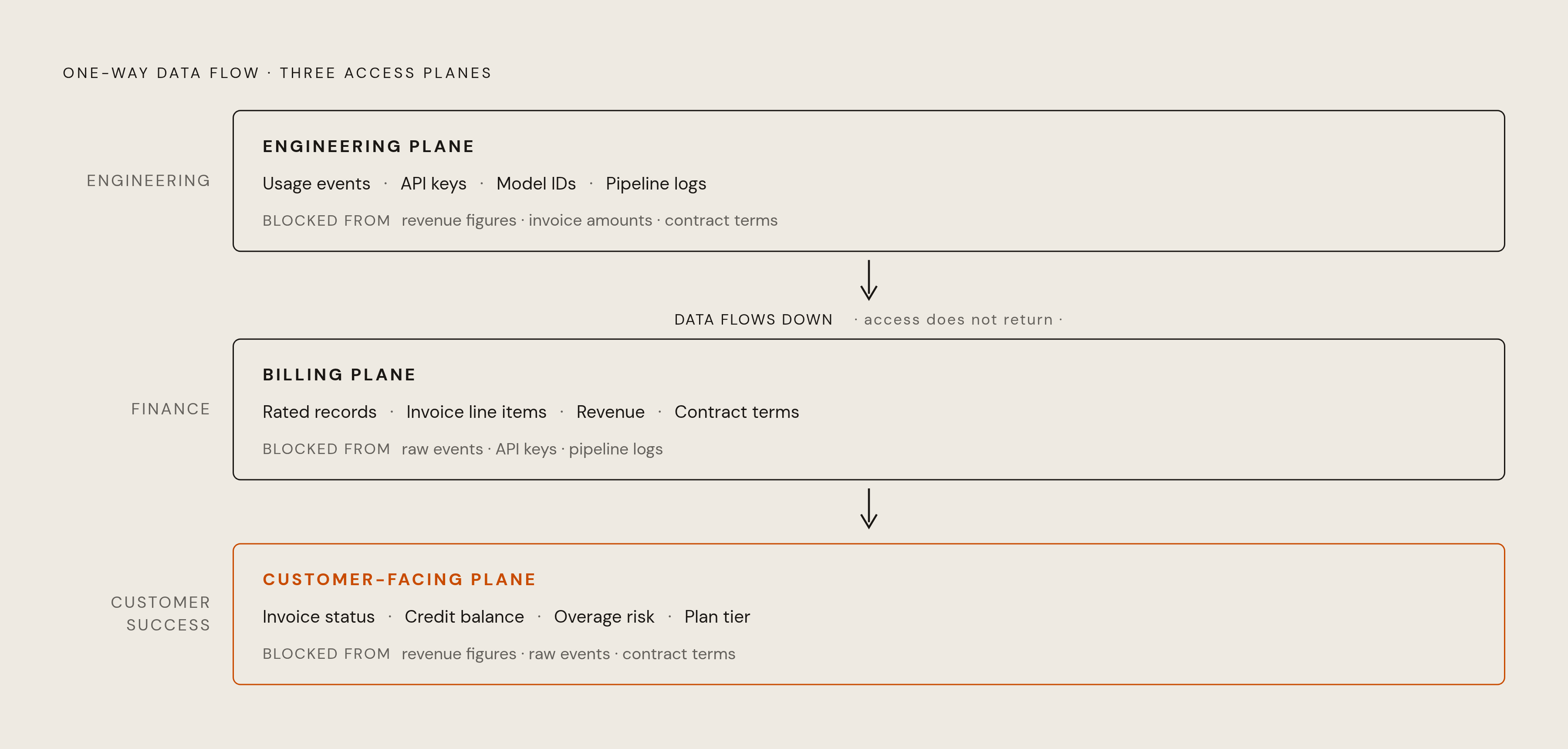
Before you assign any role, you have to split billing data into three planes, because a role built on top of an unseparated data model will eventually over-permission someone. The first is the engineering plane: raw usage events, customer IDs, API keys, model identifiers, request metadata, pipeline logs. This is the input to billing, not billing itself. The second is the billing plane: rated and aggregated records, invoice line items, credit balances, revenue figures, contract terms, discount structures. This is finance-level data, built from the engineering plane but distinct from it. The third is the customer-facing plane: the narrow subset of billing information a customer or their account manager actually needs, invoice status, current credit balance, overage risk, plan tier. This plane is a permissioned view derived from the billing plane, not a doorway into it.
Microsoft's governance guidance for Azure describes a comparable structure, splitting identity, resource access, and billing into separate planes with separate role sets, which confirms that plane separation is an established pattern in large-scale cloud governance, not a theoretical ideal invented for this article. The pattern shows up because the alternative keeps failing in the same two ways. Giving engineers billing-plane access "so they can see costs" means they end up looking at MACC credits, private offer terms, commercial discounts, and Marketplace purchase history they have no operational reason to see. Neither mistake usually comes from bad intent. Both come from convenience: the fastest way to let an engineer debug a billing dispute is to hand them billing-plane read access, and the fastest way to let finance see resource costs is to hand them resource-plane read access. From an audit standpoint, that convenience-driven shortcut looks identical to deliberate over-permissioning, because the exposure it creates is the same either way.
In a usage-based system, this separation has to be built into the pipeline itself, not patched in later with dashboard filters. Raw usage events belong to engineering, but aggregated billing records belong to finance. If both sit in the same data store and the only thing standing between them is a dashboard-level filter, one misconfigured query or one compromised credential puts the wrong plane in front of the wrong audience. The fix is to treat usage events the way a bank treats a transaction log: immutable, traceable, and kept apart from the rated billing records downstream. That means decoupling the metering pipeline, which runs on engineering credentials, from the rating and invoicing layer, which only ever exposes aggregated, permissioned views to finance and Customer Success. That decoupling serves two purposes at once. It makes the system more reliable, and it makes the system harder to misuse.
What engineering should see, own, and be blocked from
Engineering's legitimate claim on billing data is wide on the metering side and narrow on the financial side, and most access failures in usage-based billing systems happen because someone treats those two sides as one. On the metering side, engineering should own the pipeline itself: event ingestion, idempotency logic, aggregation rules, backfill procedures, and the schema that defines what counts as a billable event. Engineering should be able to read aggregated usage summaries, enough to confirm the metering system is counting correctly, without needing to open the invoice records those summaries eventually feed. Engineering should be blocked from rated invoice line items, customer contract terms, discount structures, credit balances treated as financial records, and anything that reveals pricing strategy or margin.
That boundary isn't about whether an engineer can be trusted. It comes from segregation of duties: an engineer who can both emit billable events and read the invoices those events generate holds end-to-end control over a financial process, and that is exactly the condition segregation of duties exists to prevent. Segregation of duties isn't only a fraud control. SOX requires it for publicly traded companies, and even companies not bound by that law should adopt it as a strong control. A finance auditor reviewing the billing system will ask, directly, whether the person who configured the metering rules is the same person who could approve the invoices those rules generated.
None of this means engineering has no claim on cost data. Engineers legitimately need to see what their systems cost to run, and that need should be met with read-only, scoped access to resource-cost aggregates, not with a billing-plane role. So an engineer can see what their own service costs, but they cannot see every customer's contract terms.
What finance should see, own, and be blocked from
Finance's access needs run in the opposite direction from engineering's: deep on invoices and revenue, blocked on infrastructure and configuration. Finance should be blocked from the engineering plane entirely: resource configuration, API keys, metering pipeline settings, and raw usage events carrying request metadata or engineering credentials. Finance roles belong in the billing plane, not the resource plane, and giving finance Cost Management access at the resource level to "see costs" pulls in infrastructure data that has no bearing on financial reporting and opens a compliance surface no one asked for.
Most organizations get this backward in a quieter way: finance often lacks the access it actually needs while carrying access it shouldn't have. When metering and billing run as genuinely separate systems, with no clean aggregated handoff between them, reconciliation becomes a recurring finance task instead of an automated output. The fix is to give finance read access to the aggregated output of the metering pipeline so invoices can be checked without looping engineering into every billing question. When finance has to ask engineering to pull a usage report before it can close the books, that dependency is both an access failure and a monthly tax on two teams' time.
Segregation of duties has to apply inside finance, too, not just between finance and engineering. If a finance user can both issue a credit memo and approve the invoice adjustment that memo produces, they hold end-to-end control over a financial correction, the same violation as an engineer who controls both metering and invoicing. To configure this correctly, you split credit issuance, invoice approval, and payment posting across different people, even within a small finance team. If you skip that separation, a single finance user can bypass financial controls and create fraud or compliance exposure with zero engineering access required.
One more dimension belongs in finance's access plan now, not later: AI workflows operating inside billing and finance systems need the same governance as human users. An AI assistant needs invoice records, vendor balances, and approval states to be useful, but finance data isn't a general knowledge base an assistant should browse freely, and its access has to run through the same permission logic as a human analyst's would. If you don't govern that access, AI copilots and automation tools become uncontrolled paths for financial data to leave the building, exporting records to external systems with no audit trail behind them. The governance model finance needs here mirrors the human one: define where an AI tool can query, where it can recommend an action, where it is barred from triggering one, and audit all three.
Customer Success access: what to see and the risks of excess
Customer Success is the team most often over-permissioned in a billing system, for a simple reason: their job genuinely requires billing visibility, and it's easy to mistake "needs to see billing data" for "should have billing access." What CS should see is narrow and specific: invoice status, current credit balance, plan tier, overage risk, usage trend against plan limits, and payment status. What CS should be blocked from is just as specific: pricing strategy, contract discount terms, margin data, any competitor pricing referenced in contract notes, and any billing configuration they could change rather than just view. A CS rep who can join a customer call and speak to that customer's credit balance and invoice status has exactly the access the job requires. A CS rep who can export billing records, see another account's discount terms, or view a customer they've never worked with has access that creates compliance exposure and commercial risk that has nothing to do with the job.
That risk is commercial leakage and compliance exposure rather than fraud. In regulated industries, CS access to billing records that include personal data, customer names, payment methods, invoice addresses, creates data protection obligations that most CS teams were never trained to carry.
These requirements shift again during a pricing migration, and that shift exposes a gap in how most role systems are built. Most role systems are built for steady-state access, not for a transition. Without an explicit migration role, organizations tend to pick one of two bad options: over-permission CS with full billing-plane access for the duration of the migration, or under-permission them and leave reps unable to answer the questions customers are actually asking. The right design is a migration role that's time-bounded: it grants read access to both plan structures and expires automatically once the migration completes, so you need a billing system that supports versioned roles rather than static role assignment. This is the same pattern driving the growth in billing-data complexity described earlier: more pricing dimensions mean more edge cases, and more edge cases mean access control has to flex without quietly expanding everyone's permissions along the way.
Why RBAC alone is insufficient for billing data
Role-based access control answers one question well: what can this job title see? It does not answer the questions billing data actually raises, which are about scope, time, and context, not just title. A finance analyst role under pure RBAC either has access to all customer contracts or none. It has no native way to say "this analyst can see contracts for the accounts she's assigned to, and nothing else." Under pure RBAC, a CS migration role either persists forever, quietly becoming a standing over-permission, or it gets revoked manually, and that depends on someone remembering to do it. Segregation of duties, the control finance and engineering both depend on, is a rule about which combinations of roles a single person can hold at once, not a role itself, and RBAC systems built around assigning roles to people have no native way to express that kind of rule.
What billing access actually needs is RBAC plus three layers on top of it. Attribute-based controls narrow a role by context: not "finance can see invoices" but "finance can see invoices for accounts in their assigned region." Policy-level SoD rules sit above both, and they check not what any single role permits but what a person's combined roles permit together, flagging the case where one individual holds both invoice-approval and credit-issuance rights even when each role looks fine on its own.
None of this is exotic. It's the same logic that governs access to sensitive financial information in banking, where visibility and control have to span the whole data ecosystem, not stop at a single system's login screen. Billing data in a usage-based, AI-priced product carries the same weight. An engineer's debugging session, a finance analyst's monthly close, and a CS rep's customer call all touch the same underlying events, but each of them needs a different, bounded view of what those events mean. Building that view requires more than assigning roles. It requires deciding, in advance and in writing, exactly where each plane ends and the next one begins.