Billing-to-CRM Data Reconciliation in Enterprise Revenue Operations
Architecture, not spreadsheets, closes the billing-to-CRM gap.
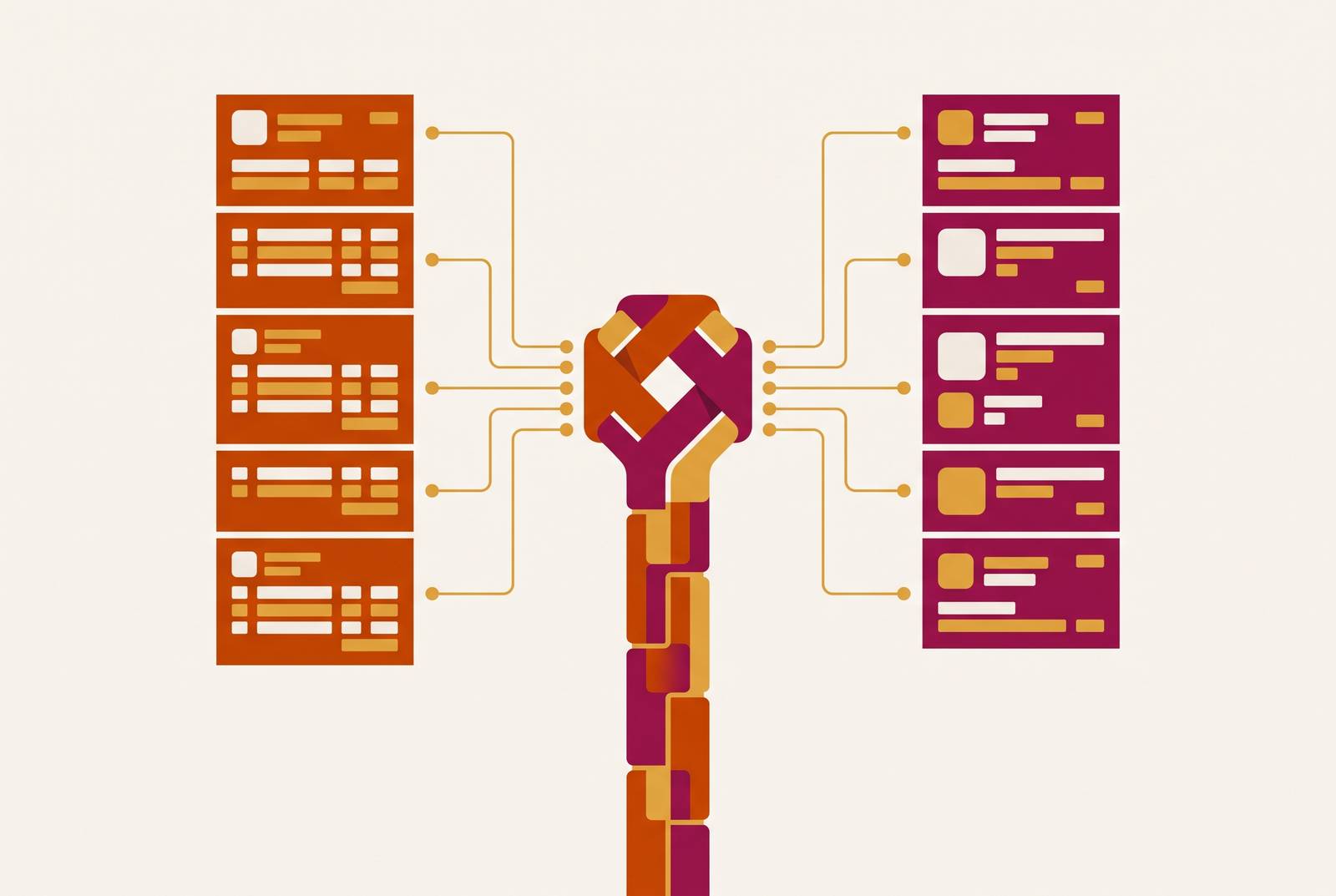
The billing-to-CRM reconciliation problem in enterprise revenue operations isn't a data hygiene issue that better spreadsheets or a cleanup sprint can fix. When the billing layer can't produce clean, real-time usage and invoice data, every system downstream, CRM, ERP, forecasting, inherits that blindness, and reconciliation turns into a monthly fire drill instead of something that just runs quietly in the background. Fixing it means understanding the specific failure modes that create the gaps in the first place, then designing the data flows between billing, CRM, and ERP so those gaps can't form structurally.
Why billing-CRM gaps are a system architecture problem, not a data quality problem
CRM holds the record of expected revenue. The bank, through the ERP, holds the record of collected cash. Reconciliation is the work of making those two views comparable. Most finance teams treat a mismatch as an error to correct rather than a structural condition to design around, which affects how forecasting errors compound over time.
A working system needs three legs standing at once: CRM for contract terms, a billing or usage engine for consumption data, and an ERP for the books that actually close. Dropping any one of those legs puts the team back to manual reconciliation, chasing numbers across tools that were never built to talk to each other. That used to be tolerable when contracts were flat and billing was predictable. It no longer is.
Most of the gaps that appear at quarter-end aren't random noise, either. Each one of these is a seam where the architecture lets two systems hold two different truths about the same deal, and neither system knows it's wrong.
How usage-based and hybrid pricing turned a manageable problem into a monthly fire drill
Deloitte's 2026 research found that 83% of AI-native SaaS companies offer usage-based pricing, and the 2025 Monetization Monitor from Revenera found that 59% of software companies expect usage-based approaches to grow as a share of overall revenue, an 18% rise from 2023. IDC's research goes further: usage-based pricing, combining prepaid and postpaid variants, now edges out pure subscriptions in buyer preference, 42% to 38%. That's a strange outcome when you sit with it for a second: the pricing model buyers want most is the one CRM and ERP systems are worst equipped to handle.
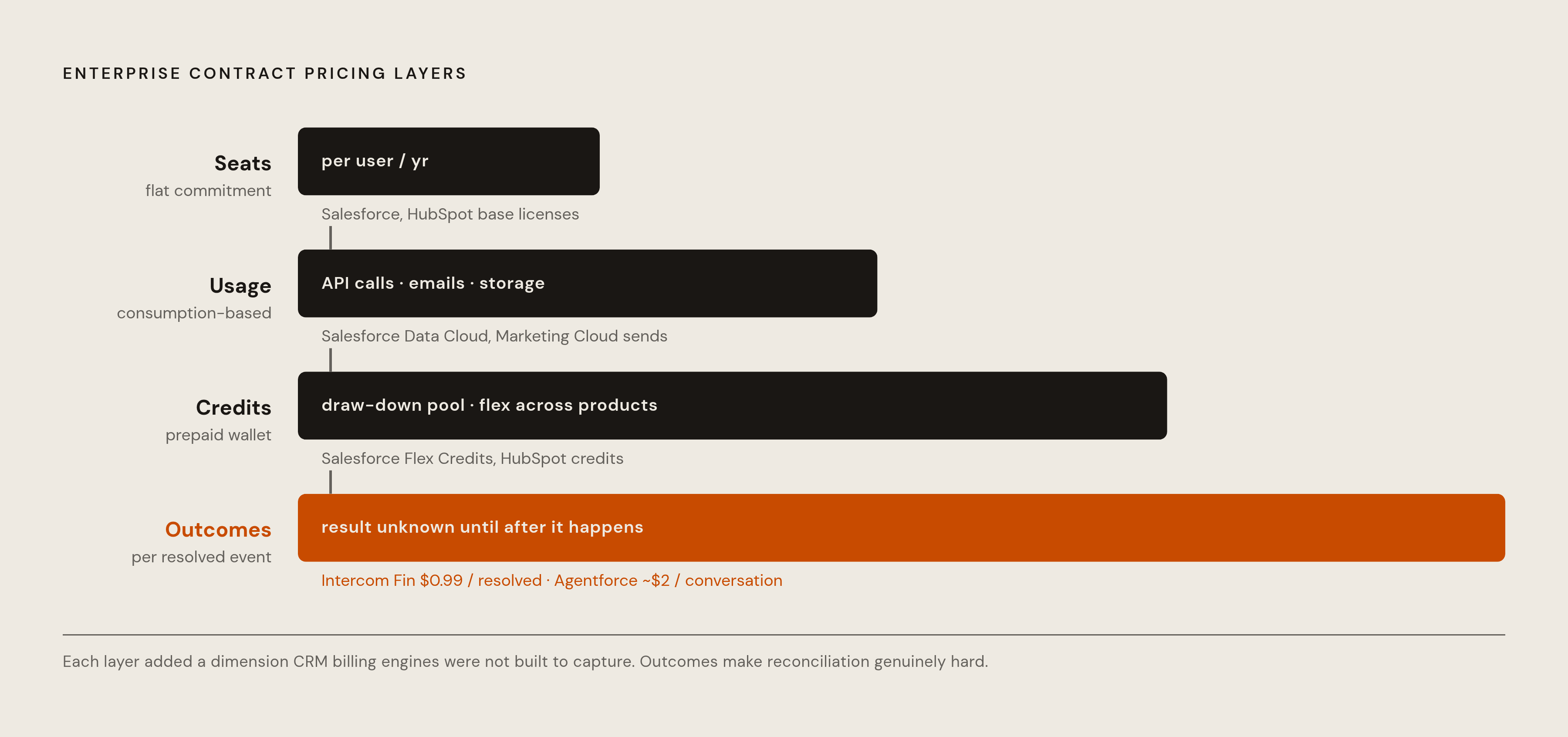
Hybrid pricing compounds the problem rather than easing it. Growth Unhinged's State of B2B Monetization report found hybrid adoption jumped from 27% to 41% in a single year, while flat-fee subscriptions kept losing ground. A single enterprise deal today routinely stacks a seat commitment, a consumption component, and prepaid credits onto one invoice. Credit-based pricing has become its own layer on top of that: the PricingSaaS 500 Index counted 79 companies offering credit-based pricing, up from 35 at the end of 2024, a 126% jump in a year, with Figma, HubSpot, and Salesforce all adding credit models in 2025. And now outcome-based billing is arriving on top of all of it, with agentic AI products like Intercom Fin charging $0.99 per resolved outcome and Salesforce Agentforce charging around $2 per conversation, a fourth pricing dimension that most billing engines, and virtually every CRM deal record, were never built to capture.
Stacking these four layers, seats, usage, credits, outcomes, on a single contract makes the reconciliation math genuinely hard. A CRM deal record might show a fixed ACV. The billing system generates a usage invoice that doesn't match it. The ERP books whatever portion is deemed recognized. Three systems produce three numbers, with nothing forcing them back into agreement when consumption varies month to month. This isn't just an accounting inconvenience. Unpredictable usage patterns make revenue forecasting materially harder, so the billing-CRM gap now distorts pipeline accuracy and board-level reporting rather than just causing finance-ops headaches.
The specific failure modes that generate reconciliation gaps in production
Any deal that can't be traced across all four records is a control gap. It's a control gap, and it should be treated with the same seriousness auditors would apply to a missing journal entry.
The named failure modes recur often enough to be treated as a checklist rather than a set of one-off mistakes. Unsigned deals get marked "won" in CRM, so billing hasn't started even though the deal already is in the forecast. Contracts get executed and billing engines never get triggered, so revenue gets recognized without an invoice existing yet. Discount drift occurs when the number agreed at close never makes it into the billing system's rate card, so the invoice amount and the CRM opportunity value simply disagree. Credits applied post-close inside the billing engine often never flow back to update the CRM deal or the ERP revenue schedule. And collection lag, cash that hasn't landed yet, gets treated by the forecast model as though it already had.
Metering-layer failures generate a second wave of the same problem, one level lower in the stack. Duplicate event ingestion after a retry produces double billing that appears to the customer as a dispute rather than what it actually is: a system error. Clock skew between ingestion nodes splits aggregation windows and causes underbilling that doesn't surface until close. A service outage can quietly drop an entire customer-month of events. A schema migration on the producer side drops records and creates disputed invoices. Missing resource tags misattribute charges to the wrong account entirely, turning a reconciliation problem into a customer trust problem.
The Cursor incident from June 2025 is a clean illustration of what happens when this kind of debt goes unaddressed. A single developer generated a $7,225 invoice in one day, and the root cause wasn't a billing error in the conventional sense, it was uncapped usage sitting inside an annually billed plan, a metering architecture decision that had no spend cap and no usage dashboard to catch it in flight. Every failure mode above shares the same root: the billing layer can't surface clean, current data, and that blindness spreads to every system that trusts it.
What real-time metering architecture requires to close the gap at the source
Stream processing is the mechanism that actually solves this, applying metering, aggregation, and rating logic to usage events the moment they arrive rather than batching them for a nightly or monthly job. That's what makes real-time dashboards, live spend alerts, and hard usage limits possible.
A few specific pieces work together to form the architecture underneath that. A message broker, and Apache Kafka is the dominant choice for this at scale, ingests events from producers as they're generated. Stateful transformations get applied before anything writes to a billing state store, and that write needs to happen at sub-second latency for the real-time promise to hold. Hard-limit enforcement sits on top of that: the system blocks a request the instant a customer crosses their credit balance, which is precisely the mechanism that would have stopped the Cursor incident before it became a headline.
None of this works without a disciplined event schema. Every event needs a unique event_id for deduplication, since the same event can and does arrive multiple times across retries, which is how double-billing happens in production. It needs a timestamp reflecting when the event occurred at the source, not when it happened to arrive, because billing period cutoffs depend on that distinction and get it wrong constantly when systems conflate the two. It needs a customer_id or subscription_id tying the event to a billing entity, closing off the incorrect-account-mapping failure mode. And it needs an event_type categorizing the usage itself, whether that's API calls, storage GB-hours, compute minutes, or token counts.
The throughput bar at real enterprise scale is not modest. A metering layer that's accurate, idempotent, and real-time is the precondition for clean data flowing into everything downstream of it. The billing-CRM gap can't be patched at the CRM layer if the billing layer itself is emitting late or incorrect events.
AI billing raises the stakes on all of this because it tolerates none of the drift that seat-based SaaS billing has always been able to absorb. Every LLM call carries a real, calculable marginal cost, so a rounding error or a duplicated event isn't cosmetic, it's a direct hit to margin. That reality pushes the accuracy bar up for the entire architecture, including the parts untouched by AI features. Vendor-stated figures give a sense of the range at scale, as purpose-built architectures combining Go and Kafka can reach up to 1 million events per second at under 60ms P99 across 20B+ events and 5B+ API requests per month in production, with exactly-once delivery and automatic reconciliation serving as the mechanisms that prevent double-billing from retried events.
How data should flow between billing, CRM, and ERP to make reconciliation continuous rather than periodic
The triangular design only works if each system holds the piece it's actually good at holding. CRM carries contract terms and opportunity data, the authoritative source for pricing commitments, discount approvals, and renewal dates. The billing or usage engine carries consumption records, invoice generation, credit wallet balances, and real-time usage state. The ERP carries the recognized revenue schedule, the general ledger entries, and the cash reconciliation itself. None of these three should be treated as periodically synced, they need to stay in continuous agreement, not reconciled once a month after the fact.
The direction of data flow matters as much as its existence. CRM needs to push the contract's effective date, its approved rate card, discount tier, billing start trigger, and credit allocation into billing, so billing never has to guess what was actually agreed. Billing needs to push invoice amount, payment status, credit consumption, and usage-to-date back into CRM, information that renewal forecasting and customer success visibility genuinely depend on. Billing also needs to push invoice records and the recognized-versus-deferred revenue split into the ERP, along with payment receipts. And the ERP needs to push confirmed cash receipt back into billing, which is the one flow that actually closes the collection-lag gap in the forecast model.
This kind of integration is getting harder to bolt on as an afterthought, because the tooling landscape is consolidating rather than expanding. LeanData's B2B State of Martech and Revenue Operations Report found the average B2B tech stack shrank from 62 tools to 37 over the past year, meaning teams are actively cutting integrations, not adding more of them. That trend makes the choice of a billing platform with native CRM and ERP connectors a strategic decision rather than a convenience.
The industry conversation tends to overstate where AI fits into all this. Gartner's 2025 Finance AI Adoption Survey found only 59% of CFOs report using AI in finance at all, and adoption without clean underlying data and workflow discipline rarely produces the automation rates vendors demonstrate in a sales deck. Bilateral data flows that actually work are the prerequisite for AI-assisted reconciliation to do anything useful.
There's a customer-facing side to this too, one that gets treated as a UX nicety when it's really a reconciliation control. Real-time usage dashboards and spend alerts aren't optional polish for AI or metered products. Products that can't show a customer their consumption as it happens generate bill shock, churn, and support costs that dwarf whatever the billing infrastructure would have cost to build properly.
Why the billing platform itself is usually the constraint (and what the build-vs-buy decision involves)
Pricing doesn't hold still long enough for a rigid billing stack to keep up. OpenView's SaaS Benchmarks found 98% of SaaS companies change pricing at least once a year, yet 55% say their current billing stack can't efficiently accommodate those changes. Across 500 SaaS companies, analysts tracked more than 1,800 pricing and packaging changes in a single year, an average of 3.6 per company. The billing system is getting reconfigured roughly quarterly whether it's built for that pace or not.
The cost of getting this wrong raises the revenue line directly. SaaS companies lose roughly 9% of MRR to failed payments and involuntary churn, and that figure still understates the real damage, since it leaves out dispute resolution time, manual correction work, and the erosion of customer trust that billing errors cause.
Building a billing system in-house makes sense in narrower cases than most engineering teams assume going in: when the billing logic itself is a genuine product differentiator, or when data residency requirements mean no vendor can run where the data legally has to live. Outside those cases, the standard market answer, pairing a separate metering tool with a separate billing tool, tends to create as many problems as it solves. That two-vendor setup doubles the integration surface, invents a brand-new reconciliation problem between the two vendors themselves, and leaves the team holding the glue layer indefinitely.
A purpose-built approach treats metering and billing as one system: event ingestion, rating, invoice generation, credit wallet management, and CRM/ERP data export all coming out of a single engine, so the data flows described above need one integration to maintain, not three. On-prem and sovereign cloud requirements aren't a fringe consideration in this decision either. For regulated industries and international enterprise deals, a platform that can only run as US-hosted SaaS gets disqualified before evaluation even starts.
Revenue recognition software and RevOps platforms that address the reconciliation layer
The platforms that matter here sit specifically at the intersection of billing data, CRM contract terms, and ERP revenue schedules, not the broader category of generic invoicing tools that never touch that intersection at all.
DualEntry supports multi-entity and multi-currency operations, with real-time audit trails built to be disclosure-ready and AI-assisted automation down to the transaction level; it integrates natively with billing, CRM, and finance workflows, and it's positioned for fast-growing multi-entity teams working through complex contracts.
Zenskar covers multi-entity and multi-currency needs as well, with audit trails that lock periods and version changes with timestamps, and it automates obligations, journals, and schedule updates directly; it offers more than 200 plug-and-play integrations spanning CRM and ERP, and it's built for finance teams handling complex pricing across SaaS, usage, and hybrid models.
Tabs runs on SOC 2 and audit controls, and it automates the full path from contract ingestion through invoicing to revenue recognition, with native integrations across CRM, ERP, and the broader finance stack plus an API for anything custom; it's positioned for teams that want billing, collections, and revenue recognition unified under one contract-to-close workflow.
SAP S/4HANA Cloud handles multi-entity and multi-currency operations within the broader SAP ecosystem, with audit trails native to that environment; automation runs medium-to-high but requires heavy configuration to get there, and it's built for mid-market to large enterprises, with the Private Cloud edition through RISE with SAP suited specifically to large enterprises already running SAP infrastructure.
Sage Intacct offers medium-to-high automation through templates and reallocation logic, though it's fairly setup-heavy to get running, and it integrates with CRM platforms including Salesforce; it's positioned for cloud finance teams that want revenue recognition embedded directly in their core financials rather than bolted on separately.
Salesforce's own offering has gone through several names in a short span, from Revenue Lifecycle Management to Revenue Cloud Advanced, before being introduced at Dreamforce 2025 as Agentforce Revenue Management, positioned as an end-to-end approach to the same problem. The renaming itself says something about how unsettled this category still is: even the vendors building for this exact intersection of billing, CRM, and ERP data haven't landed on stable language for what they're selling, because the underlying problem, real-time reconciliation across systems that were never designed to agree, is still being worked out in production, not in a slide deck. Platforms covering the billing-to-revenue-recognition layer are compared in the DualEntry 2026 comparison, last updated September 25, 2026.