Customer-Facing Usage Portals and Dispute Rate Reduction
Real-time consumption visibility eliminates the surprise that drives usage-based billing disputes.
Billing disputes in usage-based and AI products follow a predictable pattern. They are the predictable output of information asymmetry built directly into the pricing model itself. Seat-based billing rarely produces this problem because the customer knows the price before the period starts and can check it against a headcount; usage-based and AI billing invert that arrangement, and the dispute rate follows the inversion.
Why Usage-Based and AI Billing Generates Higher Dispute Rates
Seat-based pricing is static. A buyer agrees to a per-seat rate, counts the people who need access, and arrives at a number before the invoice ever shows up. There is nothing to contest in good faith because there is nothing hidden: the price was knowable in advance and the quantity was within the customer's control the entire time.
Usage-based and AI billing remove both of those guarantees. The final charge is not fixed at the start of the period; it accumulates as the customer consumes tokens, API calls, or compute minutes, and without a dedicated billing platform showing that accumulation as it happens, the customer may not know the size of the bill until it arrives. The old mental model, "I know what my bill will be before I get it," stops applying, and that mismatch between expectation and outcome is what produces the dispute.
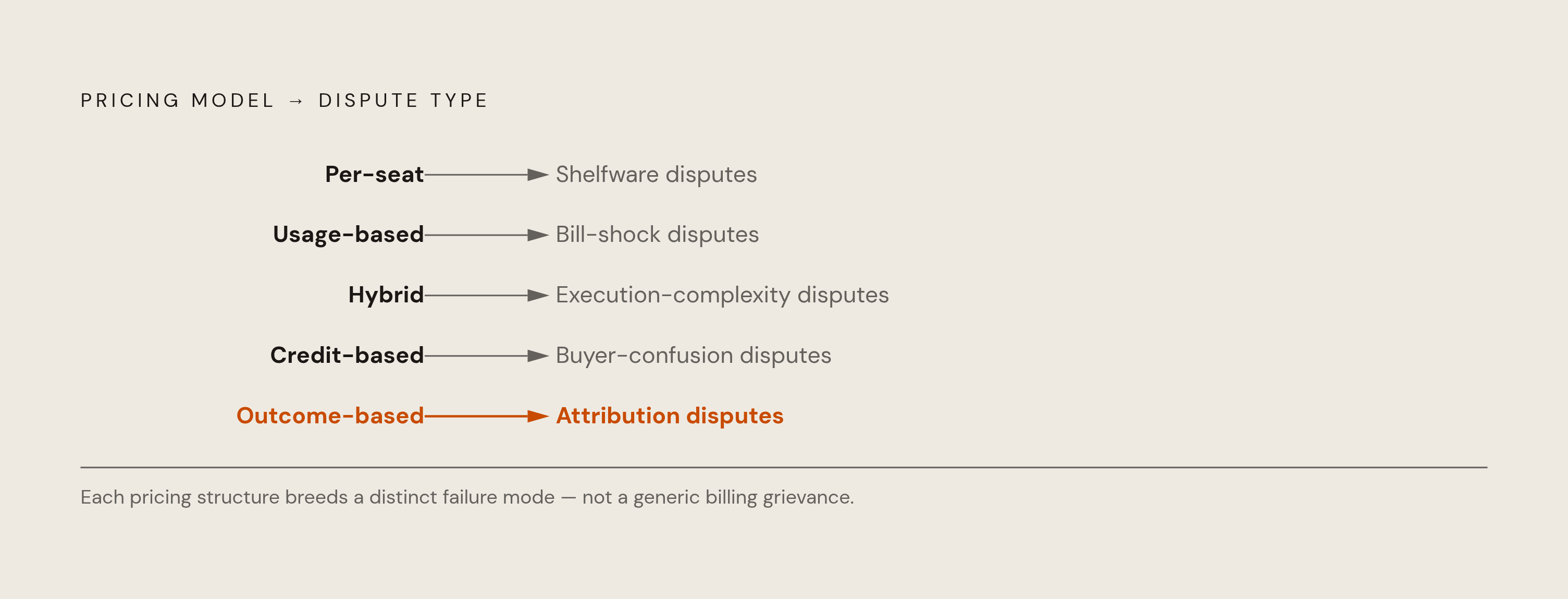
Different pricing structures don't just raise the dispute rate uniformly. Each one generates its own distinct species of complaint. Per-seat arrangements produce shelfware disputes, where the customer argues that paid-for seats went unused. Usage-based arrangements produce bill-shock disputes, where the customer says they had no idea the final number would reach what it did. Hybrid models, which combine a base fee with overage charges, produce execution-complexity disputes, because the customer can't reconcile the flat portion against the variable portion. Credit-based models produce buyer-confusion disputes, since customers often can't track how an abstract credit balance converted into actual consumption. Outcome-based models produce attribution disputes, where the customer contests whether the billed event, a "resolved" support interaction, for instance, actually met the definition the vendor is billing against.
The Cursor case remains the clearest public example of how this plays out in practice. A single developer ran up a $7,225 invoice in one day sometime between mid-June and July 2025, because an annually-billed plan carried uncapped usage and no real-time visibility mechanism to show the charge building. The developer had no way to see the number climbing until the invoice made it unavoidable. The root cause sat in a metering architecture decision, not in any misunderstanding of the pricing terms: usage was uncapped, and no in-flight alert existed to interrupt it. The usage itself was entirely legitimate. The customer contested the charge anyway, because nothing in the product had made the accumulation visible before the bill confirmed it.
AI products raise the stakes on this problem rather than merely inheriting it. Every call to a large language model carries a real, variable cost, and that means the billing system has to track consumption precisely enough to protect the vendor's margin, not simply to produce an invoice at the end of the month. A seat-based SaaS company could tolerate a certain amount of metering imprecision because the revenue per seat was fixed regardless of how the product got used. AI companies don't have that cushion. Imprecision that a flat-rate business could shrug off becomes a line item that erodes gross margin directly, which raises the operational bar for how carefully usage has to be measured and shown back to the customer.
What unites shelfware, bill-shock, execution-complexity, buyer-confusion, and attribution is that each one originates from a customer contesting something they could not adequately see. The pricing model created a number, and the customer disputed it because they had no way to verify it as it was forming.
What a customer-facing usage portal does
A usage portal is an authenticated, action-oriented surface that shows each customer their own consumption data in real time, and nothing less than that counts, since the term gets applied loosely elsewhere. A usage portal is not a help center, a CRM, or a static invoice page.
The authentication matters as much as the data itself. A portal recognizes who's logged in and shows that specific account's tickets, invoices, and consumption, rather than the generic, anonymous content a public knowledge base serves to anyone who visits. A CRM, by contrast, is the internal system of record that staff work inside; a portal is the external surface the customer acts through directly. Those are different tools solving different problems for different users, and conflating them is part of why some billing systems feel opaque even when a support team has full visibility into the account.
A login page sitting in front of a static invoice PDF doesn't clear the bar either. The value of a portal comes from the live, interactive data behind the login, and a PDF generated once a month and placed behind a password is still just an invoice; nothing about it changes the customer's ability to see consumption as it happens.
For usage-based and AI products specifically, the portal type that matters is the account portal: profile, subscriptions, billing, documents, and account hierarchy, built around consumption data as the centerpiece rather than an afterthought. Among all the features such a portal could offer, the ones that actually move dispute rates are narrow and specific: real-time consumption graphs, in-flight spend alerts, and line-item breakdowns that map each charge back to the usage event that generated it. Knowledge-base search and ticket deflection tools leave the dispute rate the same, since they address support volume rather than the information gap that produces disputes.
Precision matters in the distinction between a portal and an invoice. An invoice is a retroactive document, a record of what already happened. A portal is a continuous, live signal that exists before the invoice is ever generated. A dispute forms when the invoice becomes the customer's first exposure to what they actually consumed, which is what happened in the widely reported 2025 Cursor incident, where a developer received a $7,225 invoice in one day with no prior signal of any kind. The job of the portal is to make sure the invoice arrives as confirmation of something the customer already watched happen, rather than as the first notice of it.
How real-time consumption visibility closes the information gap
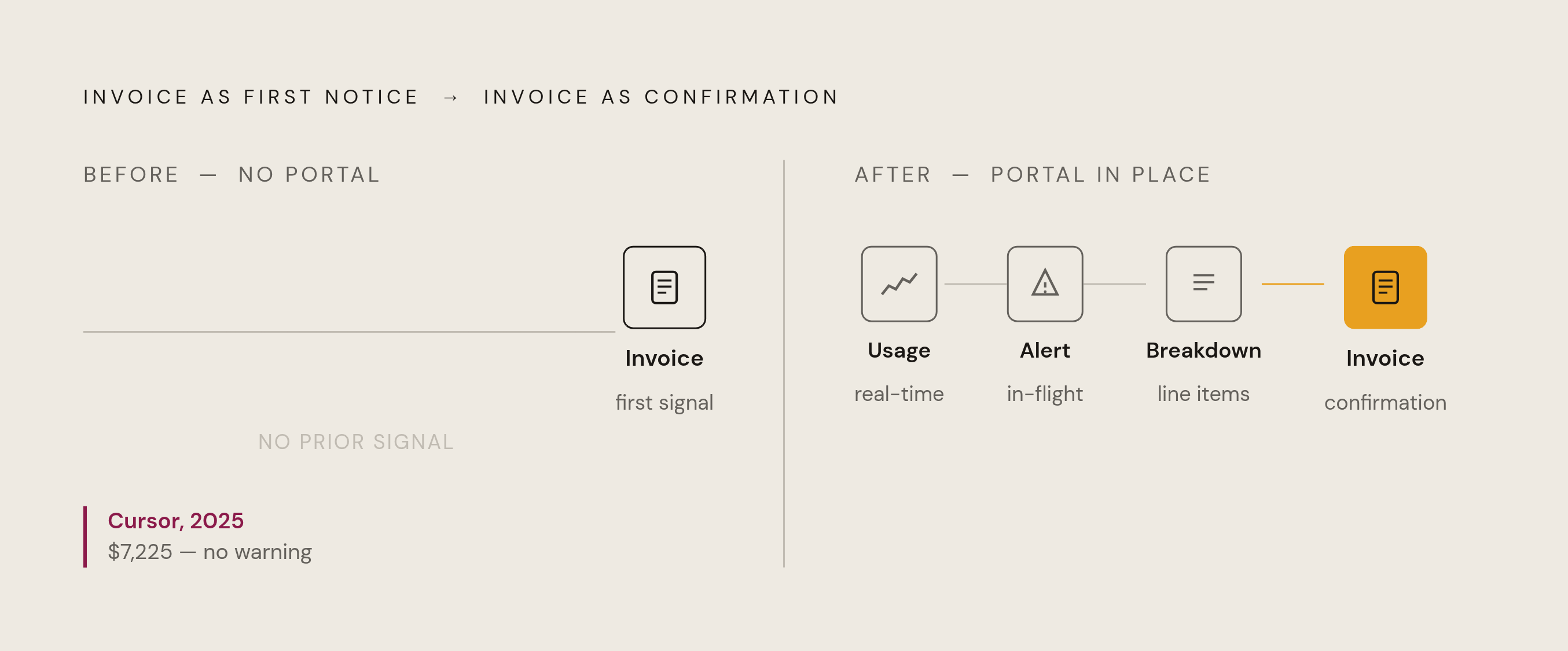
A customer who can watch consumption accumulate throughout the billing period has a much harder time disputing the final number in good faith. The portal converts what would otherwise be a retroactive surprise into something the customer witnessed continuously as it built.
This works through two separate mechanisms operating in opposite directions. Before the invoice arrives, in-flight visibility lets the customer see the number rising and react to it. After a dispute is raised, an auditable event log gives the vendor a record precise enough to resolve the disagreement on the facts. The first mechanism prevents most disputes from forming. The second mechanism closes out the ones that form anyway, by showing what happened and when.
Real-time metering underneath makes all of this possible. Batch metering, which processes usage data at fixed intervals rather than as events occur, can reconcile a bill after the fact, but it cannot power a live dashboard or enforce a spending limit before a customer crosses it. Real-time metering processes each event as it arrives, which lets the system check a customer's balance, update what the portal displays, and block further requests before usage completes. For AI products, where token consumption happens at millisecond speed, the choice between batch and real-time metering is a latency requirement, not a preference. A portal that shows yesterday's usage lags behind one that shows what happened in the last second.
The credibility of that live record depends on how the underlying event log handles correction and replay. Billing systems periodically need to re-rate events, whether because a pricing rule changed or because an error surfaced after the invoice had already gone out, and an event log built to support replay makes each re-rated charge traceable back to the original events, resolving what would otherwise be a "your word against ours" argument. That traceability only holds if duplicate events can't sneak into the record. Duplicate event IDs and duplicate idempotency keys both have to be rejected at the database layer; if double-billing is even architecturally possible, the entire audit trail loses its authority as a tool for resolving disputes. A portal showing real-time consumption is only as trustworthy as the metering infrastructure generating the numbers it displays.
In-flight spend alerts as the proactive layer that prevents bill shock before it becomes a dispute
Spend alerts do more than make a dashboard more pleasant to use. They are the mechanism that turns passive, in-flight visibility into an actual customer action, taken before the charge reaches a level the customer would contest.
The Cursor case shows exactly where the gap sat. The $7,225 invoice wasn't disputable on technical grounds, since the usage behind it was genuine, but it was disputable on practical grounds, because nothing alerted the developer during the day that the number was climbing toward that total. Had an alert fired at some meaningful fraction of expected spend, well before the invoice ever arrived, the developer would have had a chance to change behavior during the period itself rather than discover the consequence after the fact. Spend caps, usage dashboards, and alert thresholds are not optional interface polish; they function as engineering requirements for any product billing on consumption, and the Cursor incident made that requirement visible at scale.
A well-placed alert turns the customer from a passive recipient into an active manager of their own consumption. Instead of a passive recipient who finds out what happened when the invoice lands, the customer becomes an active manager of their own consumption, with enough warning to do something about it. When an alert fires at a meaningful point, a majority of a credit balance used up, or a spend limit approaching, the customer has three real options: pause usage, upgrade to a plan built for the volume they're actually running, or consciously decide to keep going past the threshold. Any one of those choices forecloses a good-faith dispute later, because the customer made an informed decision rather than discovering the outcome after the fact. The alert itself becomes a documented moment of awareness, something close to a waiver of surprise, and that documentation matters considerably if a dispute is raised regardless.
Credit-based pricing benefits from careful alert design more than most other structures, because credits are an abstraction that can hide how fast a customer is actually spending. Someone who bought a block of credits upfront doesn't necessarily have an intuitive sense of how quickly those credits convert into dollars as usage accelerates. An alert built for this model has to bridge that gap directly, showing remaining balance in both credit units and the dollar figure those credits represent, so the customer isn't left doing currency conversion in their head while the clock runs.
Transparent line-item breakdowns and invoice legibility reducing formal disputes
A charge can be entirely correct and still trigger a dispute, if the invoice presenting it can't be read. An invoice that collapses tokens, GPU-minutes, API calls, and seat fees into a single undifferentiated line will generate a dispute regardless of whether every dollar on it is accurate.
The root of the problem sits in how legacy billing systems were built. Regular billing logic expects a static quantity multiplied by a static price, a model per seat per month, say. Once API calls, compute minutes, or AI tokens enter the picture, that logic breaks down, and the invoice that comes out the other end reflects the system's confusion about how to represent variable, multi-dimensional usage rather than reflecting what the customer actually consumed. A hybrid invoice combining a base subscription fee, per-seat charges, and usage overages across several dimensions needs each component clearly separated; a customer who can't tell which line corresponds to which charge has grounds to contest the total even when it's arithmetically sound.
Legible invoices require clear separation between base charges, seat counts, and direct overage measurements; line items that name the actual event type rather than a generic label, "GPT-4o token consumption: a specific token count at $X per million" rather than simply "usage fee"; and a link or drill-down connecting each line back to the underlying event log that produced it. Outcome-based billing adds its own version of this challenge. Intercom's Fin product bills at $0.99 per resolved interaction, and that model requires the customer to be able to verify that each billed outcome actually happened and actually met the definition of "resolved" baked into the contract. Without that verification path, the invoice is asking the customer to trust a label rather than see the underlying event.
Mid-period plan changes add a smaller but related complication: any proration that isn't shown visually, a clear before-and-after breakdown of the old rate, the new rate, and the date the change took effect, is a dispute waiting to happen, regardless of whether the math behind it is correct.
The invoice functions as the portal's summary artifact. If the real-time dashboard, the spend alerts, and the event log all worked as intended throughout the billing period, the invoice should contain no information the customer hasn't already seen in some form. Its legibility is the final test of whether all that upstream visibility actually translated into customer understanding, or whether it stayed locked inside a dashboard nobody fully absorbed until the bill arrived.
How Portals Reduce Internal Support and Finance Costs
Every dispute that reaches a support agent or a finance analyst represents a cost the portal could have intercepted earlier in the cycle. The internal burden of billing opacity produces costs in headcount hours, not just in support ticket counts.
Without a usage portal in place, a single usage-based billing dispute typically pulls in three internal functions at the same time. Finance has to pull raw usage data from whatever system generated the charge and manually reconstruct how the final number was reached, work that a portal's event log and drill-down links would otherwise make available to the customer directly, without a finance analyst acting as an intermediary. Support has to field the initial complaint, translate it into language finance and engineering can act on, and manage the customer relationship while the investigation runs, often over several days. Engineering, in the more serious cases, has to be pulled in to check whether a metering or rating bug produced an incorrect charge in the first place, which is a materially different question from whether the customer simply didn't understand a correct one.
A portal that shows real-time consumption, fires alerts before thresholds are crossed, and produces invoices with event-level drill-downs addresses the dispute before any of these three functions needs to get involved. The investment in that visibility layer pays for itself in reclaimed finance and support hours well before anyone has to weigh the harder-to-measure cost of a customer who churns because an unresolved dispute left them unconvinced the vendor was billing them fairly.