IFRS 15 Compliance for Multi-Element SaaS Arrangements
How to unbundle and price multi-element SaaS deals under IFRS 15.

IFRS 15 replaced IAS 11, IAS 18, and a handful of interpretations (IFRIC 13, IFRIC 15, IFRIC 18, SIC-31) with one principles-based model meant to work the same way whether a company sells construction contracts, cars, or software. That's the thesis of the standard: five steps, applied consistently, across any industry. For SaaS companies, that promise mostly holds, but the arrangements themselves have gotten complicated in ways the standard's drafters didn't fully see coming.
Contracts now bundle subscriptions, implementation, support, usage, and sometimes an embedded license, all under one invoice line. Pricing has drifted away from flat fees toward consumption. OpenView's research put usage-based billing at over 60% of SaaS vendors, up from 27% in 2018, and AI credit and token models grew 126% year-on-year in 2025, adding a kind of variable consideration nobody was writing accounting guidance for a decade ago.
None of this means finance teams don't understand IFRS 15. Most do. Narrower and more specific, each of the five steps hides one decision that gets genuinely hard once pricing stops being a single flat number. What follows walks through each step with the kind of examples a SaaS finance lead actually runs into, and flags where the decision sits.
Step 1: confirming you actually have an enforceable contract
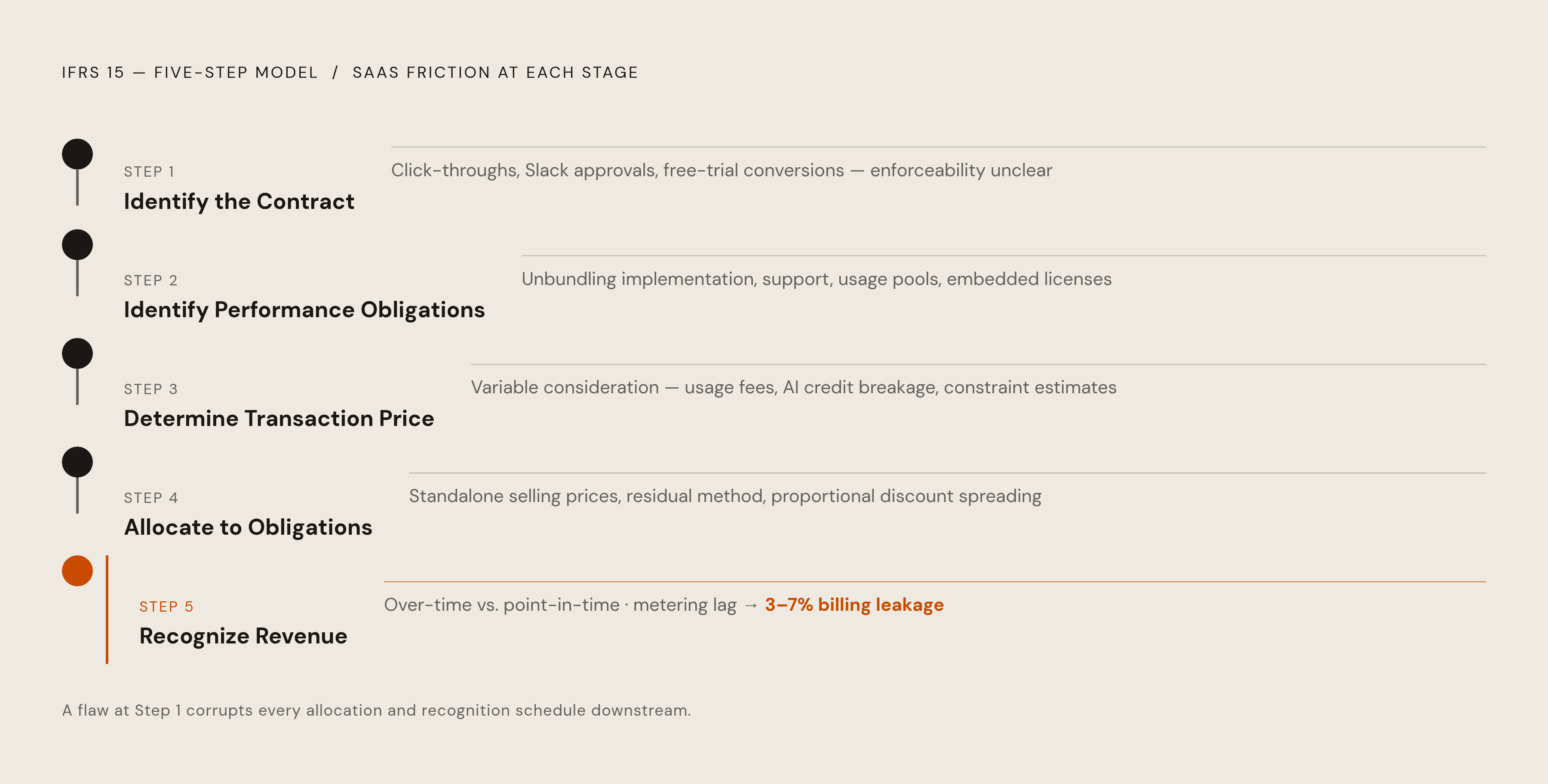
IFRS 15 sets threshold conditions before anything else matters, covering things like approval of the arrangement, identifiable rights and payment terms, commercial substance, and probable collection. Miss any one of those and there's no contract yet, whatever Sales says in the deal room.
SaaS complicates this in quiet ways. A click-through terms of service, or an API call that kicks off a paid tier automatically, counts as a contract if it's legally enforceable, no wet signature required. Free trials that convert to paid, pilot periods, letters of intent before a full contract is signed: none of these start the revenue clock until the four conditions are actually met, not when the sales rep marks the deal closed-won in the CRM.
Collectability deserves a second look too. For high-volume, homogenous transactions, like a self-serve tier with thousands of small accounts, IFRS 15 allows a portfolio-level assessment built on historical payment data, rather than reviewing every contract one at a time. That's a real relief valve for companies running volume, but it only works if the historical data is clean enough to trust.
Contract modifications are where this step actually breaks down in practice. A mid-term seat increase approved over Slack, an add-on module agreed to in an email thread with no formal amendment attached: these create real questions about enforceability, and they happen constantly. Finance needs a clear internal rule for when a change is a new contract versus a modification of the existing one, because that answer determines the recognition path for everything downstream. Get step one wrong, and every allocation and recognition schedule built on top of it is standing on a foundation that was never solid.
Step 2: unbundling what the contract actually promises
A promised good or service is its own performance obligation if two things are true: it's capable of being distinct, meaning it delivers value on its own, and it's distinct within the contract, meaning it isn't so tangled up with other elements that it can't be separated in practice.
A typical enterprise SaaS deal has more moving parts than it looks like on the invoice: platform access, onboarding and implementation, tiered support with defined SLAs, usage components (API calls, GPU-minutes, tokens, data volume), sometimes an embedded software license distinct from the SaaS access itself, and customer options like renewal discounts or rights to buy more later. Each one needs to be evaluated on its own.
The hardest call is almost always implementation. If the customer literally cannot use the platform without it, the two get combined into a single obligation. But if the implementation delivers something that persists on its own, a data migration the customer keeps using regardless of whether they renew, say, it's distinct and gets recognized separately. Get this backwards and revenue either gets pulled forward too fast or held back too long, and both directions draw audit scrutiny.
One instructive failure mode: a $1.2 million enterprise deal bundling implementation, subscription, and ongoing support that wasn't properly separated at the outset, requiring days of manual allocations and creating real misstatement risk, the kind of outcome nobody wants explaining to an audit committee. That's the archetype. It happens because nobody built the obligation-identification step into the contract template up front.
AI and usage-based pricing add a newer wrinkle. A contract that bundles a token or credit pool with a seat subscription might be treating that credit pool as a separate performance obligation, as variable consideration folded into the subscription price, or as a material right (essentially a discount on future purchases). Each classification lands revenue in a different place at a different time, so the choice isn't cosmetic.
The fix is a process available to everyone, not reserved for enterprise use. It's a checklist applied to every new contract template, mid-market included, because mid-market deals are picking up the same bundling complexity that used to be reserved for six and seven figure contracts.
Step 3: measuring a transaction price that refuses to hold still
Fixed-fee SaaS is the easy case. The transaction price is the number on the contract. Everything gets harder once volume discounts kick in below a consumption threshold that hasn't been hit yet, or SLA credits are contingent on uptime performance nobody can predict at signing, or a multi-year deal paid upfront at a discount carries an implicit financing component that has to be unwound.
IFRS 15 requires that variable consideration be estimated and then constrained: only recognize the amount for which a significant reversal in cumulative revenue is highly unlikely later. That's a conservative bar, not an aspirational one, and it's meant to stop companies from booking optimistic estimates and walking them back next quarter.
Usage-based components take this further. The transaction price for a usage fee generally can't even be pinned down at signing, so revenue gets recognized strictly as consumption happens, not estimated in advance and smoothed across the contract term.
AI credit models introduce their own puzzle. Credit pools are often sold at a discount to lock in commitment, and the accounting question is whether that discount is a variable consideration adjustment or a separate material right. Adoption is moving fast: 29% of SaaS companies already run AI credit models, and another 33% plan to add them within six to twelve months, meaning a lot of finance teams are building the variable-consideration framework for this after the product is already live, not before. There's also the question of expired or forfeited credits, breakage revenue, and whether it's recognizable at all depends on whether the company has enough historical forfeiture data to estimate the pattern with any confidence.
The operational reality underneath all of this: without metering data flowing into the revenue system close to real time, there's no credible basis for the constraint calculation. Estimation needs actual consumption numbers, not a batch file that lands three days after month-end close.
Step 4: allocating the price across obligations using standalone selling prices
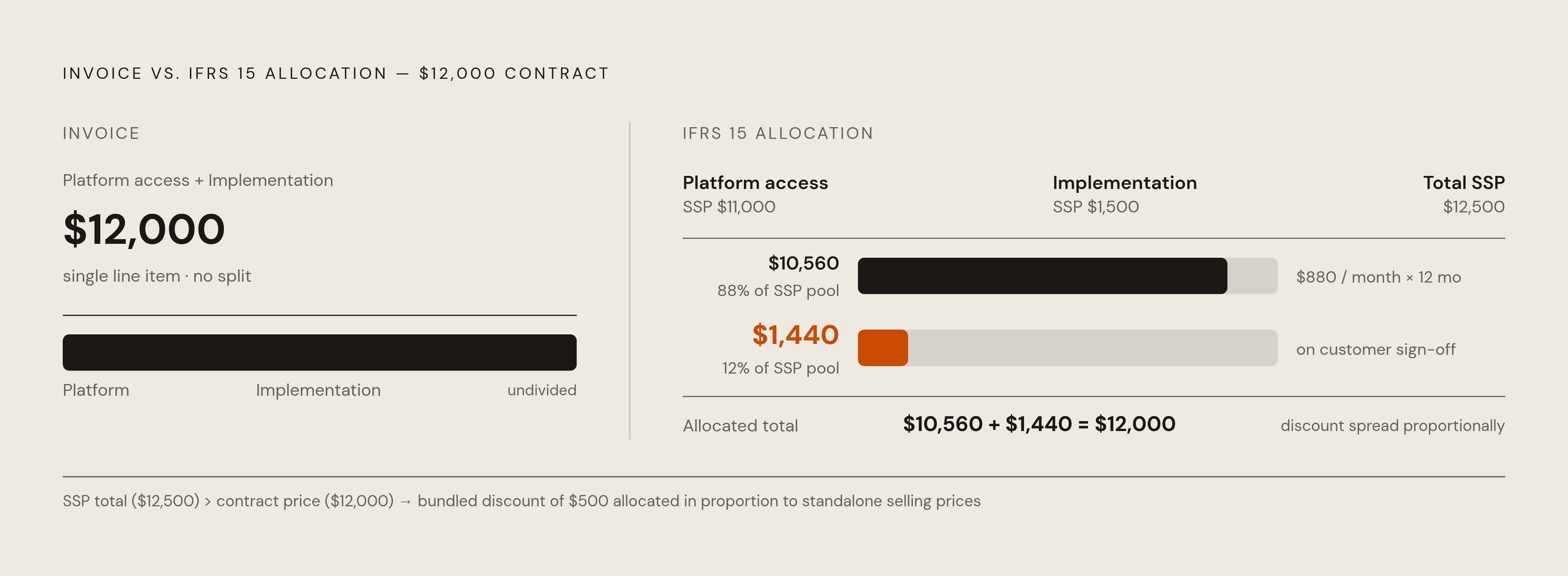
Once obligations are identified and the transaction price is pinned down, it has to be split across those obligations in proportion to what each one would sell for on its own, the standalone selling price, or SSP.
When there's no observable market price to point to, IFRS 15 gives three fallback methods. Adjusted market assessment looks at what competitors charge for something comparable. Expected cost plus margin estimates the cost of delivery and layers on a reasonable margin, and cost-plus credit models in practice tend to run a 30 to 50% markup. The residual approach, allocating whatever's left after other obligations are priced, is only allowed when an SSP is highly variable or genuinely uncertain, and it can apply to one element or to a group of them together.
A worked example makes the math concrete. Take a one-year, $12,000 contract bundling platform access with a one-time implementation. The SSP for platform access alone is $11,000; for implementation alone, $1,500. Add those up and the total SSP is $12,500, more than the actual contract price, because there's a bundled discount baked in. Allocating the $12,000 proportionally gives platform access $10,560 and implementation $1,440. Platform access then gets recognized at $880 a month over the year; implementation gets recognized when the customer signs off on it. None of those figures match the invoice line items, and that gap, the relative-SSP ratio, is the step most manual processes skip entirely.
This gets harder at scale, not easier. A company running dozens of contract variants needs one centralized, maintained SSP list, not a fresh negotiation with auditors every quarter over what a given service is "really" worth. Bundled discounts have to be spread proportionally across obligations unless there's clear evidence the discount was meant for one specific piece. And once pricing has multiple usage dimensions, tokens, GPU-minutes, API calls, storage, each one may carry its own SSP that needs tracking independently. At that point SSP maintenance stops being a finance task with a spreadsheet and becomes something finance and engineering have to own together, because the pricing logic lives in the product.
Manual SSP tracking on spreadsheets shows up again and again as a root cause behind billing errors and compliance gaps. The math in any single allocation isn't hard. It breaks under volume and variability, once there are hundreds of contract variants instead of a handful.
Step 5: recognizing revenue as each obligation is actually satisfied
Revenue gets recognized when the customer gains control of what was promised, either over time or at a single point. That test sounds simple and mostly is, until it meets usage-based pricing.
Recognition happens over time when the customer receives and uses the benefit simultaneously. SaaS subscription access falls here, recognized ratably across the service period, straight-line or exact-days depending on policy. Ongoing support with continuous delivery works the same way. Usage fees also fall into this category, but recognized as consumption actually occurs, not smoothed out in advance and not held back until the invoice goes out.
Point-in-time recognition covers the opposite case, where control transfers at a discrete moment. One-time implementation gets recognized when the customer formally signs off on the deliverable, not when the work starts and not when the invoice is cut. A distinct software license gets recognized once the customer can actually start using it. Milestones in a professional services engagement get recognized at each milestone, if each one represents a real, separately identifiable transfer of control rather than an arbitrary payment schedule.
Usage-based timing is where the operational strain shows up hardest. "As consumption occurs" only means something if metering is close to real time. A month-end batch process creates a lag between what actually happened economically and what gets reported, and that lag is exactly what auditors probe. Metering errors have been estimated to cause 3 to 7% of annual billing leakage in usage-based SaaS businesses, and the same errors that cause billing leakage cause revenue misstatement, since the two draw from the same broken pipe.
Contract modifications force a company to rerun steps two through five, not just adjust step five in isolation. A mid-term upgrade raises the question of whether it's a new contract or a modification of the old one, and that answer decides whether the fix is a cumulative catch-up adjustment or a prospective change going forward. A cancellation or downgrade means deferred revenue balances need re-checking against what obligations are actually left. An add-on usage pack bought mid-period gets treated as a new arrangement or folded into the existing one, depending on whether it's genuinely distinct from what was already there.
This step is also where disclosure requirements land. IFRS 15 calls for revenue to be broken down into categories that show how its nature, amount, timing, and uncertainty relate to economic factors, with type, timing, and geography offered as illustrative examples of how that disaggregation might be structured. Producing that breakdown without pulling data manually out of three different systems requires a system of record built to generate it, not a quarter-end scramble.
Where the five steps become a continuous process rather than a month-end checklist
None of the five steps is a one-time determination that gets made at signing and filed away. Each one is a live state that shifts the moment a contract is modified, a usage tier gets crossed, or a pricing model changes.
A mid-term seat expansion sets off the whole chain at once: obligations get re-identified (step 2), variable consideration gets re-estimated (step 3), SSPs get reallocated (step 4), and recognition gets adjusted, either prospectively or as a catch-up (step 5), and all of it has to happen inside the current reporting period, not next quarter. SaaS contracts don't sit still. Upgrades, downgrades, add-ons, usage charges, cancellations, they all force mid-stream recalculation, and a spreadsheet-based process simply can't keep pace with how often real contracts change.
Steps 3 and 5 for usage-based obligations depend entirely on accurate, timestamped consumption data. The recognition schedule is only as trustworthy as the event pipeline feeding it, full stop. A billing system that ingests usage events with immutable audit logs and idempotency controls (meaning the same event can't accidentally get counted twice) is a core requirement here. It's the actual data source that makes the constraint calculation and the recognition timing defensible when an auditor asks how a number was derived.
Disclosure adds its own pressure on top of the recognition mechanics. IFRS 15 asks for revenue broken out by type, by geography, by recognition timing, plus a reconciliation of deferred revenue from opening to closing balance. Companies running subscriptions, usage, and credits through separate billing codepaths hit a consolidation wall at disclosure time that no amount of end-of-quarter reconciliation fully closes. The reconciliation becomes a permanent tax on the close process instead of a one-time exercise.
The pattern underneath all five steps is the same one: compliance at scale needs the pricing logic (SSPs, variable consideration rules, bundling decisions) and the usage data (metered events, credit consumption) sitting in the same system. Split metering from billing, and billing from revenue recognition, across three different tools that don't talk to each other, and the reconciliation burden becomes the central outcome. It's built into the architecture by design.
Outcome-based pricing is the next stage of this same problem, not a separate one. Gartner projected that more than 30% of enterprise SaaS solutions would include outcome-based pricing components by 2025, which means the five-step model is about to get tested by an entirely new layer of variability, on top of the usage and credit models finance teams are still catching up to now.