On-Premises Billing Data Residency Requirements in Regulated Enterprise Accounts
Billing data holds regulated identifiers that most teams forget to protect.

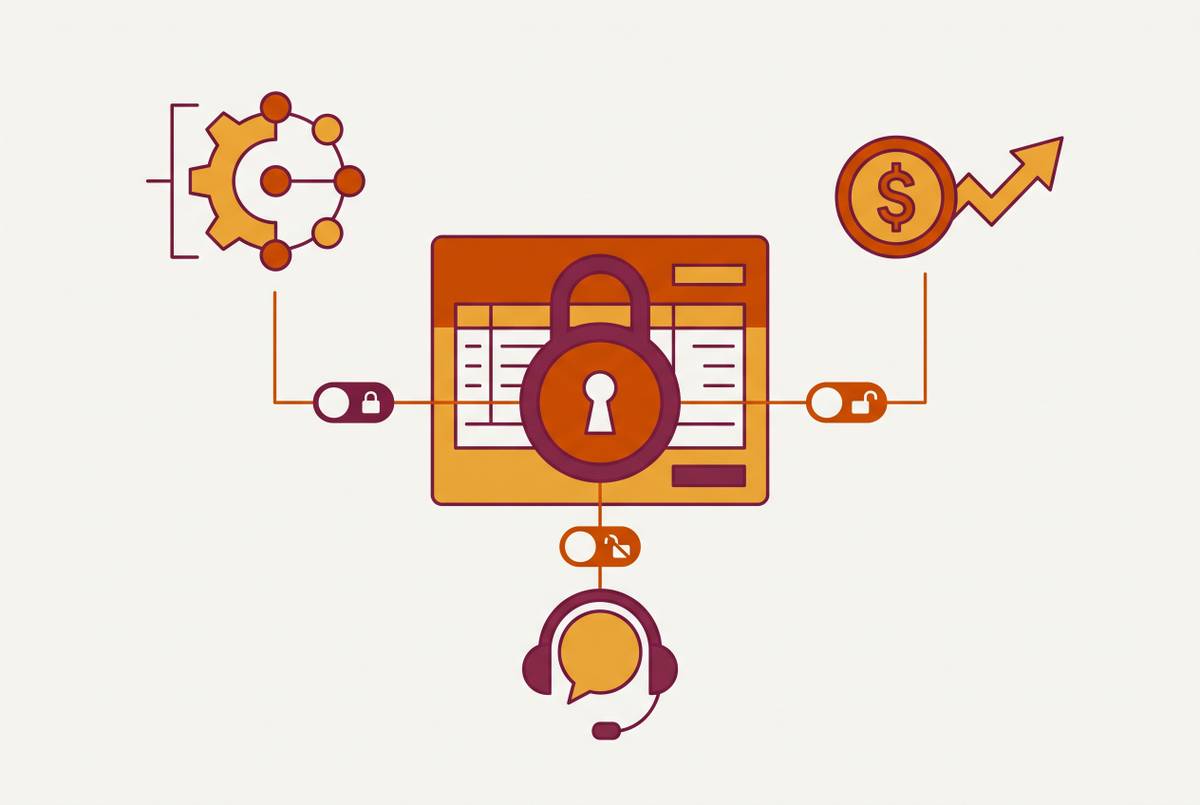
A team can spend months classifying data, drawing a careful boundary around customer records, application databases, and support tickets, and then route every invoice through a billing platform headquartered in the United States without a second thought. That single decision undoes the perimeter the rest of the organization worked to build. Billing systems hold usage logs tied to named users, consumption metadata linked to specific API calls or workflows, invoice line items that identify customers, services, and volumes, authentication records, and configuration files. Each of these categories carries personal identifiers and commercially sensitive signals, in just the form regulators have spent the last decade writing rules about.
The obligation to keep data inside a jurisdiction attaches to the identifier sitting inside the record, not to the label a team puts on the system that stores it. A billing log containing a user ID, an IP address, or a contract reference is a personal data record under GDPR, PIPL, and equivalent frameworks around the world, whether or not anyone internally calls that system "billing infrastructure" or files it under "finance tooling." Calling something back-office does not remove it from scope.
The compliance surface extends further than most teams map it. ETL pipelines that move billing events from one store to another, temporary files generated mid-process, search indexes built for support tooling, observability platforms capturing application logs, and API gateways that touch billing events are all inside the perimeter the moment they handle a record containing a regulated identifier. A single inference call routed to a server in the wrong region, or a log export sent to a vendor dashboard hosted abroad, can put regulated billing content outside the permitted boundary even while the primary database stays exactly where it's supposed to. The architectural mistake rarely happens at the database layer. It happens in the dozen smaller systems around it that nobody thought to audit because nobody thought of them as billing infrastructure.
The regulatory landscape that turns billing data residency into a hard requirement
The rules governing where enterprise data has to physically sit have multiplied over the past several years, and billing data falls under several of them at once. Any regulated enterprise working across more than one of these jurisdictions faces overlapping constraints simultaneously, and no single shared-tenancy SaaS billing platform is built to satisfy all of them at the same time.
China's PIPL says critical information infrastructure operators and high-volume processors have to store personal information collected inside China domestically. China's export rules set tiers that call for a security assessment, a standard contract, or a certification depending on data volume, so many multinationals end up running a separate technology stack inside mainland China.
A newer national data protection law is expanding local storage requirements on top of that baseline now.
Vietnam, Saudi Arabia under its personal data protection law (effective September 2023, fully enforceable September 2024), and Indonesia each carry cross-border transfer restrictions or local storage mandates covering specific data categories, including financial records and personal identifiers.
In the United States, you see the same architectural outcome come out of sector-specific frameworks instead. ITAR demands infrastructure limited to US persons. FedRAMP demands GovCloud. HIPAA demands environments where you, not a vendor, control encryption keys and maintain business associate agreement coverage. None of these are geography rules in the way PIPL or the RBI circular are, but each one forces the same conclusion: data and the keys to it must stay inside a boundary the organization itself controls.
The sovereignty gap that makes "EU region" storage insufficient for billing
Plenty of teams think they've solved data residency once they pick a European data center from a US-domiciled cloud provider. That belief is mistaken, and for billing infrastructure the mistake carries more weight than most architects account for.
The mechanism is a US federal law that allows US authorities to compel cloud providers incorporated in the US to hand over data stored anywhere in the world, including data centers in Frankfurt. A billing SaaS platform headquartered in the United States remains subject to US legal process no matter which region its servers sit in. Storing bytes in the right country and holding legal authority over those bytes are two different questions, and regulators along with enterprise procurement teams are increasingly asking the second one, not just the first.
For billing systems specifically, if a platform stores invoice records and usage logs in an EU region but its control plane remains global, it has not actually achieved sovereignty. Authentication flows, account metadata, usage metrics, and diagnostic telemetry make up that control plane, and it holds exactly the identifiers regulators are trying to govern. Residency at the storage layer means little if the control plane around it still routes through infrastructure outside the permitted jurisdiction.
Inference compounds this problem. Even once data-at-rest residency gets addressed, the moment a user interacts with a system, prompts and billing events can be processed, however briefly, on infrastructure outside the permitted region. For defense and government accounts, a transient inference hop through the wrong jurisdiction counts as a cross-border data flow regardless of how quickly it resolves.
The market has started responding to this gap. OpenAI's data residency expansion, announced in November 2025, lets eligible ChatGPT Enterprise, ChatGPT Edu, and API Platform customers choose to have customer content stored at rest in specific regions, including Europe, the UK, the US, Canada, Japan, South Korea, Singapore, India, Australia, and the UAE. That expansion addresses data-at-rest. The sovereignty exposure the CLOUD Act creates for enterprises with the strictest requirements comes from where the vendor is incorporated.
If you're a regulated enterprise account in defense, government, or high-risk financial sectors, any billing infrastructure run by a vendor incorporated in the United States carries residual legal exposure, and sovereign-cloud or on-premises deployment removes it. Gartner's finding that 61% of Western European CIOs and IT leaders said geopolitical factors will increase their reliance on local or regional cloud providers reflects exactly this calculation playing out across enterprise IT budgets.
Usage-based and AI billing models expand the compliance surface relative to subscription billing
Subscription billing produces a small, periodic record: a plan name, a renewal date, a dollar amount. Usage-based and credit-based billing produce something much larger: a continuous stream of event data, and it grows the compliance surface in direct proportion to how modern AI products get priced.
Every API call, every token consumed, every GPU-minute generates its own event, and each one can carry a user identifier, a session identifier, a reference to the original request, and a timestamp. Put together, those fields constitute a personal data record under GDPR and equivalent frameworks, so a single hour of heavy product usage can generate thousands of regulated records where a subscription model would have generated one line on an invoice at the end of the month.
Credit-based systems add a financial dimension on top of that volume. Prepaid credits sit on the books as a contract liability under ASC 606, recognized as consumption occurs, so the metering system has to write directly into the financial ledger. Usage logs and accounting records become the same data, so both have to stay inside the residency perimeter together, not get treated as separate systems with separate rules.
GitHub's transition of Copilot to a usage-based billing model shows what this looks like in practice. GitHub's official announcement states that starting June 1, premium request units will be replaced by GitHub AI Credits, consumed based on token usage, including input, output, and cached tokens, at published API rates for each model, with pooled credits available to Business and Enterprise plans. That structure generates a continuous per-token event stream in which every record ties a consumption event to an organizational identity.
For a regulated enterprise running a product built this way, every token-consumption event is a potential personal data record in the jurisdiction where the user is located. The billing pipeline processing those events has to satisfy the same residency constraints as the AI inference pipeline generating them. Pricing models have moved toward granular, continuous metering, and the compliance burden has moved with them.
Requirements for compliant billing infrastructure
You can't meet data residency requirements for billing by toggling a setting on an existing SaaS platform. It takes infrastructure designed from the outset to run entirely inside an environment the customer controls, and that specification breaks down into several concrete requirements.
Full on-premises or private-cloud deployment comes first: the billing engine, the metering pipeline, the invoice store, and the usage database all need to be deployable inside the customer's own VPC or physical data center, with no component routing events or storing records through a vendor-operated sub-processor outside the defined boundary.
Control-plane containment follows directly from that. Authentication flows, account metadata, usage metrics, and diagnostic telemetry make up the control plane, and none of it can remain global for a regulated account. It has to deploy inside the customer's perimeter alongside the data plane, because if the control plane stays separate, it recreates the sovereignty gap described above.
Sub-processor elimination is the next piece of the specification. A complete map of every sub-processor and its jurisdictional scope needs to be disclosable on demand, and any sub-processor sitting outside the defined region disqualifies the deployment for government-adjacent and ITAR-scoped accounts. A self-hosted billing deployment that removes third-party sub-processor exposure entirely is the only architecture that clears this bar.
A certification stack supports a compliance case with enterprise procurement teams even when it isn't a strict legal requirement. GDPR carries a maximum fine of 4% of global annual revenue, and neither GDPR, CCPA, nor equivalent frameworks legally require adherence to CSA STAR, SOC 2 Type 2, or the ISO/IEC 27001, 27017, 27018, and 27701 family of standards. Enterprise procurement teams treat that certification set as table stakes regardless, and carrying it supports a compliance case even where it doesn't substitute for one.
Customer-controlled encryption keys round out the specification. Regulated accounts need environments where the organization, not the vendor, holds the keys, because key custody decides who can be legally compelled to produce plaintext data under a court order or similar process.
Real-time metering has to happen inside that same perimeter. Ingesting usage events at millisecond speed, aggregating them, and feeding the billing engine all need to occur within the customer's environment. A metering agent that calls home to a vendor endpoint for aggregation breaks the perimeter at the exact point where the data is most sensitive and most continuous.
Structural limits of shared-tenancy SaaS billing platforms
These requirements aren't configuration gaps that a shared-tenancy SaaS billing platform can close with a settings panel. They follow from structural design decisions made early in how those platforms were built, decisions that can't be reversed without rebuilding the platform from the ground up.
Shared tenancy means billing events from many different customers flow through the same ingestion infrastructure, the same aggregation layers, and the same storage systems. A customer that needs its billing data to never leave a specific jurisdiction needs a pipeline dedicated to that customer and operated by the customer, since a shared, vendor-operated pipeline cannot provide that guarantee.
FedRAMP authorization illustrates the structural nature of the problem clearly. Standard shared-tenancy SaaS billing platforms don't hold FedRAMP authorization, so federal work requires self-hosting inside a customer-managed environment by default, not as an upgrade option.
The common workaround, pairing a separate metering tool with a separate billing tool and integrating the two, compounds the problem. Each integration point between the two systems is its own data flow, and it carries its own sub-processor exposure, its own residency footprint, and its own audit surface. A regulated account now has to map and defend every hop between two vendor-operated systems instead of one, which multiplies the compliance burden.
The build-versus-buy decision for on-premises billing in regulated accounts
If shared-tenancy SaaS can't satisfy these requirements, you have to ask next whether a regulated enterprise should build billing infrastructure in-house instead. Building trades one compliance problem for a permanent engineering liability, and the economics of that trade have shifted decisively against it.
The case for building rests on control, but control doesn't require building from scratch. So you have to ask whether a purpose-built billing platform can deploy inside the customer's own infrastructure, removing the sub-processor exposure that comes with SaaS while keeping the functional completeness a fully built in-house system would offer.
Building in-house carries a specific, ongoing list of obligations. Engineering, uptime, security, compliance, audit, and maintenance responsibilities all sit with the organization permanently, not just during the initial build. Every pricing model change requires engineering time. ASC 606 revenue recognition logic has to be built and kept current as accounting standards shift. Metering pipelines have to be designed for idempotent writes, replay capability, and dead-letter queue handling at the scale usage-based billing demands. None of this is a one-time project that gets checked off and forgotten. Each item is a standing obligation the organization owns for as long as the billing system runs, which makes a deployable, self-hosted platform the option that satisfies both the compliance requirement and the long-term cost of ownership question at once.