AR Aging and Collections Workflow for Consumption-Billed Invoices
Consumption billing invoices need dispute resolution before standard collections workflows can work.
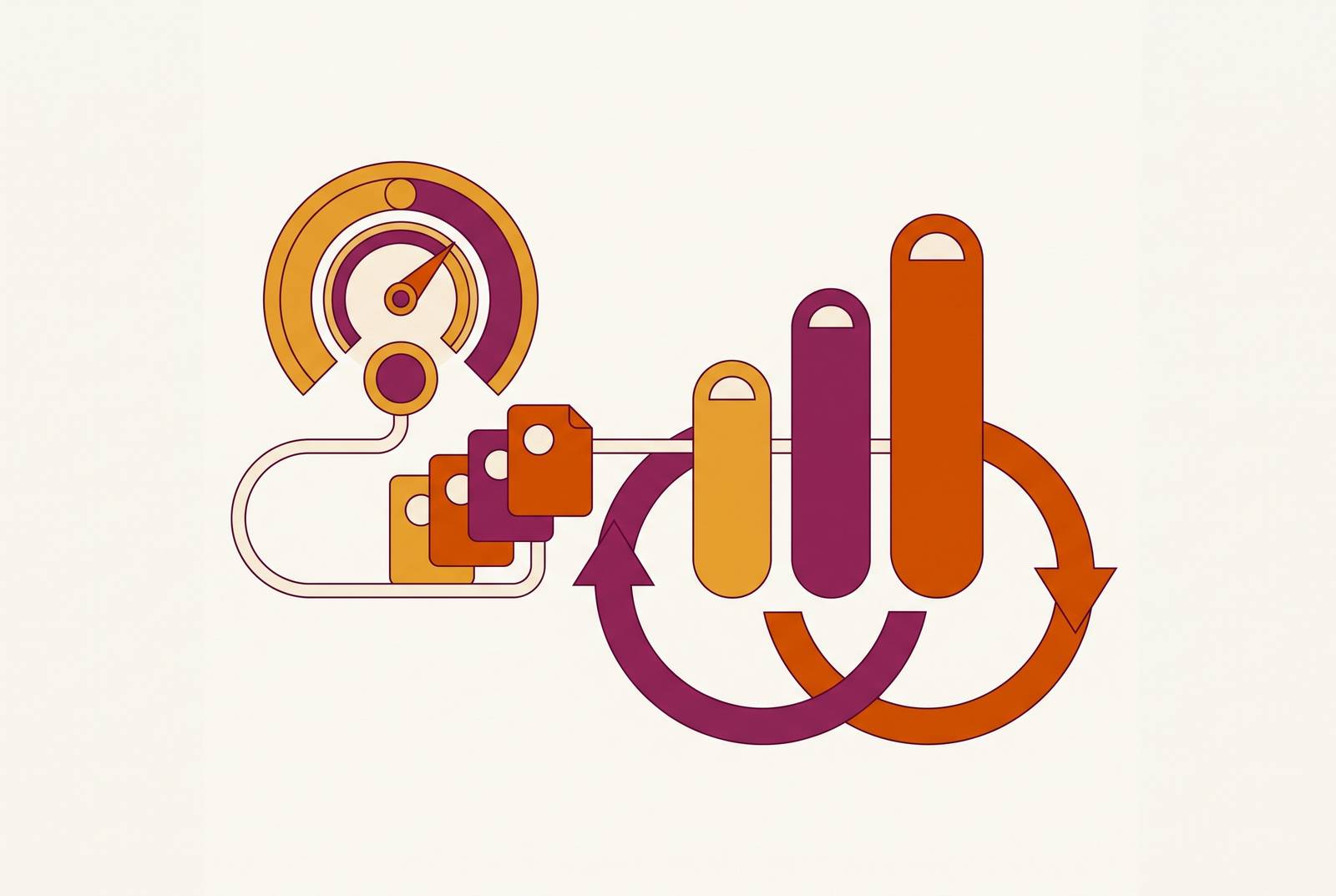
AR Aging and Collections Workflow for Consumption-Billed Invoices.
Standard AR aging workflow failures with variable invoice amounts
A healthy AR book in 2026 keeps more than 80% of receivables in the current bucket Commercial Collection Agency Association. Once total past-due balances climb above 20 to 25%, that's a collections problem by any reasonable read of the numbers Commercial Collection Agency Association. The whole framework rests on one quiet assumption: the dollar amount on the invoice is settled, agreed upon, and not up for debate by the time collections gets involved.
Consumption billing breaks that assumption before the invoice even prints. The amount owed is downstream of metering accuracy, pricing logic, and whether the customer actually understood what they were charged for, and none of that gets resolved just because a bill went out the door. An overdue consumption-billed invoice may be unpaid because the customer disputes the meter reading. Standard aging workflows can't tell the difference. They log both cases as the same kind of lateness, headed toward the same kind of escalation.
That's where the strategy breaks down in practice, not just in theory. A reminder email does nothing for a customer who thinks the invoice is wrong; it just reads as tone-deaf, and it burns a little trust with every send. The wrong move at the wrong stage doesn't just fail to collect, it actively slows down the dispute that's actually blocking payment. Effective collections for consumption-billed invoices has to treat metering accuracy, dispute resolution, and invoice comprehensibility as the first steps in the process. An AR aging report organizes every unpaid invoice into time buckets (0–30, 31–60, 61–90, and 90+ days), so finance teams can prioritize collections and forecast bad debt.
How collection probability decays for consumption billing teams
Every day an invoice sits unresolved matters for cash flow, losing value quietly and without any single event marking the loss. Every day an invoice sits unresolved, it's losing value, quietly and without any single event marking the loss.
The drift is the dangerous part. Invoices slide from current to overdue to functionally uncollectible while nobody's watching the boundary where that shift happens, and Dun & Bradstreet's Q3 2025 report found 15 of 202 tracked industry segments already carry more than 10% of their receivables sitting 91-plus days past due, a meaningful share of the economy letting money age past the point where it's easy to get back Commercial Collection Agency Association. That's not a handful of outliers. That's a meaningful share of the economy letting money age past the point where it's easy to get back.
Consumption billing makes this worse for structural reasons. A variable invoice amount often needs a fresh approval cycle on the customer's side, since a bill that's different from last month can't just get rubber-stamped by whoever signs the fixed-fee invoices. Usage disputes drag out over documentation exchanges that stretch across weeks, and every one of those weeks is costing real collection probability on the decay curve described above. And a consumption invoice the customer can't parse is, in effect, already in dispute the moment it lands in their inbox, even if no one has filed a formal objection yet.
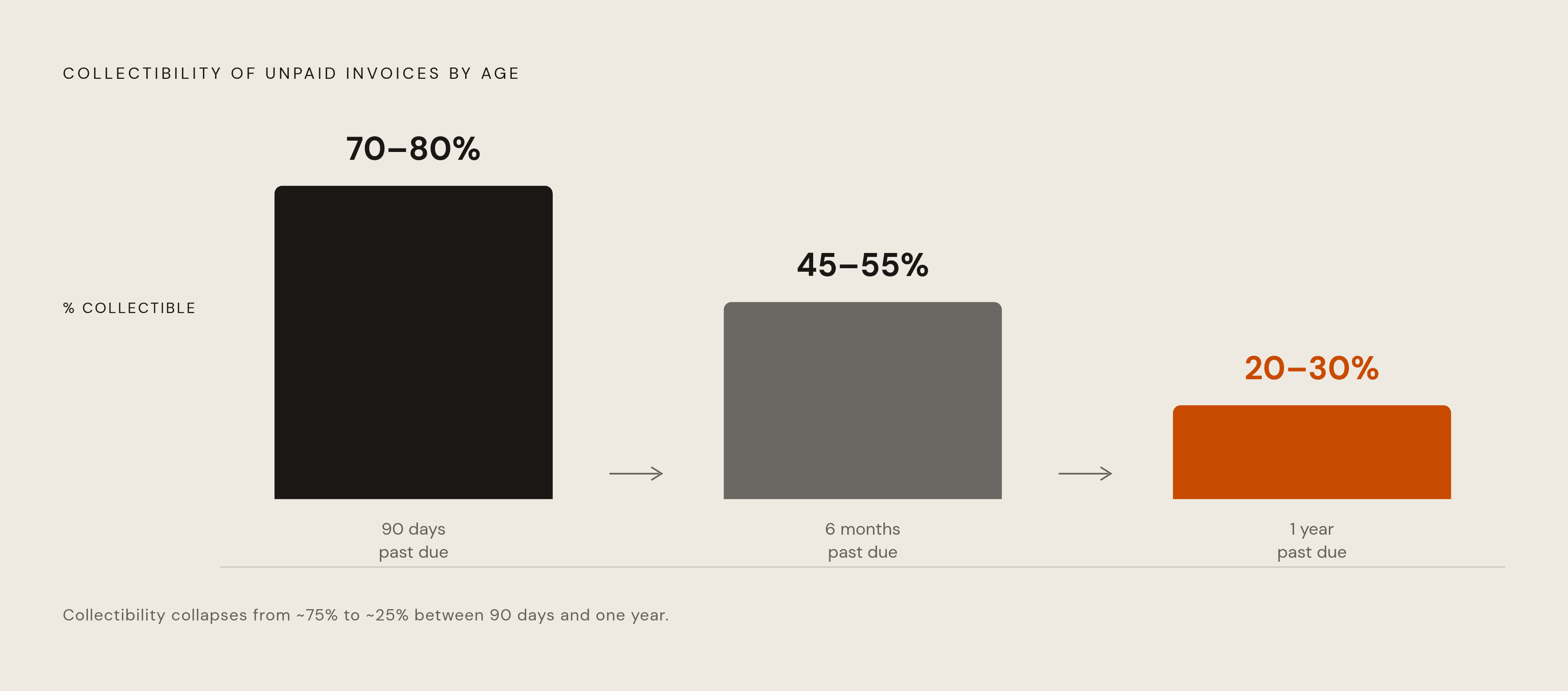
An unresolved usage dispute isn't a customer service backlog item, it's a cash flow problem with a due date attached. Resolving it faster is a direct financial intervention, not a courtesy. And the starting line is already crowded: 56% of U.S. 56% of U.S. The Intuit QuickBooks Small Business Insights survey found that 56% of U.S. small businesses carry invoices more than 30 days overdue, so consumption billing is adding friction on top of a baseline that's already strained Sage survey. It's adding friction on top of a baseline that's already strained. Data from the Commercial Collection Agency Association shows roughly 70–80% of 90-day-past-due invoices are still collectible, a figure that falls to 45–55% by six months and as low as 20–30% by one year (Commercial Collection Agency Association).
The upstream variables that consumption-billed invoices introduce before collections can begin
Fixed-amount billing doesn't have to deal with three problems that consumption billing runs into constantly. Metering accuracy comes first: the invoice is only as trustworthy as the event pipeline that generated it, and billing errors traced back to pipeline failures are a known structural risk anywhere usage gets metered and billed. Usage disputes are the second, and they're a different animal from a pricing disagreement. A customer might not think the price is wrong at all; they just can't reconcile what they were billed against what their own logs show, which means the fix is an audit. The third is comprehensibility. An invoice that lists raw token counts or GPU-minutes or API call totals without translating any of it gives an accounts payable team nothing to sign off on, and it stalls inside the customer's own approval process long before it reaches anyone who could dispute it or pay it.
Bill shock is usually the spark that sets one of these off. Zylo's 2026 SaaS Management Index put the number at 78% of IT leaders reporting unexpected charges tied to consumption-based or AI pricing in the past year, and the mechanism is concrete Commercial Collection Agency Association. A widely discussed case from July 2025 involved a single developer running up a $7,225 invoice in one day under a Cursor annual plan, and that's the exact shape of the problem: one usage spike, uncontextualized, becomes a dispute that no collections script is built to handle without someone actually digging into the underlying usage data Commercial Collection Agency Association.
Disputed invoices, broadly, are their own category of failure across any AR system, not just consumption billing Commercial Collection Agency Association. Occasionally the customer genuinely doesn't recognize the charge. Sometimes the pricing on the invoice doesn't match what's in the contract. Sometimes a credit note is sitting in someone's queue, unapplied. None of those get fixed by a collections call; they need sales, billing, and customer success actually talking to each other. Which is why the earliest and cheapest intervention point is before the invoice ever ships: PO validation, contract term checks, and customer master alignment catch a huge share of what would otherwise become a dispute weeks later. Billing accuracy, treated this way, is itself a collections strategy.
Outcome-based billing adds one more wrinkle: what counted as a successful resolution becomes the crux of the dispute. When the line item on the invoice is something like "per successful resolution," the dispute isn't about a quantity anymore, it's about a definition. What counted as a successful resolution becomes the argument, and that's a fundamentally harder thing to settle than a miscounted API call.
A collections workflow for consumption-billed invoices
Phase 0 happens before the invoice ever leaves the system. Metered totals get reconciled against the event log for the billing period, pricing dimensions get checked against the customer's actual contract terms, and PO number, billing contact, and payment terms all get checked against the customer master record. Any credit or adjustment that should show up on this invoice gets flagged now, not discovered after the customer calls to ask why it's missing.
Confirming receipt and the correct recipient matters, since a consumption invoice routed to the wrong AP contact doesn't bounce, it just ages in silence. And where a charge is notably higher than the prior period, that context needs to go out proactively, before the customer has a chance to be surprised by it.
One is the standard track, invoices the customer has acknowledged in some way, explicitly or by simply not objecting. The other is the dispute resolution track, invoices where a usage question or pricing question has come up, or where the customer's gone quiet after an unusually large bill. Disputed invoices get logged by type, metering dispute, pricing mismatch, pending credit, or comprehensibility issue, and routed to whoever actually owns that problem, billing engineering for a metering question, sales or customer success for a pricing one. Nothing in active dispute gets collections pressure applied to it. That's a strategic consideration: pressure doesn't resolve a dispute, it just makes the customer angrier while the invoice keeps aging.
Days 1–30 past due are covered by a polite reminder and confirmation of payment method and timeline. None of this should be one-size-fits-all: customers with a track record of paying late need earlier intervention than someone who's simply had one rough month, a distinction Zone & Co's 2026 AR guidance draws explicitly.
Phase 4 is 90-plus days, and it involves escalation and write-off assessment. Some invoices aged because a dispute stalled, and those may still be perfectly collectible once the underlying issue gets resolved. Others aged through the standard cadence with no dispute attached at all, and those follow ordinary write-off logic. Phase 1: Invoice delivery and comprehensibility (days 0–7). The usage summary should be sent alongside or embedded in the invoice, not raw event counts but human-readable breakdowns (e.g., "3.2M tokens across 14 projects, billed at contracted rate"). Phase 2: Dispute triage before standard collections cadence begins (days 8–30). Phase 3: Standard collections cadence for non-disputed invoices (days 31–90). At 31–60 days, the workflow calls for phone contact and a payment plan offer if the customer signals cash flow difficulty. At 61–90 days, the workflow calls for manager escalation and a formal demand with a timeline.
How metering infrastructure quality directly shapes AR outcomes
The chain runs in one direction and it's unforgiving: invoice accuracy drives dispute rate, dispute rate drives AR aging, and AR aging drives collection probability. A metering pipeline that produces errors doesn't just create a data quality problem somewhere in engineering. A metering pipeline that produces errors raises the dispute rate, and that dispute rate is visible on the aging report, months later, as cash that isn't coming in.
Deduplication is a good example of how granular this gets. Without a deduplication window in the event ingestion layer, retried events bill twice, and every duplicate charge is a dispute waiting to happen. A window of 24 to 48 hours is usually enough to catch retry-driven duplicates before they ever reach an invoice. Schema evolution carries a similar risk, quieter but longer-lasting: because billing events get stored permanently, changing the schema on an existing event type can break the ability to replay and audit anything recorded under the old schema. That matters enormously when a customer disputes a charge from three months back and the audit trail needs to hold up under scrutiny.
When a dispute lands, how fast it gets resolved comes down almost entirely to whether the billing team can produce a complete, timestamped event log tracing the charge back to its source. Teams that can't do this can't resolve disputes quickly, and every day the dispute drags is another day the AR clock keeps running. This is also where build-versus-buy stops being theoretical. Teams that build their own metering pipelines inherit the ongoing burden of keeping that audit trail intact through every schema change, every pipeline upgrade, every scaling event, and it doesn't stop being a cost after launch Commercial Collection Agency Association. Gartner's 2025 analysis found that SaaS companies with meaningful ARR building billing in-house end up with engineers spending a significant chunk of their time on maintenance instead of product work Commercial Collection Agency Association. Metering infrastructure that integrates billing and usage tracking in one system closes the reconciliation gap between what got consumed and what got billed, and that gap is where most consumption-billing disputes are actually born.
Credit-based and prepaid models as structural tools for reducing AR aging risk
Prepaid credit changes the math in a fairly direct way. Customers buy a block of credits up front and draw it down over time, so the vendor already has the cash in hand before any of that usage happens, which removes AR aging entirely for whatever consumption the credits cover. There's no invoice to age because there's no invoice generating the charge after the fact.
Credit systems also do something quieter but just as valuable: they collapse a pile of confusing billing dimensions, token counts, GPU-minutes, API calls, into one unit the customer already agreed to buy. Fewer raw, unexplained line items means fewer disputes that trace back to the customer simply not understanding what they were charged for.
That benefit only holds if customers can actually watch their balance drop in real time. Without a usage dashboard and some kind of budget alert, credits run out unexpectedly, and the friction that used to appear as an invoice dispute resurfaces at renewal or top-up time instead. The problem doesn't disappear, it just changes address.
Many enterprise AI products need both simultaneously, a prepaid credit wallet for base consumption and postpaid invoicing for overages or committed contract minimums, with the billing infrastructure handling both on the same engine without requiring a separate reconciliation step. The billing engine has to run both without forcing a separate reconciliation step between them. The postpaid overage portion is still a variable invoice, still carrying all the same metering accuracy and comprehensibility risk as before. Prepaid credit shrinks the volume of invoices that need a full consumption-billing collections workflow. It doesn't make that workflow unnecessary.
Tracking and reporting that makes consumption-billing AR visible and actionable
A standard aging bucket view can't tell a slow payer from a legitimate dispute, and that's a real blind spot, not a minor one.
A report built for consumption billing needs a few things the standard version doesn't have. A dispute status flag, disputed versus undisputed, with the dispute type spelled out: metering, pricing, comprehensibility, or a pending credit. A variance flag that catches invoices running well above the customer's prior billing cycle, since those carry elevated dispute risk and are worth catching before they age rather than after. A resolution timeline for anything currently disputed, showing how long it's been open, who owns it, and what's actually blocking it. And separate tracking for dispute-originated aging versus cadence-originated aging, so finance can tell whether the real problem is collections execution or metering and billing quality.
Most teams are still working against manual processes, and that produces the obstacles described below. BillingPlatform's AR Automation Survey found manual workflows were the top challenge across invoicing, collections, payments, and reporting, made worse by fragmented data and no predictive insight into what was likely to go wrong next Commercial Collection Agency Association. Automation, applied to this specific problem, means routing disputes to the right owner without someone manually triaging every ticket, flagging variance before an invoice ever ships instead of after a customer complains, and keeping an aging dashboard that separates the dispute track from the collections track by default rather than as a special report someone has to build.
None of it works if usage data stays locked inside engineering. Finance, product, and engineering all need direct access to the same billing and usage records, because routing every customer dispute through an engineer who has to go look something up adds days to resolution, and every one of those days adds a day to the aging clock. For a consumption-billed business, the path to a lower DSO runs through fewer disputes, and fewer disputes run through metering accuracy and invoice comprehensibility, upstream of anything collections can do on its own.