Managing Custom Pricing Tiers Across a Large Enterprise Customer Base
Billing systems built for subscriptions buckle under custom enterprise pricing.

Custom pricing across a large enterprise customer base is an infrastructure problem before it's a commercial one. The companies that struggle with it aren't negotiating bad deals. They're forcing billing systems to model contracts those systems were never built to hold. The result is manual reconciliation, invoice disputes, and engineering bottlenecks that compound with each new logo.
The failure usually shows up at month-end. Finance pulls usage data from one system, rate cards from a spreadsheet, and commit levels from a CRM, then assembles invoices by hand. The root cause isn't process discipline. It's that the billing layer cannot represent what was actually negotiated.
The structural shift behind this is real and accelerating. AI and developer-tool companies are moving away from seat-based pricing toward hybrid models that combine subscriptions, usage meters, prepaid credits, and outcome-based fees. Zylos's 2026 SaaS pricing research shows that a large share of companies now incorporate usage elements, and hybrid approaches are growing rapidly. Revenera's Monetization Monitor notes that outcome-based and usage-based plans are now growing at the same pace as subscriptions. A single customer relationship may carry multiple simultaneous pricing dimensions, and each dimension can carry a customer-specific rate.
The most practical illustration is the inference workload. Another runs hundreds of thousands. The companies that hit this wall first are AI companies, developer-tool companies, and enterprise SaaS businesses with large logos and individually negotiated contracts.
What "custom pricing" actually means when an enterprise contract is opened
Custom enterprise pricing is not a single concept but a stack of dimensions that can combine in any configuration. A billing system holding one of these contracts must model all of them simultaneously, and it must do so for every customer under management. Committed spend or minimum annual contract value, with a drawdown mechanism against which consumption is applied, forms the foundation. Prepaid credit wallets sit alongside or partially replace postpaid invoicing, meaning the same customer may prepay a credit pool and also receive a monthly invoice for overages. Usage meters attach to product dimensions such as tokens, API calls, GPU-minutes, inference steps, workflow executions, or resolved tickets, any of which may carry a customer-specific rate. Ramp schedules escalate contract value over time to reflect an enterprise's planned adoption curve. Outcome- or resolution-based fees layer on top of consumption charges, as Intercom illustrates by charging per AI resolution and Zendesk by charging only for AI-verified resolutions confirmed by a second LLM, while human-assisted escalations and unconfirmed closures remain free. Mid-cycle amendments then change rate cards, commit levels, or credit allocations without ending the contract period.
Agentic AI intensifies this complexity. Autonomous agents complete workflows without tying activity to a named user, which means per-seat pricing loses its reference point entirely. The billable event becomes the outcome or the resource consumed, not the login. A product billing across tokens, GPU-minutes, audio minutes, and hardware tiers simultaneously, each at a customer-negotiated rate, with a prepaid wallet and a minimum commit, is not a configuration problem a standard billing tool can absorb. It requires a pricing engine that resolves all these dimensions at invoice time.
Why standard billing tools fail when custom tiers are the rule, not the exception
Billing platforms built for subscription plans and seat renewals cannot model per-customer pricing dimensions. Teams managing custom enterprise tiers on these tools end up running compensating workarounds that create their own operational debt. The failure modes are recognizable to any finance or engineering lead who's lived through them. Metering gaps appear where a billing tool with no native event ingestion cannot count what was consumed at the moment it happened, so it bills from batch aggregates that lag, drift, and create disputes.
The standard market answer to these gaps is a metering tool integrated with a billing tool. It does not eliminate the reconciliation problem. It relocates it. The two-vendor approach moves the complexity into the seam between tools, where errors are harder to trace and every change requires coordinated engineering across both platforms.
The metering architecture that makes per-customer pricing accurate at scale
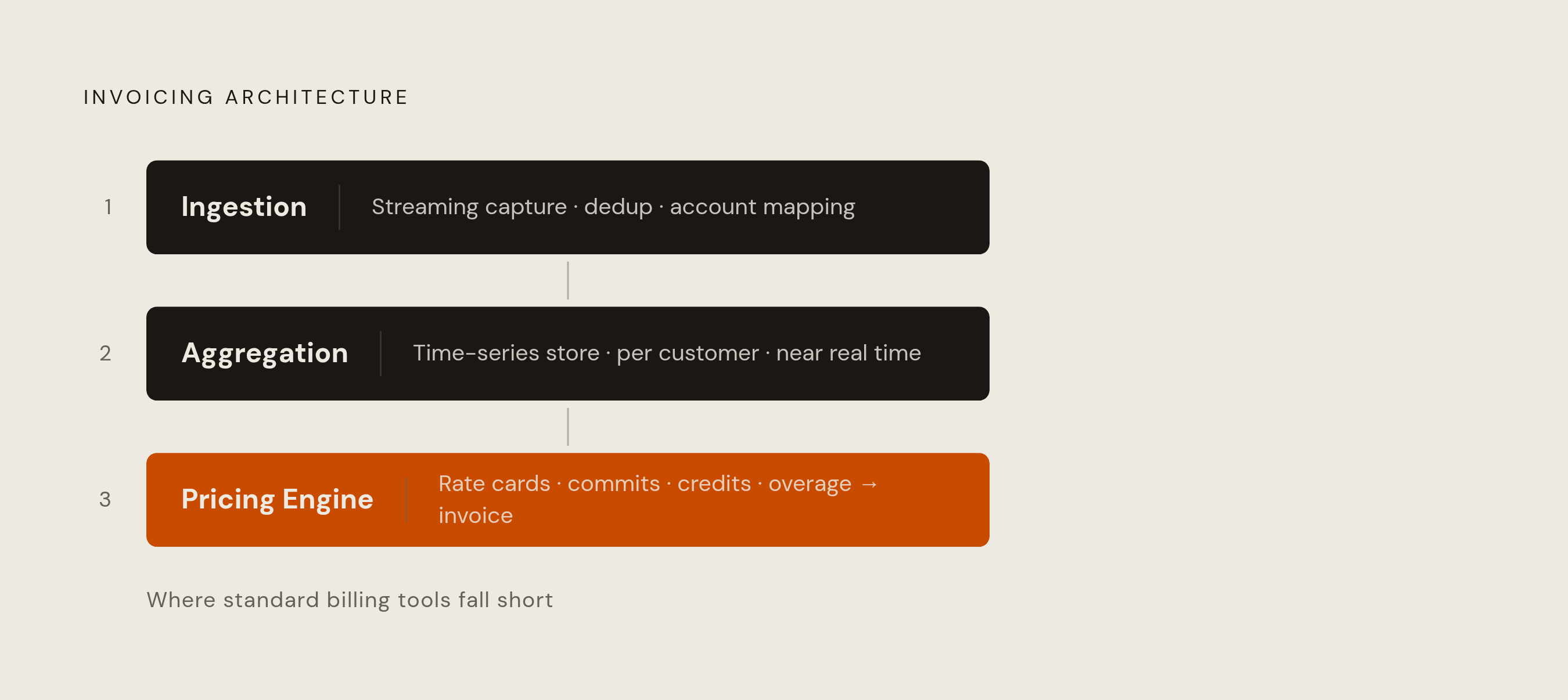
Accurate invoicing across a large base of custom-priced enterprise customers depends on a metering architecture that captures billable events in real time and maps them to the correct customer rate card at the moment of ingestion, not at invoice generation. The architecture has three layers. Ingestion is a streaming event pipeline that captures every billable event, a token generated, a tool call, an agent action, a retrieval step, the moment it happens, with deduplication and account mapping built in. Aggregation is a time-series data store that accumulates usage per customer per billing period, queryable in near real time so customers and internal teams can see consumption in flight. The pricing engine applies the correct customer-specific rate card to aggregated totals, resolving custom dimensions, commit drawdowns, credit wallet balances, and overage rates.
This matters specifically for custom enterprise pricing because a customer with a committed spend contract and a prepaid credit wallet needs their drawdown balance updated in near real time. The agentic pricing analysis notes that cost alert systems, hard usage caps, and prepaid credit bundles are the primary tools AI companies use to give enterprise buyers the budget predictability they require, and all of them depend on real-time metering to function. The maturity progression teams actually follow runs from batch aggregation with manual reconciliation, to real-time ingestion with deduplication, to near-real-time billing with contractually guaranteed metering and automated dispute resolution.
How to model custom rate cards so commercial teams can change them without engineering
The central bottleneck in managing custom enterprise tiers at scale is not that pricing is complex. If a pricing change requires a code deploy, every renegotiated enterprise contract, every mid-cycle amendment, and every renewal with adjusted terms becomes an engineering ticket. The analysis of AI pricing velocity describes companies shipping multiple pricing changes per month. At that cadence, a commercial team gated by engineering sprints cannot participate in pricing as a competitive tool.
The correct configuration model treats rate cards as data, not code. Customer-specific overrides apply as attributes on the customer record: custom unit price, custom commit level, custom overage rate, custom credit wallet balance. Mid-cycle amendments become contract events that change the active rate card from a specific date, not a new codepath. Finance and revenue operations teams hold direct access to configure and audit rate cards, with change logging that satisfies audit requirements. The billing layer's job is to make pricing changes a configuration act, not a development one.
What mid-cycle amendments and contract modifications do to revenue recognition
Every mid-cycle amendment to a custom enterprise contract, an upgrade, a renegotiated commit level, a new credit wallet, an added usage dimension, is a contract modification under ASC 606. Each one changes revenue timing, allocation, and the shape of deferred revenue. Usage-based revenue falls under variable consideration rules: it must be recognized as consumption occurs, not when invoiced, which means the billing system must produce a usage record that the revenue recognition layer can consume in the same period. Prepaid credit wallets create a deferred revenue liability that drawdowns against over time. The balance must be accurately tracked or the deferred revenue schedule is wrong. Committed spend with a ramp schedule changes total contract value and the allocation of performance obligations, and amending a ramp mid-cycle triggers a modification analysis. Outcome-based fees add contingent revenue that may or may not meet the variable consideration constraint, so the billing system must record what was resolved, not just what was attempted.
A company managing custom enterprise tiers in spreadsheets, with usage in one system, commits in another, and amendments tracked in a CRM, cannot produce a clean revenue recognition schedule. The practical implication is that accurate invoices should generate automatically from the billing system, carrying the usage record and contract state that revenue recognition requires. Manual reconciliation is not a finance process. It is an audit liability.
Whether to build or buy the infrastructure that holds all of this together
The build-versus-buy question for billing infrastructure that can model custom enterprise pricing dimensions is not symmetric. The surface area of billing edge cases, proration on mid-cycle upgrades, credit application order, dunning sequences, tax across jurisdictions, ASC 606 for hybrid models, has a combinatorial complexity that AI-assisted development still handles poorly at production scale. Building this is expensive in ways that aren't immediately obvious. Matrix pricing across multiple dimensions with committed spend, drawdown, overage rates, ramp schedules, and mid-cycle amendments is effectively a contract engine, and that is what custom enterprise pricing requires. Open-source billing infrastructure carries a permanent maintenance burden, since the engineering team that owns it must upgrade, debug, and extend it indefinitely.
There is a legitimate middle path. Some teams own the event pipeline because they already run streaming infrastructure for analytics and anomaly detection, and they buy the billing layer that sits on top. That is a rational division when the pipeline serves multiple purposes beyond billing. For enterprise billing specifically, two additional factors frequently settle the decision. Data residency is one: healthtech and fintech companies with strict residency requirements sometimes cannot use cloud-hosted billing platforms, so on-premises deployment is a hard constraint, not an edge case. Security and compliance posture is the other: enterprise buyers conducting diligence on their vendors' billing infrastructure will ask about SOC 2, data handling, and deployment model, and a homegrown system must meet those requirements too.
How to migrate existing enterprise customers to a new pricing structure without destroying trust
The safest migration pattern for enterprise customers is not a cutover. It's a sequenced introduction that preserves existing customers' economics through the renewal cycle while building the new model into net-new contracts first. Grandfather loyal customers at existing rates while new customers enter at updated pricing, a tactic with documented precedent in enterprise SaaS.
The design flaw that makes migration necessary in the first place is that tiered pricing creates misalignment at scale. One enterprise customer uses a small volume on the same plan as another using orders of magnitude more. Credit-based billing and usage metering solve this, but only if the billing system can model hybrid plans natively across both old and new contracts simultaneously. The renewal conversation itself requires tooling. Enterprise customers with custom terms will renegotiate, and the commercial team needs the ability to model a new rate card for a specific customer, simulate what the new invoice would look like against historical usage, and present that scenario without engineering involvement.
The operational controls that keep custom pricing manageable as the customer base grows
The companies that manage large bases of custom-priced enterprise customers well are not the ones with the fewest custom deals. They are the ones that have built operational controls that make each additional custom deal incrementally cheaper to manage, not more expensive. The first and most important control is customer-facing spend visibility. Enterprise buyers who can see their consumption in flight against their committed spend, credit wallet, and any usage caps generate fewer disputes and fewer escalations. Real-time visibility is a retention mechanism, not just a reporting feature. Budget alerts and threshold notifications follow: when a customer approaches their commit, their credit balance, or a usage cap, an automated alert to both the customer and the account team prevents bill shock and creates a natural upsell conversation. Internal cross-team visibility matters equally. Engineering, product, and finance should all have direct access to billing data without routing requests through each other. A system that requires a data export to answer what customer X consumed last month is not fit for enterprise operations. Automated invoice generation, with correct customer-specific rate cards applied, eliminates the first-week-of-month reconciliation burden at any scale. And an audit log for rate card changes, recording who made each change, when, and what changed, must exist for both internal governance and external audit requirements.
The pricing review cadence that research supports is quarterly for high-growth companies, annually at minimum, always after a major product capability change, with the billing system configured to allow commercial teams to make those changes without engineering involvement. A metering tool and a billing tool integrated together cannot produce a real-time customer-facing dashboard, an automated audit log, and a no-code rate card configuration layer simultaneously without significant additional engineering. The closing point is this: custom pricing tiers across a large enterprise customer base do not get easier through more disciplined negotiation. They get easier when the billing infrastructure can hold the complexity that enterprise relationships require, update it without engineering, and report on it automatically.