Role-Based Billing Visibility for Engineering, Product, and Finance Teams
Three teams need direct access to billing data to make faster decisions.

Billing data now carries three distinct jobs at once, and that convergence is what makes role-based visibility an operational necessity. Under a flat subscription, the invoice was a finance artifact: a fixed number, generated on a fixed schedule, read by one team. Usage-based and hybrid pricing changed the substance of what an invoice contains. L.E.K. Consulting's analysis of the SaaS market found that seat-based and flat-fee models continued to lose ground in 2025, as usage-based and hybrid structures gained traction by linking price to activity such as data processed, tokens used, or API calls made. Once price is tied to activity, the record of that activity becomes an engineering telemetry feed documenting system behavior, a product analytics source describing how customers actually use what they bought, and a revenue forecasting input for finance, all generated from the same underlying events. AI inference adds a further complication: every AI interaction can carry a real, variable compute cost, so the billing layer also functions as a cost-accounting system that both engineering and finance need to read correctly. Three teams now need to read the same data regularly, but each is after something different, on a different schedule, to support a different kind of decision.
What happens when all three teams route billing questions through each other
When one team holds the billing data and the others must ask for it, pricing work slows down because of the architecture of the handoff itself. Consider the engineering-to-finance path: engineers instrument the usage events and know precisely what each meter counts, while finance knows what should appear on an invoice. Without shared, direct visibility between the two, nobody owns the comparison between consumption and billing in real time, and the gap between what was consumed and what was invoiced gets closed by a manual process once a month, usually under deadline pressure. The product-to-finance path runs into a similar wall: product teams decide which features are gated and which usage tiers trigger an upgrade, but they often cannot see the revenue outcome of that decision until finance reports it weeks later, by which point the packaging change that caused the result is no longer top of mind for anyone evaluating it. The finance-to-engineering path reverses the direction of the problem. An anomaly on an invoice leaves finance unable to tell on its own whether the number reflects a metering bug or a legitimate spike in usage, so the question gets routed to engineering, who have to stop and investigate before finance can even explain the charge to a customer. Hybrid pricing makes the stakes of this routing failure higher, not lower: L.E.K. Consulting notes that usage-based and hybrid models have made revenue less predictable, pushing finance teams to track added indicators such as revenue by cohort, net dollar expansion, and usage trends, all of which depend on the same event data that engineering and product are also trying to read. The clearest symptom of all this appears at the start of every billing period. Companies running several billing codepaths, or relying on manual exports to reconcile them, spend the opening days of each month correcting numbers that an automated system should have gotten right the first time, which pushes back the close and delays every decision waiting on accurate figures.
What engineering teams need from billing data
Engineering's stake in billing data is operational: engineers need to confirm themselves that usage events are captured correctly, delivered without duplication or loss, and rolled up into the right billing buckets. That requires idempotency and traceability built into the event layer itself. Every usage event needs a unique identifier, because without one, retries, replays, and backfills can silently produce double-billing, and catching that kind of error is squarely an engineering responsibility that depends on direct access to event logs. Architecture matters here too: separating usage collection and processing from the core application, typically through a message queue or a dedicated ingestion service, keeps a spike in billing volume from degrading the product itself, and engineers need ongoing visibility into that pipeline's health as a first-class operational signal, not an afterthought. Security belongs in the same category of concern. Usage events represent money, so an emitter has to be authenticated and authorized for exactly the customers it is allowed to report on, since a compromised service that can inflate or erase another tenant's bill is a failure of billing integrity as much as a security incident. Engineers also need to understand the tradeoff between query-based and rollup ingestion architectures: raw, immutable event storage allows retroactive price changes and historical corrections, while rollup architectures sacrifice that flexibility for higher throughput, and that choice has consequences for what finance and product can later query from historical data. What engineering does not need is a revenue forecast, a customer-facing invoice layout, or a churn analysis. Folding those into the engineering view buries the operational signal engineers actually need under information that belongs to a different team's job. Engineering's billing view is ultimately about pipeline integrity: confirming that what happened in the system is what gets reflected in the ledger, nothing more.
What product teams need from billing data
Product's stake in billing data is behavioral: which tiers are filling up, which usage caps customers are hitting, which features generate the events that drive revenue. That distribution of actual usage is what governs packaging decisions, and those decisions now get made far more often than they used to. Pricing has become an operating cadence. PricingSaaS recorded more than 1,800 pricing and packaging changes among the top 500 SaaS and AI companies in 2025, an average of 3.6 per company, and the typical SaaS company now adjusts tiers, entitlements, limits, and add-ons on an ongoing basis. That cadence means product teams need billing data on a rolling basis, not a quarterly or annual one. The dominant pricing pattern now separates access, sold as a subscription, from consumption, billed through usage, credits, or outcomes, and deciding where to draw that line, and where to set the caps that trigger an overage charge, requires product teams to see how usage is actually distributed across the customer base. Bill shock is a design failure before it is a billing dispute: when a customer is surprised by an overage charge, the root cause is usually a pricing model that made consumption hard to predict in the first place, and catching that flaw requires product teams to watch usage data while it is still in flight, not after the invoice has already closed. Pricing experimentation depends on the same direct access. A quiet pilot on a new tier structure, watching attachment and expansion over several months, deciding whether to roll it out company-wide: all of this requires product teams to read revenue-by-cohort data without submitting a request to finance for each check-in. L.E.K. Consulting observes that new tools can analyze customer behavior in real time and test elasticity across segments, helping teams adjust packages and price points quickly, but that speed only materializes when the team making the packaging decision has direct access to the behavioral billing data behind it. What product does not need is raw event logs, ingestion pipeline status, or tax line-item detail. Those belong to engineering and finance, and pulling them into the product view just recreates the same routing problem in the opposite direction. Product's billing view is about behavioral signal: how customers actually use what they are paying for, read early enough to act on it.
What finance teams actually need from billing data
Finance has to turn the same behavioral data product reads into revenue figures that are both accurate and defensible, and hybrid pricing has made that job genuinely harder. Finance's core need is automated, accurate revenue recognition across a mix of subscription, usage, and outcome-based components, which requires the billing system to carry enough detail about each transaction to distinguish what has actually been earned from what has simply been invoiced. Recognition rules require revenue to be booked when the customer receives the benefit of a service, not when payment arrives, so a large annual contract produces only a fraction of its total value as recognized revenue each month. Usage components complicate that math further, since the amount a customer ultimately owes depends on consumption that has not happened yet at the time the contract is signed. Bundled deals add another layer: a contract that combines subscription access, onboarding, and a premium support tier can create multiple separate performance obligations under ASC 606, requiring the transaction price to be allocated across each one individually, and finance needs the billing system to preserve that deal structure rather than collapsing it into a single total that has to be unbundled by hand every period. Revenue leakage follows directly from fragmented or manual billing systems: homegrown and patchwork setups create gaps between what was consumed and what was invoiced, and closing those gaps without an automated, auditable billing output means a reconciliation sprint every single month. Finance also owns the customer-facing side of the invoice. A customer who cannot understand a bill is a customer who disputes it, delays payment, or churns at renewal, which makes the invoice both a compliance document and a retention tool, and finance needs control over how usage components are presented without filing an engineering request every time the format needs to change. What finance does not need is raw event logs, pipeline architecture detail, or packaging experiment data. None of that improves recognition accuracy, and all of it distracts from the reporting work finance actually owns. Finance's billing view is about revenue accuracy and auditability: proving that the number on the books is the number that was actually earned.
One Billing Platform, Three Views
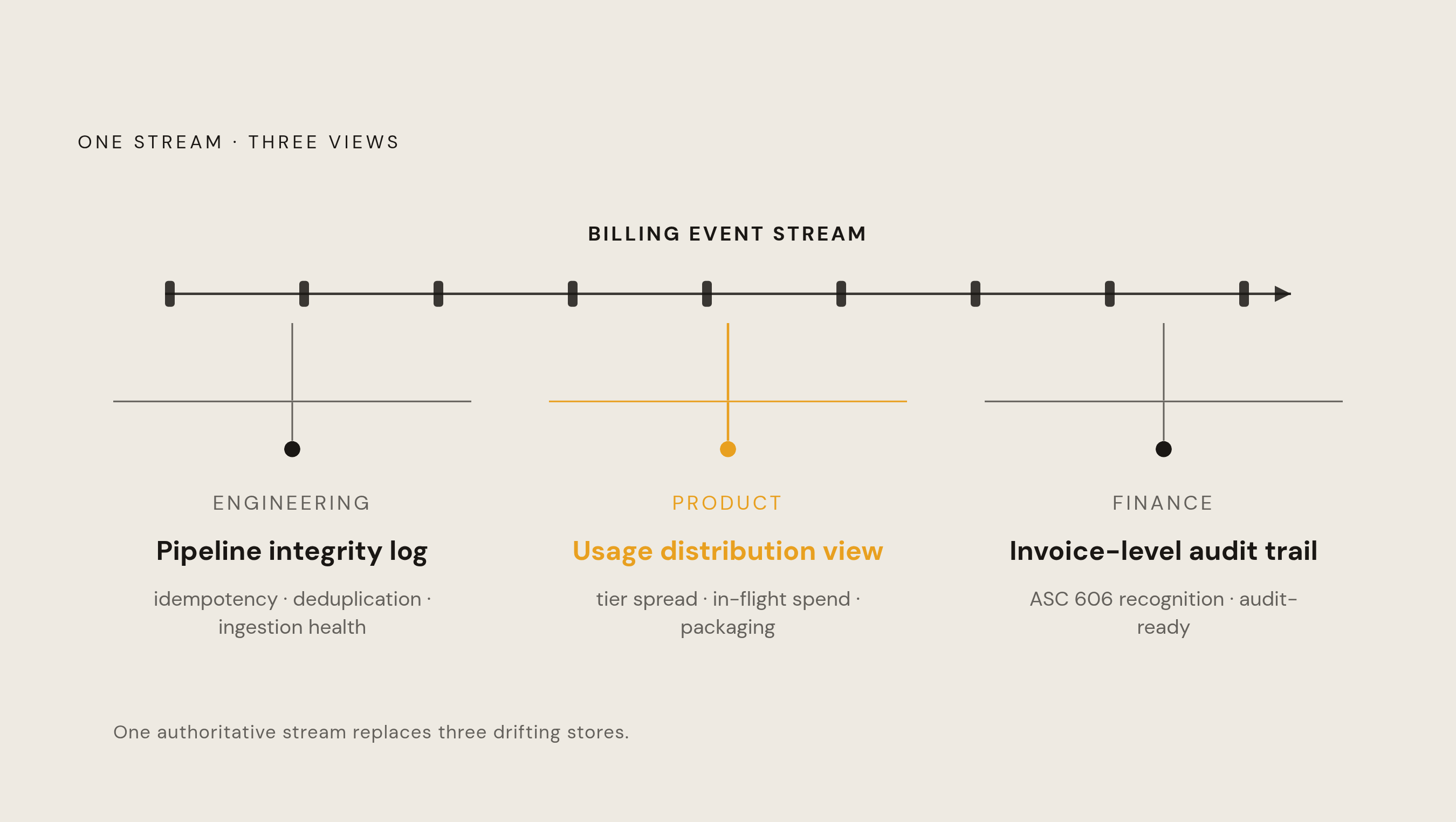
Three legitimate sets of needs against the same data do not argue for three separate billing systems. They argue for one system capable of exposing a different view of the same underlying data to each team, without forcing any of them to route a request through the others. When metering and billing run as separate tools stitched together by a third party, the event-level data engineering depends on and the invoice-level data finance depends on end up living in different systems with no guarantee that the two stay consistent. So every discrepancy between them becomes a manual reconciliation task, and that is precisely the problem role-based visibility exists to eliminate. Pricing changes make the cost of fragmentation concrete. A new usage tier changes the event schema engineering has to instrument, the packaging logic product has to manage, and the revenue recognition treatment finance has to apply, all at once. Coordinating those three changes across separate systems opens a window between the pricing decision and its accurate billing execution, and errors live in that window. Building the three views in-house is not a simple shortcut around this problem: it means building multiple query layers, multiple access-control schemes, and multiple data pipelines on top of whatever metering infrastructure already exists, and the maintenance cost of that stack grows every time a new pricing model gets introduced. Governance requirements cut across all three teams in the same way. Usage events represent money, and a system that fails to enforce authentication and authorization at the event layer cannot be safely opened up to engineering, product, and finance simultaneously without risking the integrity of the data itself, which argues for a purpose-built platform with real access controls rather than for splitting the data further across more tools. Prepaid credit arrangements make the case concrete. A customer who holds a prepaid credit balance and also receives a monthly usage invoice needs the credit drawdown and the invoice reconciled against the same event stream. Splitting that stream across two separate systems makes accurate billing structurally impossible, not just inconvenient.
Billing Infrastructure for Role-Based Visibility
Billing infrastructure built for role-based visibility keeps one event stream at the center and builds a purpose-fit interface on top of it for each team, with access controls and levels of detail matched to what each one actually needs, rather than maintaining separate data stores that drift apart over time. For engineering, that means direct access to event-level logs with both event time and ingestion time visible, idempotency keys traceable down to the individual event, and pipeline health that can be checked without going through a finance report. The internal application database stays the source of truth for debugging, and the platform's meter summaries exist for billing, but the two have to agree with each other or the whole arrangement breaks down. For product, it means real-time dashboards showing how consumption is distributed across tiers and usage dimensions, in-flight spend alerts that surface bill-shock risk before an invoice closes, and the ability to model a pricing change against actual usage patterns and see its projected revenue impact, all without looping in engineering to run the query. For finance, it means automated invoice generation that preserves enough deal structure to support ASC 606 allocation, revenue-by-cohort reporting that ties usage trends back to recognized revenue, and an audit trail running from the raw event to the final invoice line item, turning reconciliation into a verification step. None of this holds up if pricing itself is hard to change. SaaS pricing now gets adjusted several times a year, so a platform that requires an engineering sprint just to modify a tier, add a usage metric, or change a credit allocation cannot keep pace with that cadence, and finance and product teams need the ability to make those changes directly. Deployment constraints matter too: enterprise customers with data residency requirements need the same role-based billing visibility as cloud-native companies, and infrastructure that only runs in a single public cloud rules out part of the market before an evaluation even starts.
None of these internal views work if the developer-facing side of the platform is weak. An event ingestion API that is clumsy to work with, or an SDK that fights the engineering team instead of helping it, forces engineers to build their own abstraction layer on top of the platform, which recreates the maintenance burden that buying billing infrastructure was supposed to remove. The same discipline that makes the internal views trustworthy extends outward to the customer. Spend dashboards and real-time budget alerts are not optional extras bolted onto a pricing page. AI and metered products that cannot show customers their own consumption while it is still happening generate bill shock, billing disputes, and churn, and the cost of that churn outweighs the cost of the billing infrastructure that would have prevented it. Customer-facing visibility depends on the same event-level accuracy that engineering, product, and finance all need internally, so the argument for role-based visibility does not stop at the edge of the organization. It extends to the customer reading the invoice on the other end.