Overage Billing Governance and Approval Workflows in Enterprise Accounts
Enterprise software now needs spending controls designed for agentic workloads, not seats.
Enterprise software pricing rested on a simple bet for two decades: the cost of serving one more user was close enough to zero that a flat annual fee made sense for both sides. AI-metered pricing has broken that bet. When an agent can run thousands of inference cycles, retrieval calls, and tool executions to complete a single task, marginal cost per user becomes the main event. Per-seat pricing worked because value tracked human seat occupancy: one person, one login, one predictable slice of usage. Agents don't work that way. They generate value through inference cycles and tool calls that have no fixed relationship to a human session, so two accounts with the same number of seats can produce wildly different bills depending on how aggressively their agents run. That's why, between June 1 and July 20, 2026, GitHub, OpenAI, and Anthropic all moved flagship products onto credit-based metering, with GitHub AI Credits, ChatGPT Workspace Agents layering credits on top of seats, and Anthropic rolling out its own usage credits. Each of these moves happened because token spend under agentic workloads had become impossible to forecast at the contract level, and a flat number could no longer stand in for it. Enterprise CFOs are left holding invoices that read like utility bills: opaque, hard to project month to month, and disconnected from the headcount math procurement used to approve the contract. That disconnect turns the overage into a financial event that someone, somewhere in the organization, now has to manage.
What an Overage Is in a Metered Enterprise Contract
An overage is a breach of a pre-authorized spending ceiling, and in an enterprise account that breach pulls in procurement, finance, and legal the moment it happens, not just the team running the workload. The contracted limit in an enterprise agreement works as a budget ceiling, and before anyone signed it, it had to clear a delegation-of-authority process. Usage that crosses it was never approved through that process. The organization is now paying for something no one with the authority to approve it actually approved. The clearest illustration of how fast this can spiral: Cursor generated a $7,225 invoice for a single developer in July 2025. Overages cut in both directions. The same coordination gap produces both failure modes: engineering ran the workload, finance received the invoice, procurement owns the contract, and none of the three had shared visibility into consumption while it was happening. The overage gets discovered when the bill arrives, not at the moment it was created, and by then there's no good option left except argument.
The four control layers that make up an enterprise overage governance framework
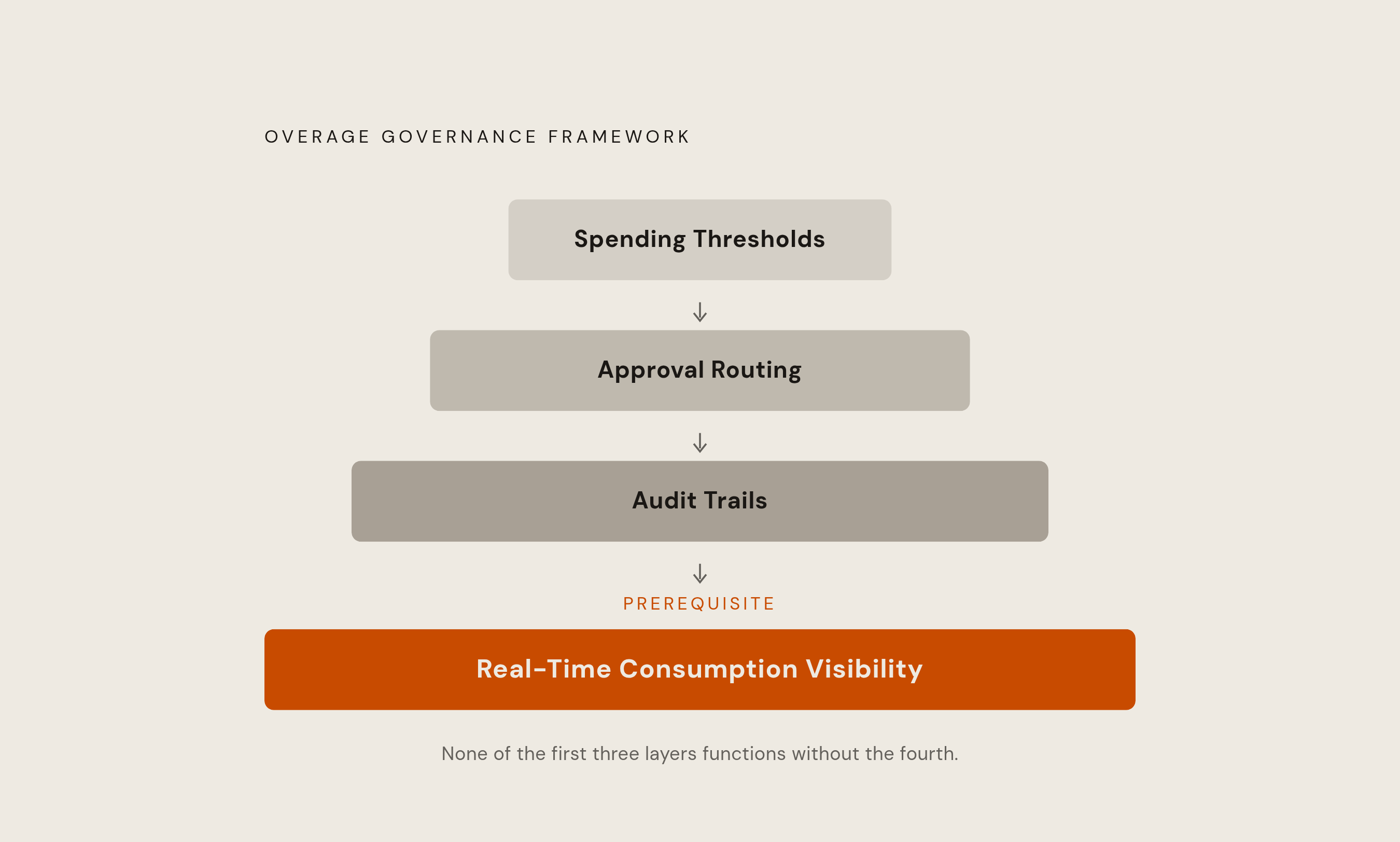
Overage governance works as a layered system, not a single policy memo. Four layers do the work. Spending thresholds define when an action needs to happen. Approval routing determines who has the authority to authorize that action. Audit trails record what was decided and by whom. Real-time consumption visibility feeds all three of the others the data they need, so they can function before the billing cycle closes. Google Cloud's Gemini Enterprise model shows what that choice looks like in practice: admins decide whether overages are even allowed, and if a spend cap triggers, resuming usage takes a single click in the console, or the admin can let overages flow through to consumption rates instead. Approval routing is the tiered delegation-of-authority logic that sends an overage request to the right person based on amount, business unit, vendor category, and contract type. Real-time visibility is the dashboard and alert layer, so you can see spending against thresholds while the billing cycle is still open. None of the first three layers does anything without the fourth. A threshold nobody can see isn't enforced, an approval workflow that fires after the invoice lands is too late to matter, and an audit trail of decisions made after the fact isn't governance; it's a postmortem.
How spending thresholds are designed
Most organizations that set spending thresholds aren't short on intent, they're short on granularity. A cap set at the account level will miss the workload-level spike that actually produces the overage, because the math that matters happens at the workload level, not the account level. A $50,000 monthly cap on an enterprise account does nothing to stop a single team from burning through $40,000 of it in 72 hours on an agentic workload that nobody was watching in real time. Threshold design that actually holds up requires nesting: account, department, team, and workload each get their own cap, and those caps aggregate upward without someone manually reconciling spreadsheets at month-end. Soft and hard thresholds do different jobs, so you need to run them side by side. Soft thresholds fire an alert and kick off a review. Hard thresholds stop the workload cold until someone with authority says otherwise. Google Cloud's Gemini Enterprise model shows the value of that friction: when a spend cap triggers, resuming usage requires a deliberate click from an admin, making the cost of overriding a cap visible. You should put spend caps and usage dashboards in the product requirements document, next to any other core feature. Leaving them out isn't a neutral design choice, it's a decision with a dollar figure attached to it later.
Approval routing: matching authorization authority to overage risk
A threshold breach only becomes a resolved decision once it reaches someone with the authority to approve or decline it, and that routing has to mirror the organization's actual delegation-of-authority rules rather than whatever a billing platform ships with by default. The working principle is straightforward: small, low-risk overages get auto-approved or fast-tracked by a department budget owner, overages above a set dollar threshold escalate to finance leadership, and anything that breaches a contractual ceiling outright needs procurement or legal in the room. The routing engine has to weigh several variables at once. Escalation paths matter as much as the primary route. Automation can flag anomalies and suggest next steps, but the decision to approve a credit, change a price, or write off a charge should stay with a named human, especially where the choice carries compliance risk. For organizations with multiple legal entities, the routing also has to respect entity boundaries: an administrator scoped to one entity's enrollment doesn't have the standing to approve an overage on another.
Audit trails: what must be recorded
An audit trail of overage decisions earns its keep well outside the compliance office. It's the record that settles a contract dispute, backs up a renegotiation, and tells engineering leadership which team actually drove the cost. Each governance event needs a minimum set of facts attached to it: the timestamp of the threshold breach and the consumption level that triggered it, who the request was routed to and when, what action that person took (approved, declined, escalated) and when, any rationale given for an exception, and the billing outcome that followed, whether the overage was offset, charged at consumption rates, or converted into a committed credit. The audit trail proves its commercial value when an enterprise account disputes an overage charge. When an enterprise account pushes back on an overage charge, the audit trail answers the only question that matters: was the charge ever surfaced to an authorized approver before the billing cycle closed? Regulatory frameworks like SOX and GDPR require every action to be timestamped and attributed, and a billing governance audit trail has to meet the same bar as the accounts-payable trail it eventually feeds into. Compliance is the floor this trail has to clear.
Real-time consumption visibility as the prerequisite for all other governance controls
Thresholds, approval routing, and audit trails only work if the consumption data behind them arrives while the billing cycle is still open. Real-time visibility is the infrastructure that the other three layers depend on to function. Every API call, every token consumed, and every resolved task has to generate a timestamped event record the moment it happens, not a line item aggregated in a batch job that runs overnight. Batch processing is exactly where the governance gap opens up: a threshold breach at 2 a.m. doesn't reach an approver until the next business day under a batch model, and by then the workload may have run for hours past the cap it should have stopped at. GitHub moved most Copilot plans to usage-based token billing on June 1, 2026 (annual Pro and Pro+ subscribers kept their premium request-based pricing until their plan expired), but what mattered more than the price change was what it did to the meter itself. Once usage is tracked per request, per model, and per user, it becomes something an organization can actually observe: who spends, on which workflows, and how efficiently. That observability has to extend to the customer, not just the internal team. Products that can't show customers their own consumption in real time generate bill shock, support tickets, and churn that cost far more than building the visibility layer would have. Agents that watch usage patterns can flag customers approaching a threshold and trigger a proactive notice or an automatic plan adjustment before the invoice closes, so you catch a usage spike or an unexpected model substitution before it hardens into a number nobody saw coming.
Keeping finance, procurement, and engineering aligned when usage exceeds contracted limits
Overage governance usually fails for an organizational reason rather than a technical one: engineering, finance, and procurement are each looking at a different slice of the same event, and none of them is looking at it at the same time as the others. Engineering sees consumption in units the contract doesn't speak, tokens, API calls, GPU-minutes, and knows a workload is large without being able to translate that into a dollar figure against the contract. To close that gap, all three functions need direct access to the same billing data, so a shared real-time dashboard can turn raw usage events into the dollar terms the contract runs on, instead of routing every question through another team's inbox. Role-based access is how that gets built in practice: engineering needs workload-level attribution, finance needs entity-level accruals, procurement needs contract-ceiling utilization, and a single governance platform has to serve all three views without forcing anyone into a custom export-and-report cycle. The workflow itself becomes the coordination mechanism. A threshold alert that routes to a named approver in finance, copies the workload owner in engineering, and logs the action somewhere procurement can review later replaces the informal scramble that otherwise follows an invoice: who knew this was happening, and why didn't anyone say something sooner? Automation can flag the anomaly and suggest a next step, but the decision has to stay with the named approver in the delegation matrix. Governance, in the end, is a shared operating model that three functions run together, not a setting any one of them configures alone.
Requirements for Purpose-Built Usage Billing Infrastructure
A governance framework is only as strong as the billing infrastructure underneath it. A platform that can't take in usage events in real time, attribute cost to the right workload, and enforce thresholds across several pricing dimensions at once will turn governance back into a manual, after-the-fact exercise no matter how well the policy is written. Event ingestion has to run at the speed inference actually happens, which for AI products means milliseconds, not minutes. A platform that can't keep up will always be working from stale consumption data, and stale data makes real-time alerts and threshold enforcement impossible regardless of how the policy is written. Building this kind of infrastructure from scratch takes months, and it leaves you with a permanent maintenance burden. Most teams that end up evaluating purpose-built platforms have already learned, the hard way, that billing systems designed for subscription renewals were never built to count usage, let alone govern it.
Designing the governance rollout: from shadow metering to enforced thresholds
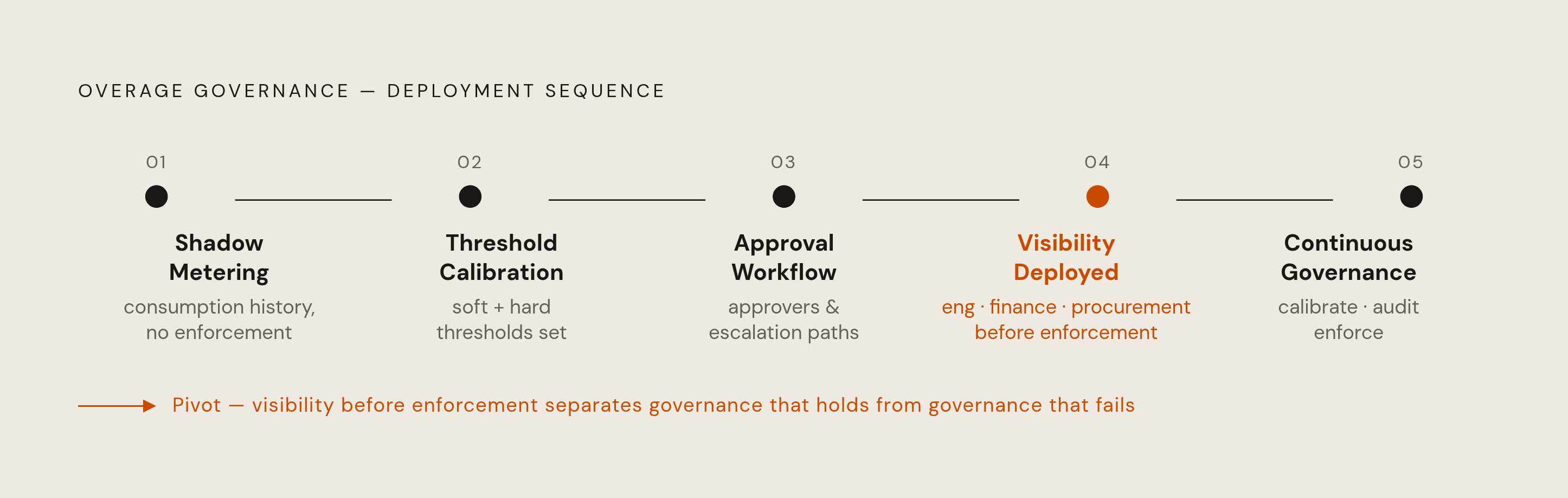
Governance frameworks tend to fail in deployment when you enforce them before the organization has a real metering baseline to calibrate against. The right sequence runs from observation to calibration to enforcement, not from a written policy straight into production. The first phase is shadow metering: usage meters run in the background with no thresholds enforced yet, which builds the consumption history that makes any later cap defensible, since caps set without that history will be wrong in one direction or the other. The second phase is threshold calibration: soft thresholds get set at a fraction of the contracted ceiling based on what shadow metering actually showed, and hard thresholds get set at the ceiling itself, with a clear overage provision spelling out what happens if it's crossed. The third phase configures the approval workflow itself, mapping the organization's actual delegation-of-authority rules into the system before any threshold goes live, including named approvers, escalation paths, time-to-escalate rules, and what counts as an acceptable exception rationale. The fourth phase deploys real-time visibility to engineering, finance, and procurement all at once, before enforcement begins, so each function starts from the same shared picture. Customer-facing visibility should roll out on the same timeline, because when customers can see their own consumption against their threshold, they raise fewer disputes and fewer renegotiation conversations once the bill lands. The fifth and final phase is continuous governance: threshold calibration, approval routing, and audit trail review become recurring operational work, not a project that gets closed out after launch. Finance teams should not have to spend the first week of every month reconciling billing errors by hand. Invoices should be accurate on arrival, and the governance framework should catch exceptions before they turn into disputes, with pricing reviews timed to contract renewals and product milestones so the whole system stays calibrated to how the organization is actually being used, not to the assumptions it started with.