Multi-Product Entitlement Management Across a SaaS Product Portfolio
Managing entitlements across products prevents revenue leaks and operational chaos.
A company that approves a second or third product launch is making a growth decision, and that decision quietly breaks the entitlement logic the first product was built on. At one product, the rules about who can access what are few enough that embedding them directly in the codebase works fine. At two or three products, each with its own subscription tiers, usage limits, and feature flags, that embedded logic starts to diverge. Different teams make different assumptions about what a "seat" means, how a downgrade gets enforced, how a trial converts into a paid account. None of those teams is wrong in isolation; they simply built for their own product, and nobody was responsible for making the assumptions match.
The divergence is a commercial liability before it is a technical one. Renewals slip when no one inside the company has a single authoritative answer to the question a customer success manager asks on a Tuesday afternoon: what is this customer entitled to, across every product they've bought? Skipping that step keeps the costs from staying contained to engineering. As more products and customers get added on top of the fragmented foundation, operational overhead grows, compliance exposure grows, and so does revenue leakage.
Entitlement management and its widening scope at portfolio scale
An entitlement is the enforceable record of what a specific customer is allowed to use, under what conditions, and for how long. That sounds like a simple definition, and at a single product it mostly is. The definition gets substantially harder to hold onto once one customer holds entitlements across multiple products at the same time, because now the record has to describe not one set of rights but several, layered and sometimes contradictory.
Entitlements cover which features are accessible, which usage limits apply (seats, API calls, storage, tokens), which tier or edition governs access, and the time boundaries that bound all of it. Each of those events changes what a customer is entitled to, and the change has to take effect at the moment the event happens, not whenever a batch job gets around to it.
At portfolio scale, a single customer account can hold entitlements spanning different billing cadences (monthly on one product, annual on another), different pricing models (per-seat on one, usage-based on another), and different feature sets governed by entirely different product teams. The entitlement system is the single point of truth for customer status: active subscriptions, renewals, cancellations, all of it. Any gap between that record and what the running system actually does is a compliance problem and a revenue problem at the same time.
How per-product entitlement logic accumulates into compounding operational drag
When entitlement logic lives inside each product's own codebase, you turn every pricing or packaging change into an engineering ticket, and the consequences compound as the portfolio grows. It is a predictable output of an architecture where access logic and commercial logic are written by different people, at different times, for different products, with no shared definition between them, not a story about any one team failing.
A plan change made in the billing system doesn't automatically propagate to the access layer when entitlement logic is scattered per-product. When a customer upgrades or downgrades, you need the entitlement system to update immediately, through a real-time, event-driven integration. A downgrade might revoke premium features or tighten quotas, and those changes have to take effect right away to keep access correct, keep the company compliant, and avoid interrupting service the customer is still paying for.
Without a centralized layer, every product team ends up building its own enforcement logic: redundant implementations, differing interpretations of the same commercial terms, and no shared audit trail connecting any of it. Compliance reviews and M&A diligence bite hardest at enterprise scale, where they demand one authoritative record of who was entitled to what and when. Revenue leakage is the financial expression of all of this: customers consuming entitlements that were never properly enforced, or customers churning because access was wrongly revoked. Zylo's SaaS Management Index found that the average organization uses only 54% of its provisioned licenses, a figure consistent with the kind of drift that fragmented entitlement logic produces at scale.
What a centralized entitlement layer looks like in practice
A centralized entitlement layer decouples access and pricing logic from any individual product's codebase and turns it into a shared service that every product in the portfolio queries, rather than a capability each product reimplements on its own. It applies equally to traditional desktop software, to IoT devices, and to cloud-native multi-tenant platforms, because the underlying problem, binding access rights to runtime behavior without hardcoding them into application logic, is the same wherever licensed software runs.
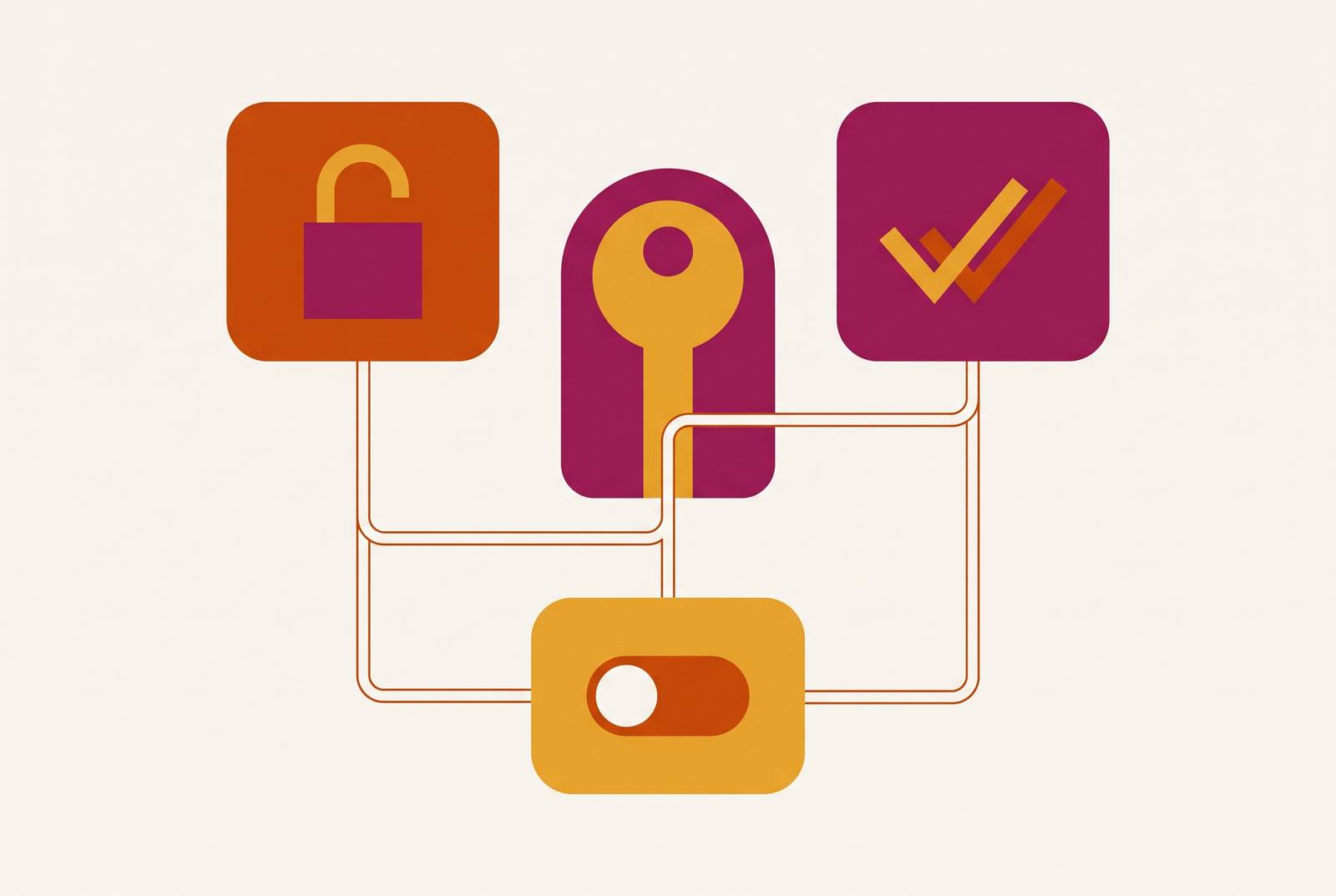
The architecture rests on three interlocking components. Entitlement data gets synchronized through webhooks, APIs, or scheduled jobs so access rights are enforced in real time and discrepancies between the commercial agreement and the running system stay minimal; this same synchronization also makes auditability simpler and improves the experience customers actually have when they upgrade or downgrade.
The modular version of this architecture separates invoicing, licensing, and the application core into distinct layers connected through clean interfaces, instead of tangling them together through shared business logic that only one team fully understands. Products in the portfolio become consumers of the entitlement API instead of owners of entitlement logic: a product asks "is this tenant allowed to do X?" and gets back an authoritative answer, without having to implement the policy itself. The trial and demo lifecycle fits neatly into the same architecture. Trial entitlements get provisioned without any billing event attached, and the same system converts them into paid entitlements the moment the customer signs, with no separate code path required to handle the transition.
The speed and cost of pricing and packaging decisions under the entitlement layer
When you decouple entitlement configuration from product code, pricing and packaging decisions that once required engineering sprints become changes that take hours, and that speed compounds into a real competitive advantage over time. With a well-architected entitlement layer, teams adapt without touching core application code: adding a feature means updating entitlement configuration, changing prices means adjusting the subscription or billing system, launching a new package or edition means defining a new entitlement profile. None of those paths requires a code change.
That shift moves ownership of the pricing decision itself. Only 24% of companies conduct regular pricing experiments, and decoupled entitlements lower the cost of running one to a configuration change.
Upsell and cross-sell motions benefit immediately from this same structure. When every product in the portfolio shares a single entitlement record, the system can surface what a customer isn't yet entitled to across that portfolio, creating a natural expansion motion that fragmented systems can't support, because no fragmented system has visibility into the full picture to begin with. Renewal operations improve for the same reason. The entitlement record becomes the authoritative source for what renews, when, and on what terms, and sales and customer success teams can see the complete picture without querying three separate product databases and reconciling the differences by hand.
Centralized entitlements under hybrid and usage-based pricing models
As SaaS portfolios move from pure per-seat pricing toward hybrid and usage-based models, the entitlement layer has to track live consumption against limits, not just binary access rights, and no per-product implementation can do that reliably across a multi-product portfolio. Hybrid models, a base subscription paired with a metered usage layer, are now the dominant commercial structure in B2B software. Entitlements under this model are dynamic: a customer's rights shift continuously as consumption moves against the allowances included in their plan.
Credit models add a further complication. AI features are accelerating this shift further: standard plans bundling included AI credits per user, overages generating additional charges per interaction, outcome-based pricing where the entitlement itself is conditional on a verified result. None of these fit the binary access model that per-product entitlement logic was originally built to handle.
The seat model faces its own structural pressure, because AI agents now act as users in their own right, collapsing seat counts even as overall software usage keeps rising. The entitlement system has to shift its unit of measurement from users to consumption events to keep up, and that shift requires a metering-aware entitlement layer rather than a headcount database that was never designed to count anything but people. Customers also need visibility into their own spend against their entitlement in real time, so they can manage budgets and avoid the kind of bill shock that damages trust. That visibility isn't achievable when entitlement data sits scattered across separate product silos with no shared view across them.
Requirements for billing and metering infrastructure to keep pace with the entitlement layer
A centralized entitlement layer is only as accurate as the billing and metering infrastructure feeding it, and billing infrastructure that can't count usage events in real time will produce entitlement records that are stale the moment they're written. The entitlement layer depends on a continuous, accurate signal from billing. When a customer's prepaid credits deplete, the entitlement has to change immediately. When usage crosses a threshold, the access or pricing tier has to update without anyone manually triggering it.
That requirement demands three things working together: an event ingestion layer that captures billable events the instant they happen, an aggregation layer that sums those events per customer per billing period, and a pricing engine that applies the rate card to the aggregated totals, all feeding the entitlement record in close to real time. Idempotent event logging matters enormously here. Duplicate events inflate usage totals, inflated totals produce incorrect entitlement states, and incorrect entitlement states produce wrong access decisions and disputed invoices. The error travels the full distance from metering through entitlement through to the customer's experience of the product.
Pricing dimensionality raises the stakes further. If a portfolio bills across tokens, GPU-minutes, API calls, and seat counts simultaneously, it can't tolerate a billing system that only models one of those dimensions well. The entitlement layer has to reflect all of them accurately, at the same time, for the same customer. The practical consequence for infrastructure selection is straightforward. A metering tool and a billing tool that are integrated together are still two systems that have to stay in sync to produce one entitlement record, and every integration gap between them appears in a customer-facing problem or a finance reconciliation headache.
Entitlement accuracy's connection to finance, compliance, and revenue recognition
Entitlement records determine what was actually delivered to each customer and when, which makes their accuracy the foundation for correct revenue recognition, clean audits, and defensible M&A diligence. Revenue recognition for usage-based fees requires knowing precisely what each customer consumed in each billing period, and that data lives in the entitlement and metering record. When those records are fragmented across products, finance has to reconcile them by hand before every close.
That reconciliation carries a cost measured in time as much as labor. Compliance and audit requirements demand a single authoritative record that covers feature access, usage limits, and the commercial terms governing both. Scattered per-product records can't satisfy that requirement without reconstruction, and reconstruction under audit pressure introduces exactly the kind of error that audits exist to catch.
M&A diligence and IPO readiness both demand clean revenue attribution across the full portfolio. Acquirers and underwriters will ask what each customer holds, what they consume, and what they pay, and the entitlement system is where that answer has to live, in one place, verifiable without a weeks-long reconstruction project. Accurate entitlement records, synchronized with real-time metering, are the safeguard against that specific category of restatement risk.
Migrating from per-product entitlement logic to a centralized layer without breaking running products
Migrating to a centralized entitlement layer works as a phased effort, not a single cutover. You manage the risk by making the centralized system additive before it becomes authoritative, so nothing that currently works stops working while the new system comes online. The lowest-risk starting point is read-only integration: the centralized entitlement system ingests the existing per-product entitlement data without yet making any access decisions itself. That step validates data completeness and surfaces gaps before any product depends on the new layer for anything that matters.
Any new product launching during the migration should be built against the centralized API from day one. Existing products get migrated one at a time, with each product team switching from its internal logic to the centralized API while keeping the old internal logic in place as a fallback until confidence in the new system is fully established. Customer-facing entitlement changes during migration carry the same risk profile as a pricing model change: a customer who experiences an unexpected access change during what was supposed to be a purely technical migration loses trust in the product itself, not just in whichever team happened to be running the migration. The work has to stay invisible to the customer from start to finish.
Whether any of this holds up depends on the billing integration. The centralized entitlement layer can't become authoritative until it's receiving reliable, real-time signals from the billing and metering infrastructure underneath it. Teams that try to centralize entitlements before fixing that billing feed will find their new layer is exactly as stale as the one it replaced. Once the migration completes and the billing feed is solid, the value becomes concrete: adding a new feature, changing a price, or launching a new package requires only a configuration update, not a code change in any product across the portfolio. Pricing velocity, compliance clarity, and billing accuracy all converge on the same infrastructure at that point, and the return on the migration is exactly that convergence.