Metering Infrastructure Vendors for Real-Time Usage Aggregation in AI Billing
AI billing requires real-time metering of token usage across multiple dimensions and rates.

Metering infrastructure for AI billing must do more than count events. It must link usage to the right account, handle traffic that is hard to predict, prevent duplicate charges, and turn several usage dimensions into rated spend in real time. Those requirements, rather than a generic billing feature list, are the basis for evaluating whether a vendor can support AI workloads at scale.
Why AI billing is a fundamentally different metering problem than traditional SaaS billing
Traditional SaaS billing was designed around a seat-count model, with one user, one price, and one invoice line. That model assumes the cost of serving another user approaches zero. AI products break the assumption because every inference call carries compute cost. With a flat subscription, revenue stays the same while the cost of serving the customer grows as they use more.
The atomic billing unit is no longer a user or a subscription period, but a single API call. Even that call produces several billable quantities, including input and output tokens rated at different prices. BillingPlatform says production volumes reach billions of billing events per month as each call creates more usage to price separately. A nightly reconciliation pipeline cannot provide a current view of that consumption, regardless of how accurately it eventually produces an invoice. The mismatch is architectural.
The specific technical behaviors of AI workloads that break standard metering assumptions
Agent loops create an attribution problem before they create a counting problem. A single user action can trigger dozens or hundreds of downstream calls, tool invocations, and retrieval steps. Each action needs a clear relationship to the customer, project, or tenant responsible for it. Resolving those relationships later means changing live invoice logic.
Token asymmetry creates a separate rating problem. Input and output quantities each need their own rate, calculated as (input_tokens × rate_in) + (output_tokens × rate_out). A single “charge per token” setting cannot represent that distinction, and separate model-specific workarounds become harder to maintain as the catalog grows.
Nondeterminism then makes the quantity itself unpredictable. The same prompt can produce different token counts, especially with streaming, function calling, or agent chains, so metering must tolerate variance and ingestion must absorb sudden surges. Mixed workloads add another independent requirement. A customer may consume GPU-hours for fine-tuning, tokens for inference, and images analyzed for vision, with each metric routed to its own pricing model.
What a reliable usage event contract must contain, and why schema decisions made early are hard to reverse
The usage event contract is the foundation shared by metering, invoicing, and dispute resolution. Customer and project identifiers must remain stable when an organization is renamed or its account hierarchy changes, or invoice history loses its anchor. The timestamp must record when the action happened. Otherwise, delivery delays can move usage into the wrong billing period.
Unit and quantity must stay atomic because quantities joined when they are collected cannot be split later to apply different prices. A correlation ID connects the event to its originating request, session, or agent run, allowing an invoice line to be traced to application logs. A billable flag and reason code make the billing decision explicit. A schema version lets the system interpret historical events under the correct rules as pricing evolves. These fields are not administrative decoration, because omitted distinctions constrain every later pricing change and investigation.
The four pipeline stages where AI metering breaks down — and what correctness at each stage requires
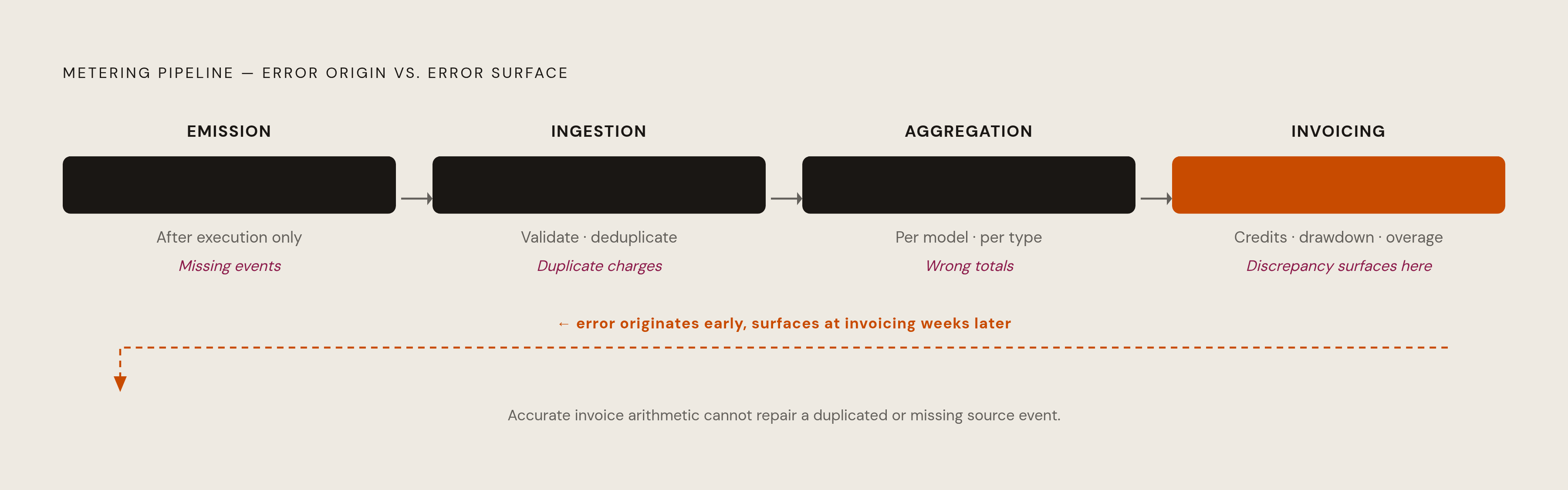
Correctness begins at emission, where the application records every billable completion, embedding request, tool call, or agent step. For AI workloads, emission must come after execution so the event has the actual token counts. Output tokens are not known before the model responds.
Ingestion must then validate, buffer, and durably store each event while absorbing traffic spikes. Idempotency prevents a network retry from becoming a second charge. An explicit late-event policy determines revenue treatment when usage arrives after its billing period closes.
Aggregation turns those records into billable quantities under consistent unit definitions and rules. It must track concurrent dimensions per customer, model, and inference type. Invoicing then converts metered totals into line items, applies credits or discounts, and charges the customer, with prepaid drawdown preceding overage billing. Each stage can fail independently, so a discrepancy discovered during invoicing may originate in an ingestion error from weeks earlier. Accurate invoice arithmetic cannot repair a duplicated or missing source event.
What the rating engine must do that most billing platforms cannot
The rating engine must keep calculating what usage costs as well as recording that it happened. BillingPlatform proposes a practical test of whether three variables and three rates for one model can be configured in a UI without engineering involvement. Formula support matters because otherwise each model-inference combination needs its own rate plan. That workaround turns pricing expansion into a maintenance and audit problem.
Rating must also run continuously, with rated usage available within minutes. Customers who track token consumption and set budget alerts need a dollar balance that shows their recent usage. Prepaid credits belong in that same workflow, with real-time balances, consumption applied before billing, and alerts at defined thresholds.
Execution guardrails impose a further requirement. Credit reservations, circuit breakers for agent loops, and anomaly detection must act before more usage is generated. The engine therefore needs a connection to execution-layer controls rather than operating only as a post-hoc accounting system.
How real-world pricing shifts have exposed the metering infrastructure gap in production
GitHub’s move from Premium Request Units to GitHub AI Credits illustrates the change in billing granularity. GitHub states that credits are consumed based on token usage, including input, output, and cached tokens, at published model-specific API rates.
HubSpot shows why entitlements and overage policy must also be explicit. Its AI credit model offers pay-as-you-go overage billing beyond subscription allotments, but accounts default to pausing usage without capacity packs or auto-upgrading when packs have been purchased. Zendesk adds a different attribution requirement by pricing its AI resolution agent per resolved conversation. The billable unit is an outcome.
Atlassian’s model as of June 9, 2026 combines Rovo AI credits per user per month with additional per-conversation charges for products such as the Virtual Service Agent above included limits. These models require subscription entitlements, consumption, and outcomes to reconcile on one invoice. BillingPlatform identifies the workaround pattern as token-calculation scripts, spreadsheet mappings between models and rate plans, and manual fine-tuned pricing corrections that stop working as the business grows.
What multi-dimensional pricing at scale actually requires from the aggregation layer
Those pricing models make aggregation a problem with three concurrent axes. Metric type determines the unit being measured, including input tokens, output tokens, compute seconds, images, and audio minutes. The model or inference type sets whether a base model, fine-tuned model, batch job, or real-time call gets a different rate. Customer terms then change those rates through committed-spend discounts, volume tiers, or custom tables. The aggregation layer must use all three without needing a separate rate plan for every combination.
Keeping raw events lets teams use SQL-based metric design to do more than they could with fixed summaries. Streaming keeps recent usage at hand, while the original records keep the detail needed to ask what a customer would have paid under an earlier rate. That question matters both when testing pricing and when resolving a dispute. If aggregation discards the underlying events, a total cannot reconstruct distinctions that were removed.
Customer-facing spend visibility as a metering requirement, not a product feature
Customers need to know the dollar amount consumed against a budget, which requires the rating engine to price events continuously and expose current balances. Refreshing a dashboard more often cannot make up for delays in the totals it uses. Its freshness is bounded by the work happening underneath it.
Threshold alerts and credit balance floors need that same up-to-date state. To guard against further consumption, they must activate before additional usage is generated. API-powered usage and spend views can expose that state directly inside the customer’s product. The architectural requirement is a shared, current account of rated spend. Without it, unexpected consumption charges create bill shock, support demand, and churn risk, while making enterprise buyers less confident about controlling their costs.
The decoupled architecture pattern — where it works and where it breaks for AI billing
The “build the meter, buy the biller” pattern has real advantages when usage counting is simple. Engineers own the metering pipeline and send account totals out-of-band to a billing system of record. Finance can change pricing without changing collection, while engineers can replace metering infrastructure without disturbing billing. That separation creates a useful boundary between two responsibilities.
AI workloads stress the boundary when customers need rated spend before the biller receives its export. Rating logic must then be duplicated or synchronized between systems, creating a consistency risk. Prepaid guardrails create another dependency because the credit balance must be accessible at the moment of an API call. A wallet updated from batched totals cannot serve that purpose. When pricing must also be applied per event, the supposedly simple meter takes on rating responsibilities, and maintaining the integration becomes a permanent obligation.
What purpose-built metering infrastructure looks like when evaluated against AI billing requirements
The requirements point toward an integrated metering and billing engine rather than a subscription tool connected to a counter. Its ingestion layer must accept events at millisecond speeds while preserving correctness under production load. Its rating layer must model combinations of tokens, GPU-minutes, audio minutes, and megapixels without multiplying separate plans. Prepaid wallets and postpaid invoicing must use the same engine so spend visibility, credit drawdown, and billing do not depend on competing calculations.
Configurability matters just as much as throughput. Product and finance teams need to set pricing dimensions, rates, and tiers themselves because waiting for an engineering sprint to change pricing slows the business down. Retained raw events provide the basis for corrections and audit trails as those terms change. For enterprise buyers requiring on-premises or sovereign cloud deployment, a platform that cannot meet the requirement is disqualified before its pricing features matter. This is the infrastructure profile AI, developer-tool, and enterprise SaaS businesses need when subscription tooling no longer fits.
The evaluation questions that separate adequate metering infrastructure from infrastructure that will survive AI billing at scale
A vendor evaluation should ask how the system preserves correctness. The vendor should explain how retried events are deduplicated and what explicit policy governs events arriving after period close. Ask it to demonstrate a three-variable formula using input tokens, output tokens, and compute seconds, configured in a UI within minutes without an engineering ticket. Ask whether rated spend is ready within minutes or has to wait for nightly processing.
The wallet questions should establish whether prepaid credits are financial objects with rollover, expiry, pooling, and real-time drawdown. Ask whether the balance can be evaluated in-flight before an API call generates usage. For aggregation, ask whether raw events survive and whether concurrent metric types can be priced without a separate plan for every combination.
Finally, ask whether product and finance teams can change dimensions, rates, and tiers themselves. Require the vendor to explain how plan versioning preserves legacy prices while introducing new terms without billing disruption. Ask about on-premises and sovereign cloud deployment where residency is a hard constraint. The architecture must keep usage, rated spend, credits, and invoices consistent as AI consumption grows.